12 Best Contentoo Alternatives for 2026
A practitioner's guide to 12 Contentoo alternatives, sorted by whether you need words at volume or a creative team that owns your brand.

I have briefed content marketplaces like Contentoo for real marketing teams, and I keep running into the same wall. They are very good at one thing: words, at volume, on a set schedule. Then the moment you need a video cut or a motion piece or a look that holds across forty assets, they go thin. You end up stitching three vendors together and praying the tone matches.
So I did not want to write another feature dump where twelve tools all sound identical. I sorted these by the decision that actually matters. Do you need copy at scale, or do you need a creative partner who owns your brand from brief to delivery? Those are different problems, and most of the confusion around “Contentoo alternatives” comes from pretending they are the same problem.
Here is who each option is really for, including where my own studio, Moonb, fits and where it does not.
Why marketing teams start looking past Contentoo
The pressure is real, and it is not slowing down. Adobe surveyed more than 1,600 marketers and found that 71% expect content demand to grow more than fivefold by 2027, with 62% saying it already grew that much in the past two years. Most of that growth is in social content and short-form video, well ahead of blog posts.
That is the mismatch. Contentoo and most of the platforms below were built around written content and translation. If your roadmap is turning toward video, motion, and branded visuals, a writer-first marketplace can only take you part of the way. And volume alone is not the goal anymore. Wistia’s 2025 report, drawn from more than 14 million videos, found that overall video engagement dropped about 7% in 2024, the largest single-year dip in four years. Generic output at scale is exactly what people scroll past. Consistency and craft are what hold attention.
I co-founded Moonb, a creative studio, so I have a horse in this race. I will be upfront about that in the Moonb section, and I will tell you plainly when another option on this list is the smarter call for your situation.
How I compared these
I did not rank these by star ratings or price tags. Those tell you almost nothing about whether a partner will actually fit. Instead I looked at four things I care about when I am the one making the buying call:
- Primary output. Is this a words engine, a design-and-video engine, or a pure talent marketplace?
- Who carries the management load. Do you direct the work, or does someone own quality on your behalf?
- Consistency across a body of work. Will asset number one and asset number forty look like they came from the same brain?
- Real fit. Not “who is best” in the abstract, but who is right for a specific kind of team.
Every option here was live and operating when I checked. Let me walk through them.
1. Moonb
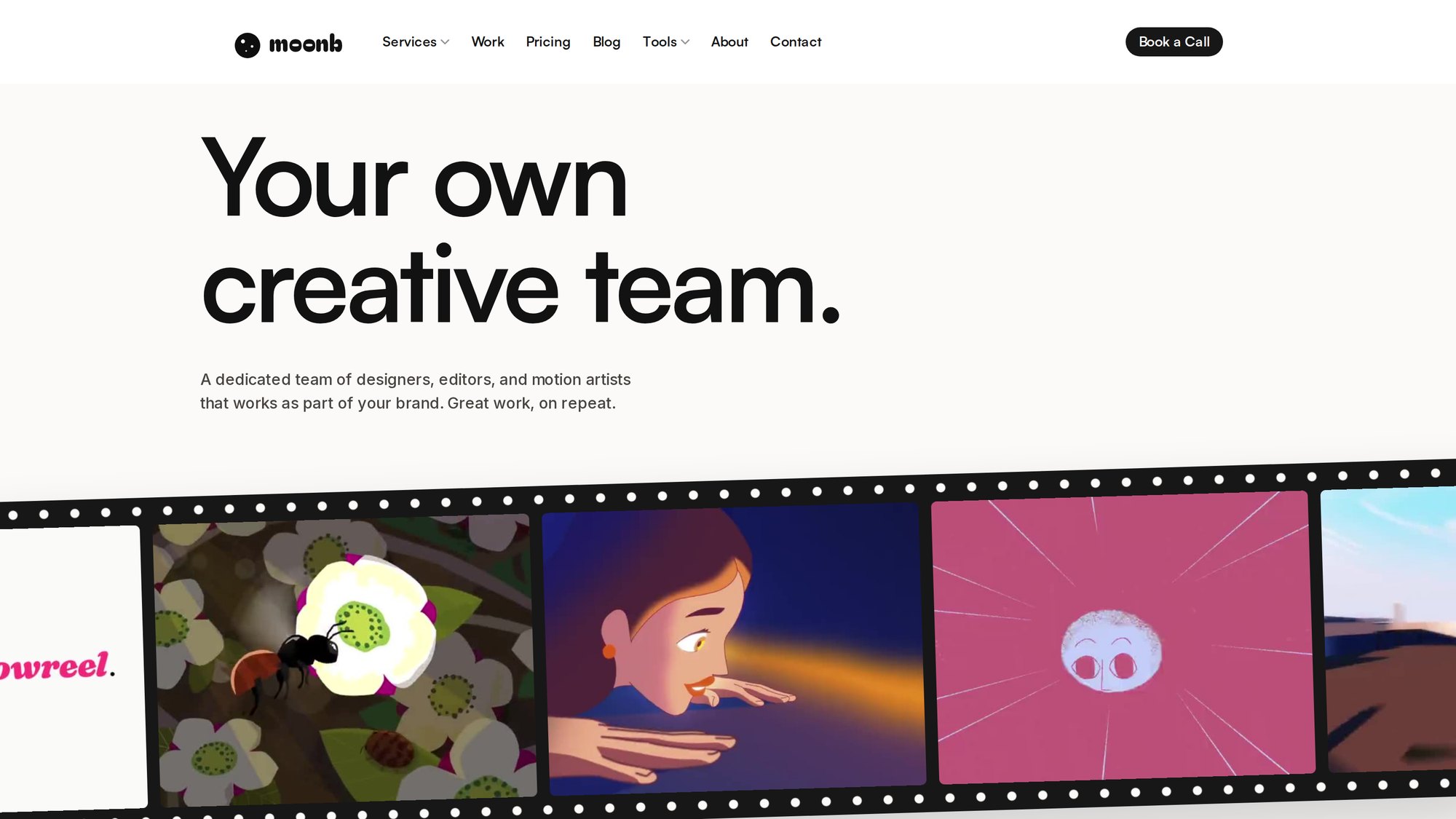
Moonb is my studio, so read this section with that in mind. We are an embedded creative team that produces video, design, motion, and animation for marketing teams. The difference from a marketplace is structural. You get one dedicated Creative Director who learns your brand and stays with you, plus the specialists behind them, instead of a rotating cast of freelancers you re-brief every time.
That model exists for one reason. When the same people own your work over months, the taste holds from one asset to forty. A marketplace optimizes for matching you to whoever is available. We optimize for a team that already knows how your product sounds and what your last campaign looked like. We work with marketing teams at companies of many sizes, and the point is ongoing production, not one-off tasks.
Where we are not the answer: if what you truly need is a high volume of written blog posts at a predictable per-word rate, a writer marketplace below will serve you better and I will happily point you there. We are built for visual and motion-heavy creative, not for spinning up two hundred SEO articles a month.
Best for: An embedded creative team that produces video, design, and motion for marketing teams under one dedicated Creative Director, so the output stays consistent the way a marketplace of rotating freelancers rarely can.
2. WriterAccess

WriterAccess is one of the more mature writer marketplaces, and it shows in the tooling. You get a large vetted pool of writers with visible ratings, plus AI-assisted briefing and SEO integrations that plug into tools your team probably already uses. Pricing runs per word with platform access on top.
If your content need is mostly written and you want predictable costs with workflow controls, this is a solid, unglamorous workhorse. It is a marketplace at heart, so you still own the vetting and direction.
Best for: A large vetted writer marketplace with built-in SEO tooling, best when your need is mainly written content at predictable per-word rates.
3. Verblio
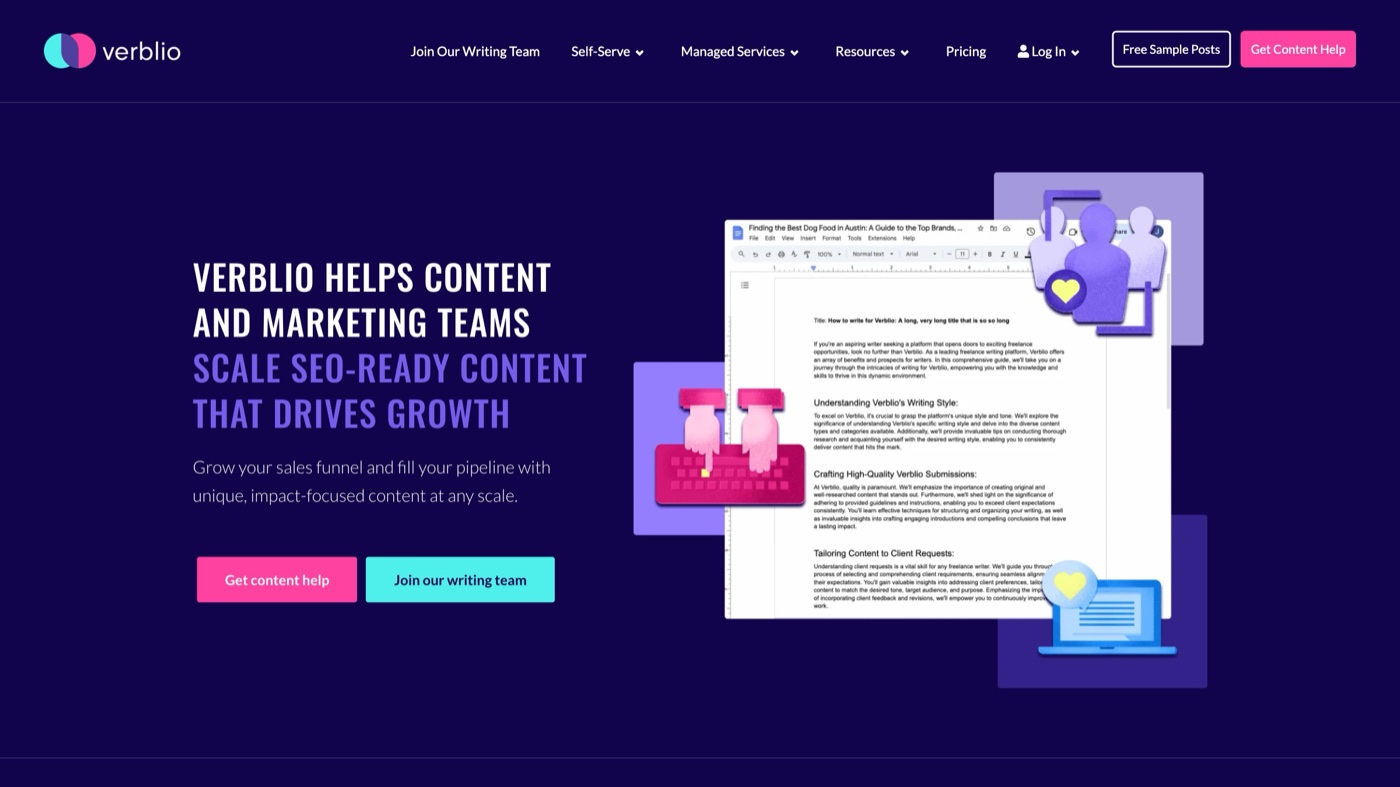
Verblio leans into a hybrid model where AI drafts and human writers refine, and on its classic plans you pay only for pieces you approve. That approval-first structure lowers the risk of paying for work that misses. Turnaround is quick, which suits teams that publish on a steady cadence.
The tradeoff is the one you would expect from any hybrid: for highly technical or brand-sensitive pieces you may cycle through a few writers before you find the right fit. For volume blog and SEO work, it moves fast.
Best for: Hybrid AI-plus-human writing where you pay only for pieces you approve, a fit for blog and SEO teams that want fast written turnaround.
4. Compose.ly
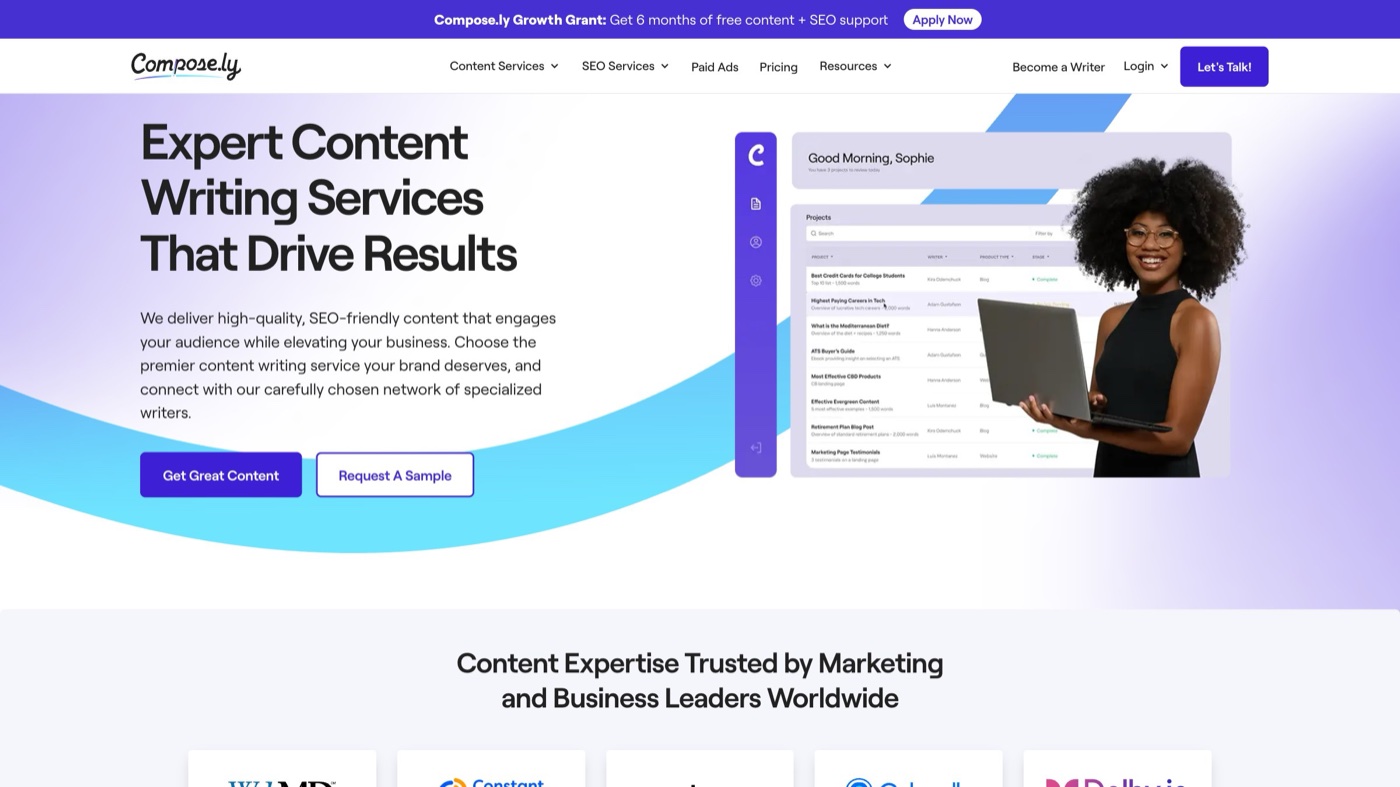
Compose.ly is the more hands-off end of the writing spectrum. Every piece runs through in-house editorial review, and you can tap subject-matter experts for content that needs real authority behind it. That editorial layer is the selling point for teams that do not want to manage writers directly.
You pay more than a bare marketplace for that oversight, and larger programs usually start with a scoping call. If you value a managed feel over granular control, that is a fair trade.
Best for: A managed writing service with in-house editorial review and subject-matter experts, for teams that want words handled hands-off.
5. ClearVoice
ClearVoice sits closer to a managed content program than a self-serve tool. It builds a dedicated team of vetted freelancers matched to your industry and voice, with account support wrapped around it. This is for brands running ongoing editorial, not one-off assignments.
Pricing is custom and quote-based, and the model is built around recurring retainers. If you want an editorial engine that behaves like an extension of your team, it fits. If you want to buy a single article, look elsewhere.
Best for: Managed content programs built around a dedicated freelance team, suited to brands wanting ongoing editorial with account support.
6. Contently
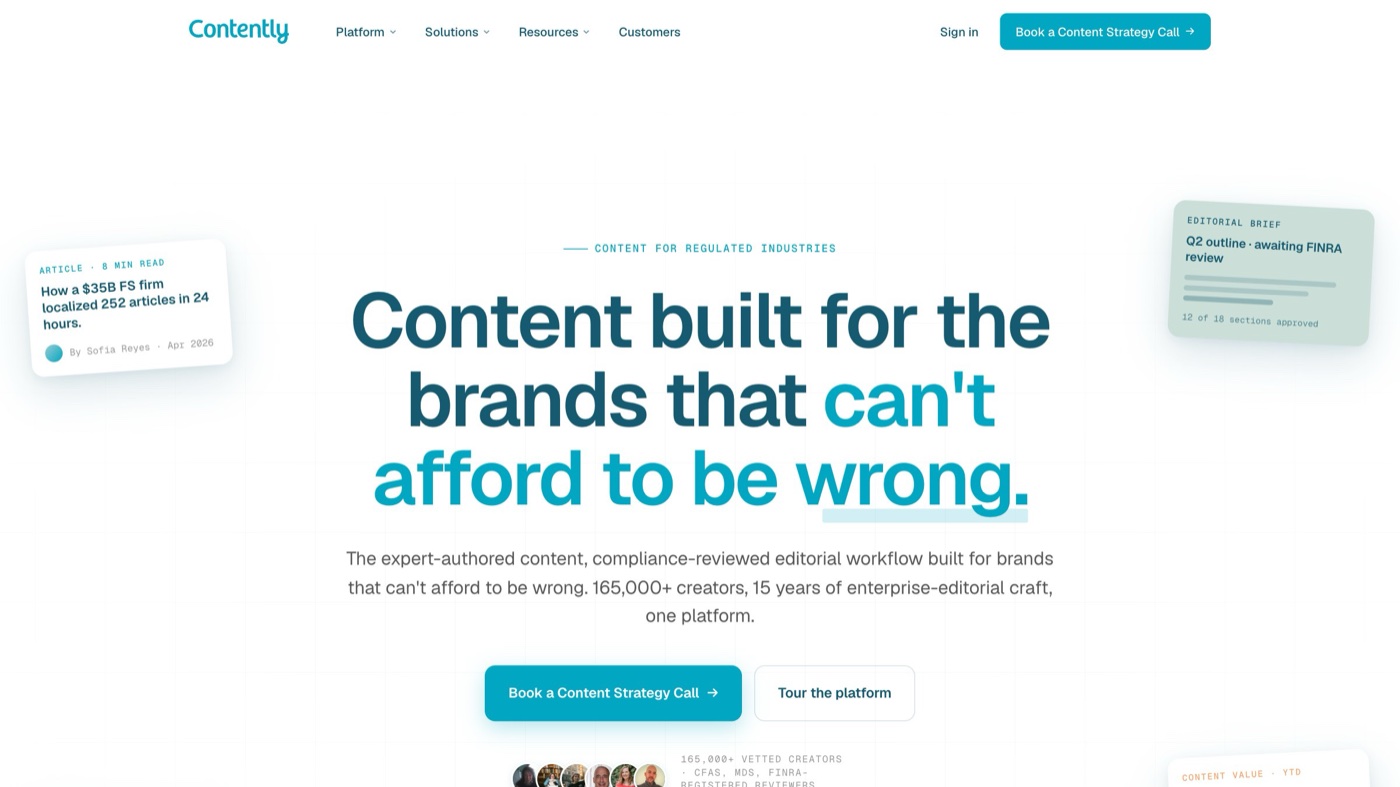
Contently is the enterprise pick. It pairs a serious software platform (planning, analytics, governance, rights management) with an invitation-only network of elite freelance creatives. If you are in a regulated industry or a large organization where compliance and brand governance are non-negotiable, this is built for you.
It also carries enterprise weight: annual commitments, a committed content spend, and pricing that is not public. Small teams will find it heavy. Large ones will appreciate the guardrails.
Best for: An enterprise content platform with governance, compliance, and an elite freelance network, built for regulated or large organizations.
7. Scripted

Scripted blends AI-assisted briefing with a network of vetted expert writers, on a membership model with monthly credits. The idea is to speed up the ideation and briefing stage with AI, then hand the actual writing to a human who knows the subject.
It works well for teams that want production speed without giving up human authorship. Costs can vary per piece beyond your included credits, so it rewards teams with a steady, plannable pipeline.
Best for: AI-assisted briefing paired with vetted expert writers on a membership model, for teams blending production speed with human writing.
8. Crowd Content

Crowd Content is pure pay-as-you-go with tiered quality levels, no commitment required. You place an order at the quality tier you want and receive the content. That makes it a natural fit for high-volume commodity work like product descriptions and straightforward SEO articles.
Quality can wobble at the lower tiers, and the higher tiers start to approach the cost of more managed options. But for scaling commodity copy without contracts, the simplicity is the point.
Best for: A pay-as-you-go writing marketplace with tiered quality levels, fitting high-volume commodity copy without any commitment.
9. Upwork

Upwork is the largest open freelance marketplace, and it gives you maximum control at the cost of maximum effort. You post, you interview, you vet, you manage. The talent pool spans every discipline and every rate, with escrow and contract tooling to keep things safe.
The real caveat is time. Finding and directing the right people is genuine work, and the client fees add up. If you have a project manager who can own that, the flexibility is unmatched. I wrote more about sourcing talent this way in my guide to platforms to hire video editors.
Best for: The largest open freelance marketplace, offering maximum flexibility if you have the time to vet and manage talent directly.
10. Fiverr Pro
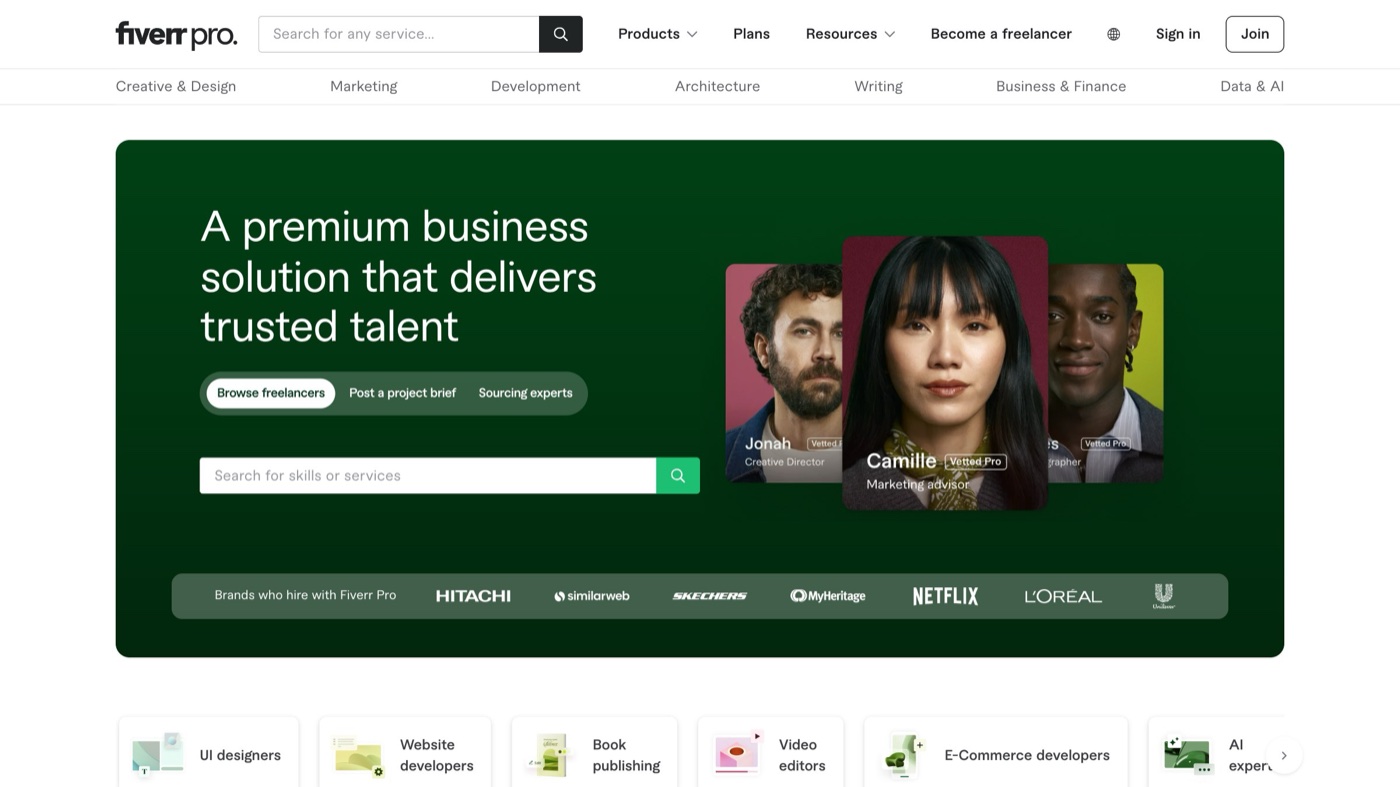
Fiverr Pro is the curated, hand-vetted tier of Fiverr, aimed at business clients who want project-based flexibility with a higher quality floor. Freelancers earn the Pro badge through an application process, and business accounts get collaboration and shortlisting tools.
It sits between hiring a lone freelancer and using a fully managed service. Pricing is upfront per gig or hourly, though marketplace fees still apply. Good for vetted one-off projects without a long-term contract.
Best for: A curated tier of top-rated freelancers with business tooling, for vetted project-based work without long-term contracts.
11. Superside
Superside is the closest thing on this list to what my studio does, so I will be even-handed. It is a managed creative service for enterprise teams, covering design and video through a structured request workflow. If you are a large organization that wants creative at scale through a defined process, it is a serious option.
The tradeoff is the one you get with any large, process-driven operation. The request queue can feel transactional, and the people on your work rotate more than they would with a small dedicated team. Whether that matters depends on how much brand continuity you need.
Best for: A managed design-and-video creative service for enterprise teams that want creative at scale through a structured request workflow.
12. Codeless
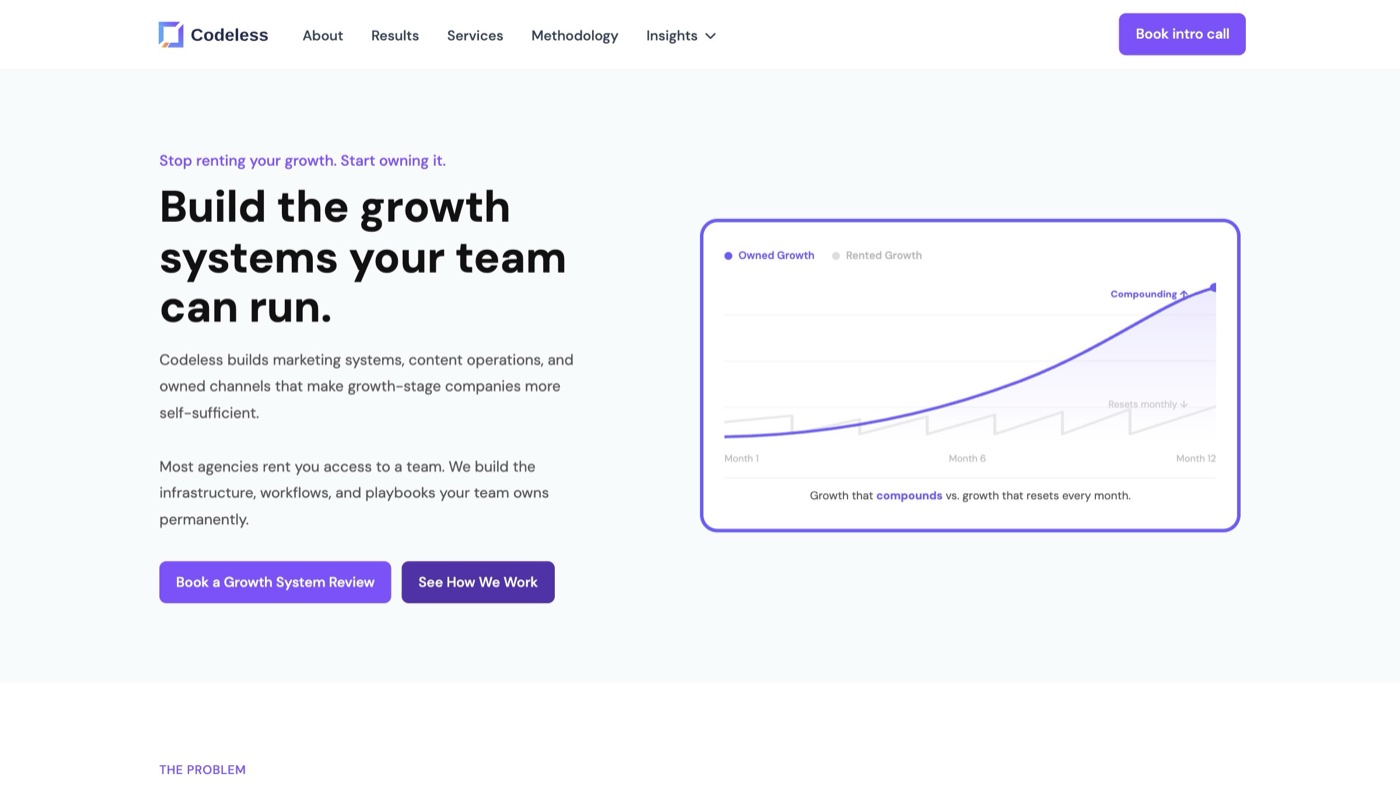
Codeless is a specialized SEO content operation with fixed monthly packages, built for SaaS and B2B teams chasing rankable long-form articles. It bundles strategy, expert writing, and editorial QA into a managed service with a dedicated team, rather than freelancers you juggle yourself.
The commitment is real: high monthly minimums and multi-month contracts. This suits companies that want to dominate search with a steady stream of authoritative long-form content, not teams buying a single piece.
Best for: An SEO-focused content operation with fixed monthly packages, for SaaS and B2B teams chasing rankable long-form articles.
The comparison at a glance
Here is the shortlist reduced to the two questions I actually ask: what does it primarily produce, and who is it really for.
| Company | Primary output | Model | Best fit |
|---|---|---|---|
| Moonb | Video, design, motion | Embedded creative team, one dedicated Creative Director | Brand-consistent visual creative |
| WriterAccess | Written content | Writer marketplace with SEO tooling | Predictable per-word written work |
| Verblio | Written content | AI-plus-human, pay for approved pieces | Fast blog and SEO cadence |
| Compose.ly | Written content | Managed, editorial-led | Hands-off quality control |
| ClearVoice | Editorial content | Managed dedicated freelance team | Ongoing editorial with account support |
| Contently | Content plus platform | Enterprise software with elite freelance network | Regulated, large organizations |
| Scripted | Written content | AI briefing plus vetted writers, membership credits | Speed with human authorship |
| Crowd Content | Written content | Pay-as-you-go, tiered quality | High-volume commodity copy |
| Upwork | Any discipline | Open freelance marketplace | Teams that can vet and manage |
| Fiverr Pro | Any discipline | Curated freelancers with business tooling | Vetted project-based work |
| Superside | Design and video | Managed request workflow | Enterprise creative at scale |
| Codeless | Long-form SEO articles | Fixed monthly packages | SaaS and B2B ranking programs |
Content marketplace versus an embedded creative team
This is the real fork in the road, so let me make it concrete. A marketplace matches you to talent. An embedded team learns your brand and stays. Both are legitimate, but they solve different problems, and choosing wrong is where teams waste money.
A marketplace wins when the work is modular and the quality bar per piece is what matters, not continuity across a body of work. Two hundred product descriptions do not need to feel authored by one mind. A dedicated team wins when they do: a campaign, a launch, a year of social video that has to feel like one brand. Adobe found that 47% of marketers say a single piece of content can involve between 51 and 200 people to create, review, and activate. Every hand-off is a place for the brand to drift. Fewer, more embedded people is one way to fight that drift.
There is a workload angle too. An In-House Creative Industry Report covered by Marketing Dive found workload rose for 82% of in-house creative teams, driven largely by demand for digital content. That is the pressure most people feel when they start hunting for a Contentoo alternative. The real question is not which vendor is lowest per unit. It is which model reduces the number of hand-offs and re-briefs your team is drowning in.
Video is where this distinction bites hardest. Wistia reports that 43% of businesses now produce at least one marketing video a week, and 76% produce at least one a month. Sustaining that cadence with a rotating cast of freelancers is brutal, because each one has to relearn your brand before they are useful. If video and motion are core to your plan, weigh a team model seriously. If you want to go deeper on that, our full breakdown of video content creation covers how to keep a cadence without burning out.
Which one is right for you
Strip away the noise and it comes down to one honest audit of your own need.
If you mostly need words, a lot of them, at a predictable cost, pick from the writer marketplaces. WriterAccess, Verblio, or Crowd Content for volume; Compose.ly or Codeless when you want editorial weight and SEO authority handled for you. If you have the bandwidth to direct talent yourself, Upwork and Fiverr Pro give you the most control. If you are an enterprise with governance requirements, Contently is built for exactly that.
If your real need is visual, meaning video and motion and design that has to stay consistent across a growing body of work, then a marketplace is the wrong shape and a creative team is the right one. That is where Superside and my own studio, Moonb, live. Between those two, the question is scale versus continuity. Superside is built for enterprise volume through a structured queue, and Moonb is built for a small dedicated team that knows your brand and stays with it.
I would rather you pick the option that actually fits than the one with my name on it. Run a small pilot with your top one or two choices before you commit. A real project tells you more about a partner than any comparison table, including this one.
Frequently asked questions
A marketplace matches you to available talent for individual pieces, and you usually own the vetting and direction. An embedded creative team gives you the same people over months, led by a dedicated Creative Director who learns your brand. Marketplaces suit modular work where each piece stands alone. An embedded team suits work that has to stay consistent across a whole campaign or a year of assets, because fewer hand-offs means less brand drift.
Most alternatives on this list are writer-first, so for video, motion, and design you want a creative team rather than a copy marketplace. Superside works for enterprise teams that want creative at scale through a structured request queue. Moonb works for teams that want a small dedicated group who knows their brand and produces video, design, and motion together. The choice between them comes down to scale versus continuity.
Be honest about your team's bandwidth. Open marketplaces like Upwork and Fiverr Pro give you the most control and flexibility, but finding, vetting, and directing talent is real ongoing work. A managed partner costs more per unit but absorbs that load and owns quality on your behalf. If you have someone who can dedicate time to directing talent, self-management is fine. If your team is already stretched, a managed partner removes the hand-offs that slow everything down.