Marketing Video Production: A Practical Guide for 2026
How marketing video production actually works, from types and briefs to delivery models, cost bands, and the measurement plan that has to sit behind it.

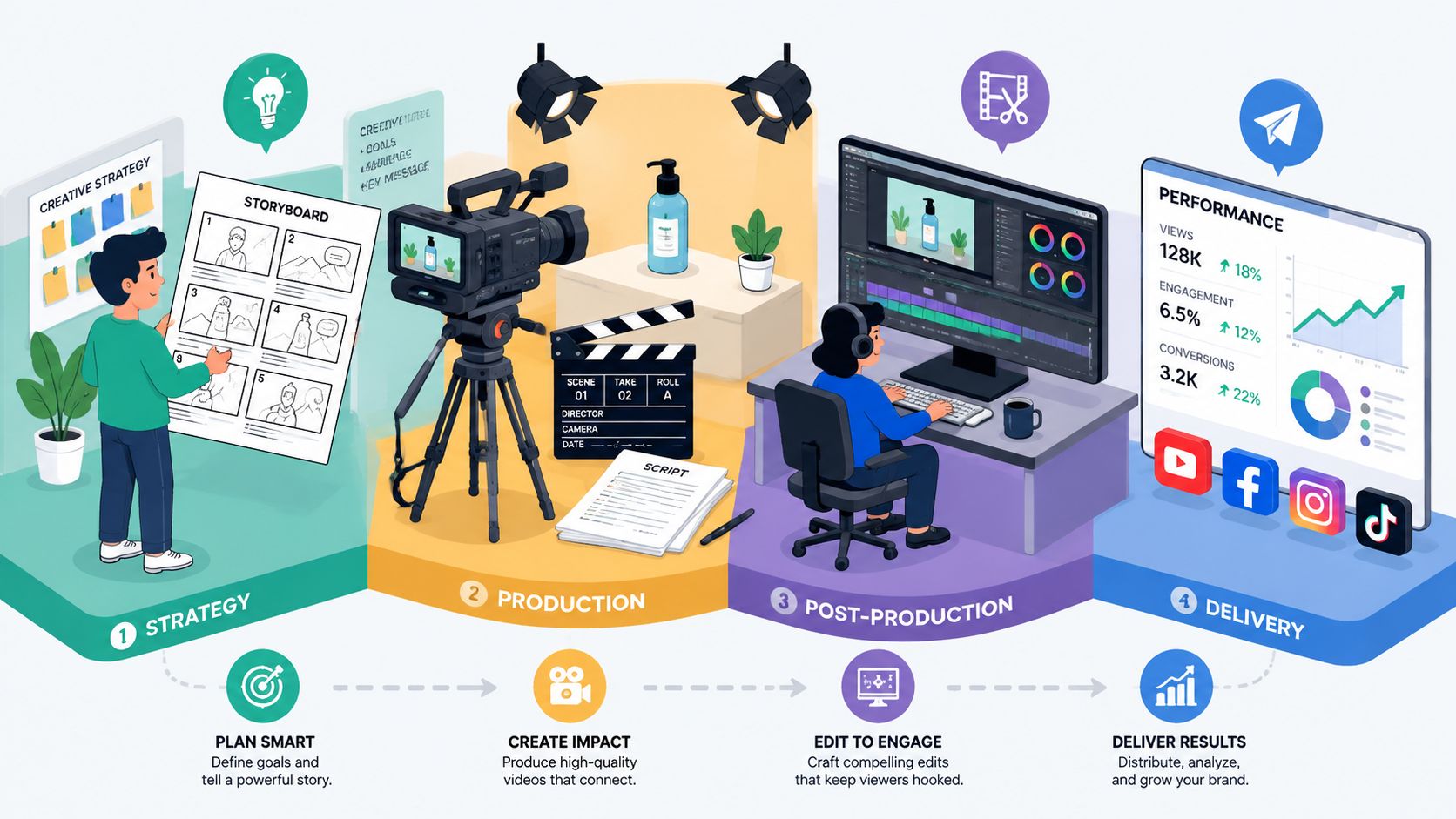
Marketing video production is the end-to-end process of planning, producing, and delivering video built specifically to hit marketing outcomes such as awareness, demand, and conversion. Wyzowl’s long-running video marketing benchmark has been tracking wide adoption for years, with the 2026 update showing 91% of businesses using video as a marketing tool and 82% saying it delivers a good ROI, published in Wyzowl’s video marketing statistics. The practical question is no longer whether video belongs in the mix, but what to make, how to scope it, and how to prove it worked.
I work at Moonb, a creative team that ships marketing video week after week for teams that do not want a rotating cast of freelancers, so I see the same three-way scoping problem constantly. A campaign deadline is close, the creative team has a rough idea, and three production quotes arrive with completely different assumptions. One includes scripting, casting, animation, cutdowns, and distribution-ready files. Another covers a shoot and one edit. The totals are not comparable, yet leadership still wants a confident recommendation.
A useful production plan removes that uncertainty early. It connects the funnel stage to the format, defines every deliverable before anyone prices the work, and chooses a production model that matches the team’s actual cadence. It also sets the measurement plan before filming starts, not after the first report arrives.
What Marketing Video Production Covers
Video production quotes often look precise while describing completely different jobs.
Marketing video production covers strategy, creative development, scripting, production, post-production, delivery, and measurement. Its defining feature is intent. The opening line, visual treatment, runtime, aspect ratio, and final call to action should each support a stated marketing outcome.
A corporate video may serve internal communications, recruiting, training, or executive messaging. A product video may explain features or help a support team answer recurring questions. These formats can overlap with marketing, but their success criteria differ. Training content needs clarity and completeness. A paid social cut needs a reason to keep watching immediately and a clear path to action.
The brief should make those differences explicit. A brand film for awareness might prioritize storytelling, recognition, and emotional resonance. A paid social cut for conversion needs a clear problem-solution structure, supporting proof, and a direct call to action within the first five seconds. Both assets may come from one campaign, but using the same script for each usually weakens one of them.
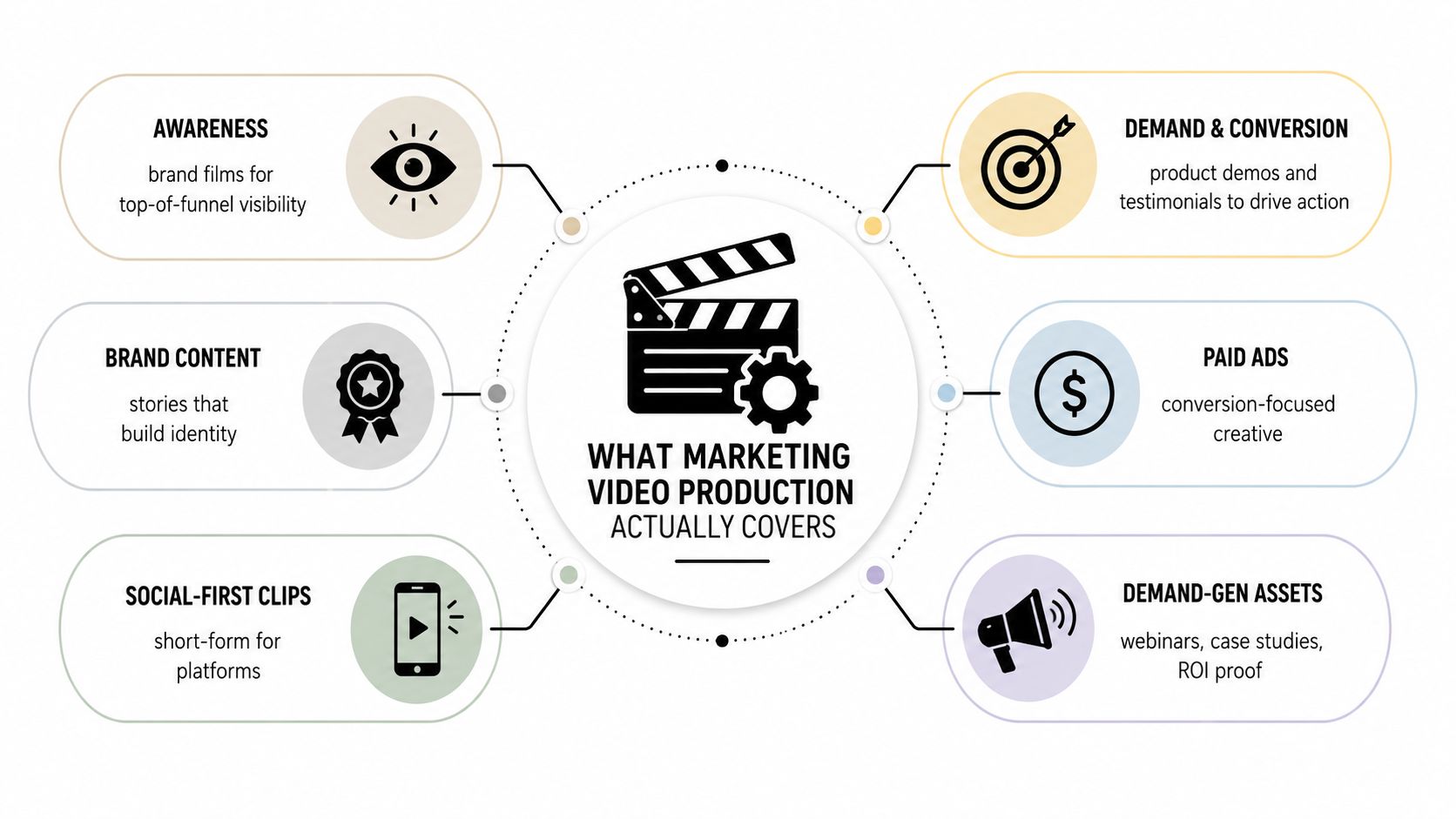
The production chain
A usable scope connects these decisions:
- Strategy: Define the audience, funnel stage, business goal, distribution channel, and primary success metric.
- Creative: Set the concept, message hierarchy, script, storyboard, shot list, and visual direction.
- Production: Confirm crew, talent, locations, equipment, schedule, permissions, and on-set responsibilities.
- Post-production: Specify editing, motion graphics, sound mixing, captions, color work, and required versions.
- Delivery: List the platforms, file specifications, review process, and approved asset handoff.
- Measurement: Tag the campaign, monitor the selected metrics, and compare performance with a relevant baseline.
A quote is comparable only when these outputs and assumptions are written down. Otherwise, a team can approve a polished master video and later discover that it fails in a vertical feed, cannot be shortened without losing its message, or lacks the call to action needed for a demand campaign.
Practical rule: Scope distribution before the shoot. Channel requirements shape the opening, framing, sound design, captions, runtime, and cutdowns.
The video marketing ROI guide can help connect format choices with channel requirements and campaign outcomes.
Marketing video production is a campaign system, not just a camera day. The brief should state what the video must do, which audience it must move, which deliverables are included, and how success will be judged after publication.
Core Video Types and When to Use Each
Start with the campaign objective, then choose the format. Reversing that order leads to the familiar “hero video” problem, where one expensive asset is expected to create awareness, explain the product, generate leads, and close sales across every channel.
The common formats have different jobs:
Brand films build awareness and positioning. They work when the audience needs to understand what a company stands for, why its category matters, or how its point of view differs. They usually need a strong central idea and careful art direction. They’re a poor fit for a bottom-funnel retargeting audience that already knows the brand and needs a specific offer.
Product and explainer videos create clarity during consideration. They can show a workflow, simplify a technical product, or demonstrate how a feature solves a real problem. For SaaS, the script should follow the user’s decision process rather than list every feature. Moonb’s guide to explainer video types can help when deciding between live action, motion graphics, screen capture, and hybrid formats.
Social-first clips are designed for reach and fast comprehension. Vertical framing, captions, a visible subject, and a concise opening matter more than a cinematic setup. They can come from a modular shoot, but they need their own edit logic. A horizontal brand film squeezed into a vertical frame usually feels like an afterthought.
Paid ad creative is built for performance. The first seconds need to establish relevance, and the rest of the edit needs to earn continued attention. Google’s YouTube guidance says the skip button appears after five seconds, creating a clear threshold for paid video openings. Its guidance also notes that 95% of YouTube videos have sound, so audio, on-screen copy, and pacing should be planned together. Think with Google’s YouTube creative guidance gives the production team a practical reference.
Demand generation assets include webinars, testimonials, case study films, event content, and thought leadership. These formats provide proof and context. A testimonial should answer the buyer’s concern, not merely praise the vendor. A case study film becomes more useful when it connects the customer’s problem, decision, implementation, and result in a way the target audience recognizes.
| Video Type | Funnel Stage | Primary Channel | Typical Length | Production Complexity |
|---|---|---|---|---|
| Brand film | Awareness | Website, YouTube, campaign landing page | Short to long form, based on story | Medium to high |
| Product explainer | Consideration | Website, sales enablement, email | Short to mid-length | Medium |
| Social-first clip | Awareness and demand | Reels, TikTok, Shorts, LinkedIn | Short form | Low to medium |
| Paid ad creative | Demand and conversion | YouTube, paid social, display | Short form | Low to medium |
| Testimonial or case study | Consideration and conversion | Website, email, sales outreach | Short to mid-length | Medium |
| Webinar or event asset | Demand | Landing page, email, video platform | Longer form with cutdowns | Medium to high |
Vidyard’s business video benchmarks show that 65% of viewers stay engaged to the end when a video is under one minute, while 20% remain engaged through videos longer than 20 minutes. That doesn’t mean every video should be short. It means runtime needs to match intent. A concise paid ad may need one problem and one CTA. A technical webinar can justify more time because the audience has chosen to learn.
The production plan should usually include a master asset plus multiple versions. One shoot can produce a longer anchor video, short vertical clips, paid cutdowns, still frames, and captioned variations. AI can help with transcription, translation, versioning, and rough assembly. Tools such as an AI-powered marketing video creation tool can support that workflow, but the creative team still needs to protect the message, brand voice, legal review, and final editorial judgment.
IAB guidance also places practical limits around ad placements. Its standards describe maximum durations of 30 seconds for one standard format and 15 seconds for another, while bumper creative is commonly 3 to 10 seconds. The same guidance says 60-second spots should be used sparingly in specific placements. Build those constraints into the brief instead of trimming blindly at the end. IAB’s digital video in-stream ad guidelines provides the placement detail.
How to Scope and Brief a Video So Quotes Are Comparable
The biggest quoting problem is usually not production pricing. It’s ambiguity. If three providers interpret the same request as three different projects, their totals, timelines, and assumptions can’t be compared.
A usable brief gives everyone the same object to price. It doesn’t need to predict every creative choice, but it must define the boundaries that affect labor, logistics, and deliverables.
The copy-ready brief checklist
-
Business goal and primary metric: State whether the video supports awareness, demand, or conversion. Choose one primary metric, such as view-through rate, CTR, cost per lead, pipeline influence, or CPA. Secondary metrics can follow, but a single primary measure keeps creative decisions focused.
-
Audience and funnel stage: Identify who will watch, what they already know, and what action should follow. A first-touch prospect needs a different opening from an existing customer evaluating an upgrade.
-
Core message and mandatory points: Write the one idea the audience should remember. Add required product claims, legal language, proof points, or brand phrases. A long list of “must include” messages often signals that the concept needs prioritization before production.
-
Channel and aspect ratios: Name every intended placement and specify whether the team needs 16:9, 9:16, 1:1, or other exports. Framing and graphics should be designed around these requirements from the start.
-
Deliverables and cutdowns: List the master duration, short edits, language versions, caption files, thumbnails, stills, and any platform-specific exports. “A video and some social clips” is not a deliverable list.
-
Creative approach: Describe whether the piece is live action, animation, screen capture, motion graphics, interview-led, or hybrid. Include reference links for tone, pacing, lighting, transitions, and sound.
-
Production requirements: State the number of locations, shoot days, contributors, presenters, actors, product samples, and customer approvals. If the project needs a customer testimonial, confirm access before the quote is finalized.
-
Post-production and approvals: Define the number of revision rounds, who approves the work, how legal review works, and who supplies final copy or translations. A slow approval chain can create more schedule pressure than the edit itself.
-
Brand assets and usage rights: Share logos, fonts, guidelines, product screens, music requirements, stock references, and any existing footage. Clarify how long and where talent, music, and footage may be used.
-
Budget and deadline: Give the available budget as a planning boundary, not a substitute for scope. Include the launch date, review milestones, dependencies, and the date when all materials will be available.
The creative brief template gives this checklist a practical structure you can adapt for internal review or external bids.
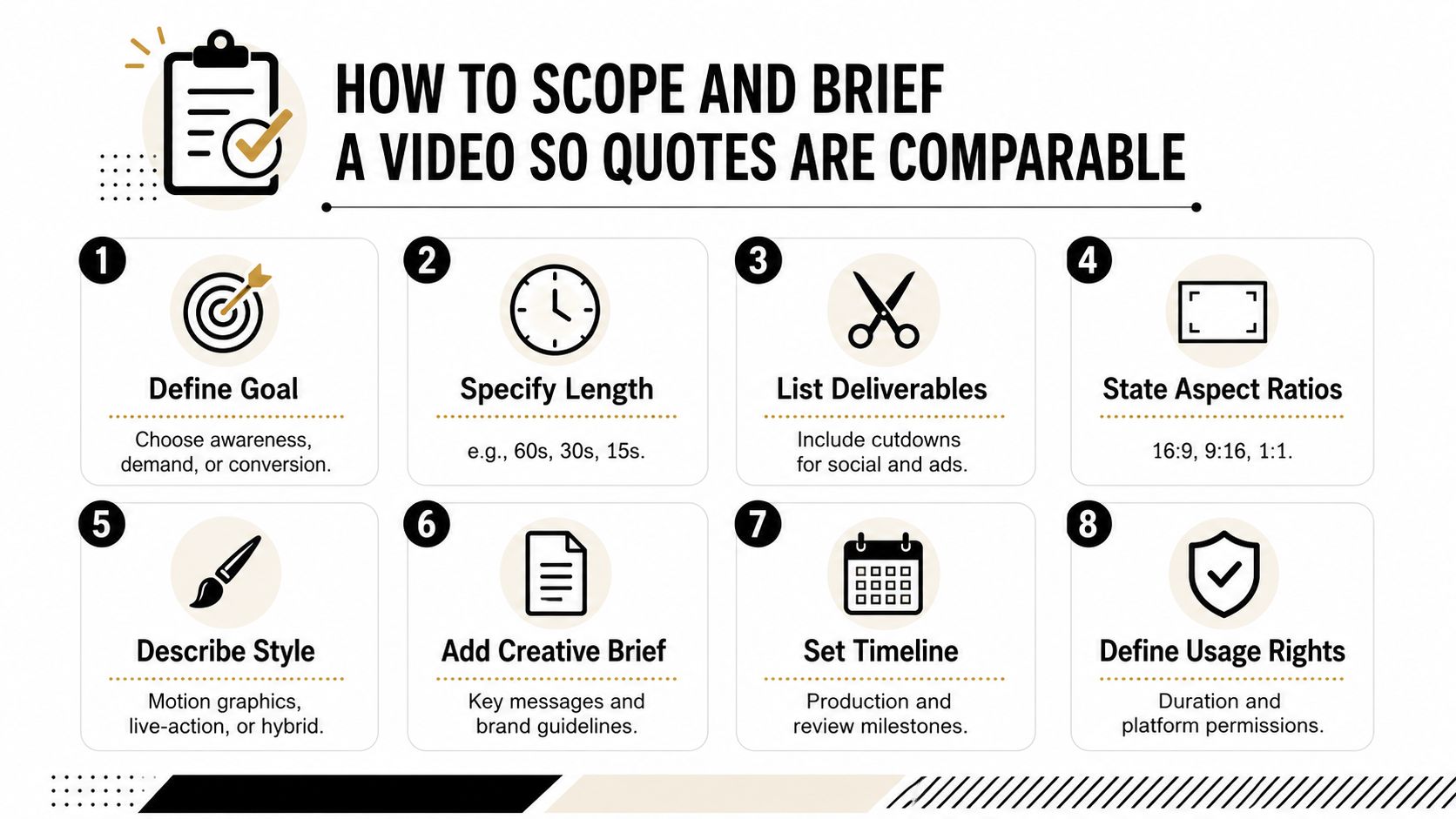
A specific brief lets three providers bid on the same defined work. Ask each one to separate strategy, scripting, production, post-production, licensing, project management, and optional items. Then compare line by line.
A lower total often means fewer assumptions have been priced, not that the work costs less.
Share the same brief, references, deadline, and questions with every bidder. Ask what they have excluded. That last question often reveals the difference between proposals.
From approved brief to delivered files: a realistic timeline
Teams underestimate the calendar more than the budget. A single marketing video with a shoot usually runs three to six weeks from approved brief to final files, and most of that time is not the shoot day.
A typical shape looks like this. The first stretch is pre-production: locking the script, the shot list, casting or talent confirmation, locations, and the schedule. The shoot itself is one or two days. Post-production then takes the bulk of the calendar, a first cut, a review round, sound and color, motion graphics or animation if the piece needs them, captions, and every aspect-ratio version. Legal and stakeholder approvals sit on top of that, and they are the step most likely to slip.
- Pre-production and approvals: about a week for a straightforward piece, longer once casting or multiple locations are involved.
- Production: one to two shoot days for most marketing videos, more for multi-location or multi-format shoots.
- Post-production: usually the longest phase, especially once you count revision rounds, versioning, and captions.
- Buffer: build in real slack for approvals and one honest revision round, because both take longer than the plan assumes.
Animation-led pieces skip the shoot but not the time. Storyboarding, design, and frame by frame work simply move the effort earlier and deeper into post. The lesson is the same either way. Put the launch date next to the approval chain before you commit to it, not after.
Choosing Between In-House, Studio, and Freelancer Models
A campaign can stall even with a strong concept if the production model does not match the workload. Choose based on content cadence, internal decision-making, brand sensitivity, and the coordination your team can realistically absorb.
An in-house team offers direct brand knowledge and quick access to stakeholders. It works well when video is a steady operating function, priorities are clear, and staff can remain productive between campaigns. The costs include salaries, hiring time, equipment, software, and the limited specialist range of a small team. Adding every skill internally can create more management overhead than the work justifies.
Freelancers provide flexible access to specific craft skills. An editor, animator, cinematographer, or sound designer may be the right choice for a focused assignment. The client still owns the brief, schedule, contracts, handoffs, feedback, and quality control. Once several specialists are involved, coordinating them can become a separate project. If the decision is really agency versus shop versus embedded team, our guide to choosing a video marketing agency walks through it.
A creative studio gives the campaign a producer or lead who coordinates multiple disciplines. Depending on the scope, one team may cover strategy, creative direction, production, editing, motion, and sound. That coordination and strategic input appear in the fee. The model also depends on timely client decisions, since a studio cannot protect a schedule if approvals arrive late.
An embedded creative team sits between a conventional studio and internal production. It works inside the client’s workflow, learns the brand through repeated collaboration, and supports a recurring pipeline. This suits teams that need consistent output but do not want to hire every role required for each campaign. Moonb is one example of a dedicated creative team delivering video, motion graphics, design, animation, and brand content on a steady weekly rhythm. For a deeper explanation, see this guide to creative as a service.
| Dimension | In-House Team | Full-Service Studio | Freelancer Network | Embedded Creative Team |
|---|---|---|---|---|
| Speed to first draft | Fast once staffed | Depends on intake and schedule | Fast for a defined task | Fast when workflow is established |
| Brand knowledge | Strong and continuous | Built during the engagement | Varies by person | Grows through ongoing collaboration |
| Creative range | Limited to team skills | Broad across disciplines | Deep in selected crafts | Broad with consistent context |
| Cost pattern | Fixed staffing and tools | Project or engagement fees | Per-project specialist fees | Ongoing team allocation or defined scope |
| Coordination | Internal management | Centralized producer or lead | Client coordinates contributors | Shared workflow with one team |
| Best fit | High, steady volume | Major campaigns or complex launches | One-off work or specialist needs | Recurring output and internal capacity gaps |
Match the model to the workload
Choose in-house when video is central to marketing operations and the team can keep people busy with a reliable stream of work. Choose freelancers for occasional, narrow, or highly specialized assignments. Choose a studio when the project needs several disciplines, a clear creative lead, and a defined beginning and end.
The embedded model addresses a capacity gap. Your team may own the brand and strategy while lacking enough production capacity to execute every campaign. The external team should extend internal judgment, not replace it. Set clear decision rights so the client retains priorities, approvals, and measurement while the production partner handles agreed execution.
Assess management time alongside the production fee. A model that looks efficient in a proposal can become expensive if marketers spend their week briefing, chasing, and reconciling contributors instead of shaping the campaign.
Realistic Cost Drivers and Illustrative Ranges
Video pricing varies by market, year, scope, rights, and production standard. The ranges below are illustrative planning bands, not hard facts or market benchmarks. Use them to structure a conversation, then request a line-by-line proposal for the actual brief.
The main cost drivers are straightforward:
- Creative scope: A clear interview-led concept takes less development than a scripted story with multiple scenes, locations, characters, and visual effects.
- Pre-production: Strategy, research, scripting, storyboards, casting, location scouting, scheduling, and production design all affect the quote before the camera appears.
- Crew and talent: Directors, producers, camera operators, sound specialists, stylists, presenters, actors, and subject-matter experts bring different requirements and rates.
- Locations and logistics: Travel, permits, set construction, insurance, catering, equipment transport, and location access can change the production plan quickly.
- Post-production: Editing, sound design, color, motion graphics, animation, VFX, captions, music licensing, stock footage, and versioning add labor after the shoot.
- Deliverable volume: A master video plus several aspect ratios, language versions, short cutdowns, and platform exports needs more editorial time than one file.
- Timeline pressure: Rush work may require extra crew, parallel editing, faster review, or reduced flexibility around locations and talent.
| Deliverable | Pre-Production | Production | Post-Production | Total Range |
|---|---|---|---|---|
| 60-second hero brand film | $5,000 to $20,000 | $15,000 to $60,000 | $10,000 to $40,000 | $30,000 to $120,000 |
| Set of five social cutdowns | $2,000 to $8,000 | $5,000 to $20,000 | $5,000 to $20,000 | $12,000 to $48,000 |
| Product explainer with animation | $5,000 to $15,000 | $0 to $5,000 | $15,000 to $60,000 | $20,000 to $80,000 |
For a more detailed breakdown of production categories and scope questions, use Moonb’s guide to corporate video production prices.
Two proposals can differ several times over because they may describe different services. One may include positioning, script development, casting, a production designer, multiple shoot locations, three edit rounds, music licensing, captions, and cutdowns. Another may include only a shoot and execution of a supplied script.
Compare assumptions, not just totals. Ask whether the quote includes:
- Number of concepts and script revisions
- Number of shoot days and locations
- Crew roles and equipment
- Talent fees and usage rights
- Animation or motion graphics duration
- Music, stock, and licensing
- Edit rounds and approval stages
- Final aspect ratios and file formats
- Project management and delivery
The video production cost guide is useful when you need to turn those questions into a more detailed scope. Cutting a line item can be sensible, but cutting pre-production often moves the cost into reshoots, re-editing, or internal review time.
Measuring ROI with Metrics That Match the Goal
Set the measurement plan before the shoot. A video can’t be judged fairly against a metric it was never designed to influence.
For awareness work, track reach, view-through rate, completed views, and brand lift where a suitable study is available. For demand generation, track CTR, landing-page conversion, cost per lead, and the quality of leads generated. For sales-focused work, track pipeline influenced, CPA, and assisted conversions.
Raw view counts are easy to report and difficult to interpret. A view may reflect a quick scroll, a forced placement, or genuine interest. Think with Google’s YouTube attention research connects longer viewing time with stronger outcomes and reports that ads watched for more than three seconds are associated with higher brand awareness, ad recall, and consideration. The attention research from Think with Google supports a more useful question: did the creative earn enough attention to move the viewer toward the next step?
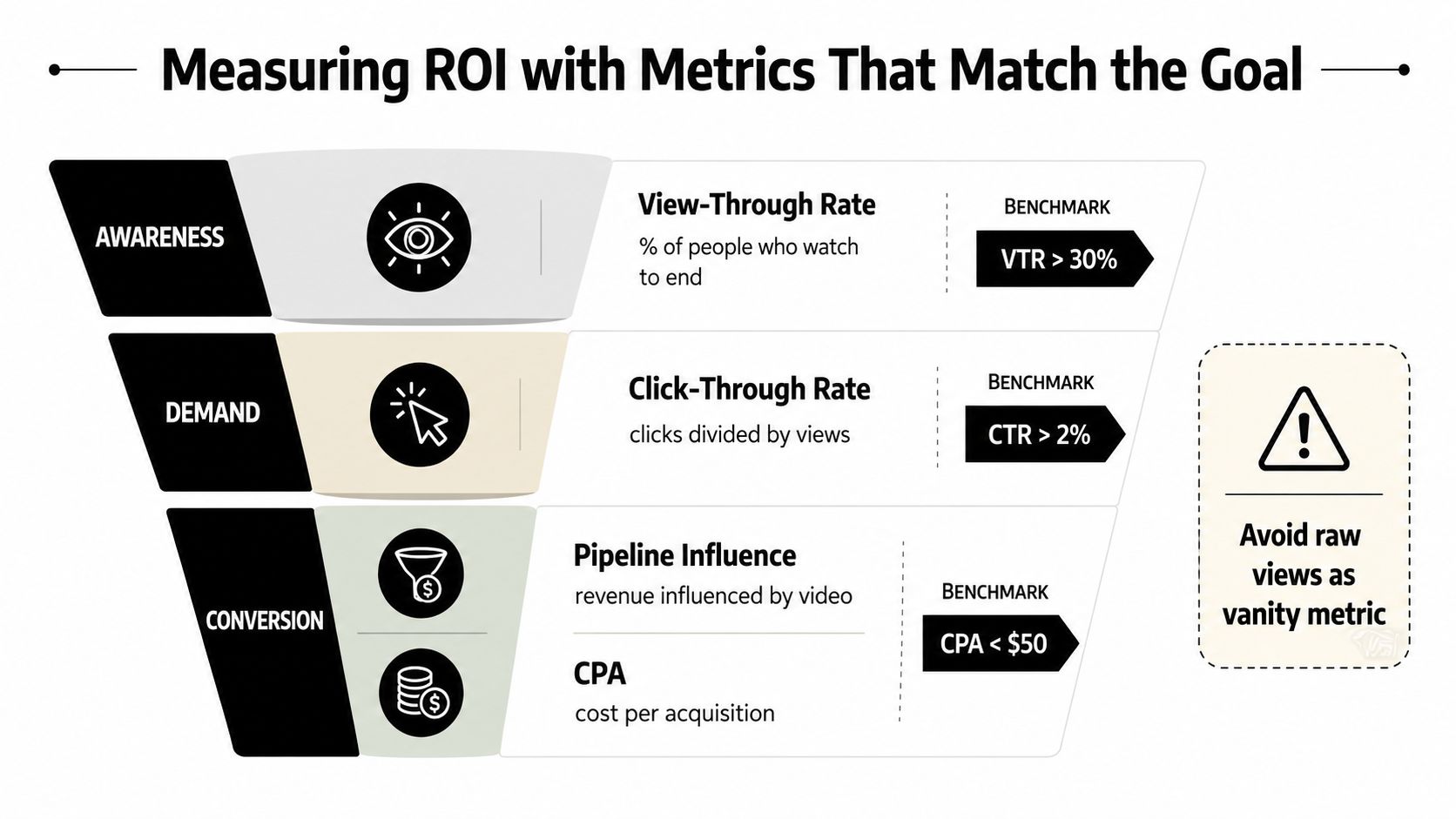
Build a measurement chain
Use a simple chain from exposure to business impact:
- Awareness: View-through rate, reach, completed views, and brand lift.
- Demand: CTR, landing-page sessions, landing conversion rate, and cost per lead.
- Conversion: Pipeline influence, assisted conversions, CPA, revenue contribution, and customer quality.
Tag each asset separately. Use consistent UTM conventions for links in video descriptions, landing pages, email, and paid campaigns. Pair platform analytics with website events so you can see what happens after the click. Record the baseline, audience, spend, placement, runtime, creative version, and launch period.
Attribution needs restraint. Video often assists a conversion rather than closing it alone. A prospect may watch a brand film, return through a search ad, attend a webinar, and speak with sales before becoming an opportunity. Last-click reporting would give the video no credit, while giving it all the credit would also mislead leadership.
Measurement rule: Report video as one part of the buyer journey, then show the evidence for its contribution at each stage.
Wyzowl reported that 93% of video marketers consider video important to their overall strategy, which is a useful signal of adoption but not proof that any specific asset worked. Your own campaign data matters more than a general industry figure. Compare versions against the same audience and placement where possible, and avoid changing the creative, targeting, offer, and landing page all at once.
For a deeper framework covering attribution, testing, and reporting, use Moonb’s video marketing ROI guide. The practical output for leadership should be clear: what the video cost, which audience saw it, what action followed, how much pipeline it influenced, and what the next production should change.
Start your next project with a one-page brief that names the goal, audience, channel, deliverables, approval process, deadline, and primary metric. Send that same brief to three production partners, compare their assumptions line by line, and choose the team whose scope matches the campaign you need.
Frequently asked questions
Cost tracks scope more than any headline range. A social cut from a lean team can be a few hundred dollars; a launch film with animation, custom sound, and a rights-cleared talent shoot can run into six figures. Ask three vendors for like-for-like quotes on the same brief before anchoring on any number; the differences usually come from scripting, revisions, and finishing, not the shoot itself.
Depends on the piece. A full creative agency is stronger when the concept work is heavier than the shoot, and a production company is stronger when the shoot is heavier than the concept. For ongoing marketing video across formats and channels, a dedicated creative team that carries both is often the least-friction option.
Match the length to the placement, not to a preference. A paid social cut for cold audiences usually earns its cut around 10 to 20 seconds. A landing-page product video can run 60 to 120 seconds once the visitor has already clicked. A customer story or webinar can stretch further because the viewer has opted in. Cutting one master into three placement-specific versions almost always beats trying to make one version work everywhere.