11 storyboard examples and what to copy from each
Eleven real storyboards and animatics, from Pixar's Inside Out and the KPop Demon Hunters Golden boards to Blender Studio's Charge thumbnails, with who made each one, the style, and what to copy.

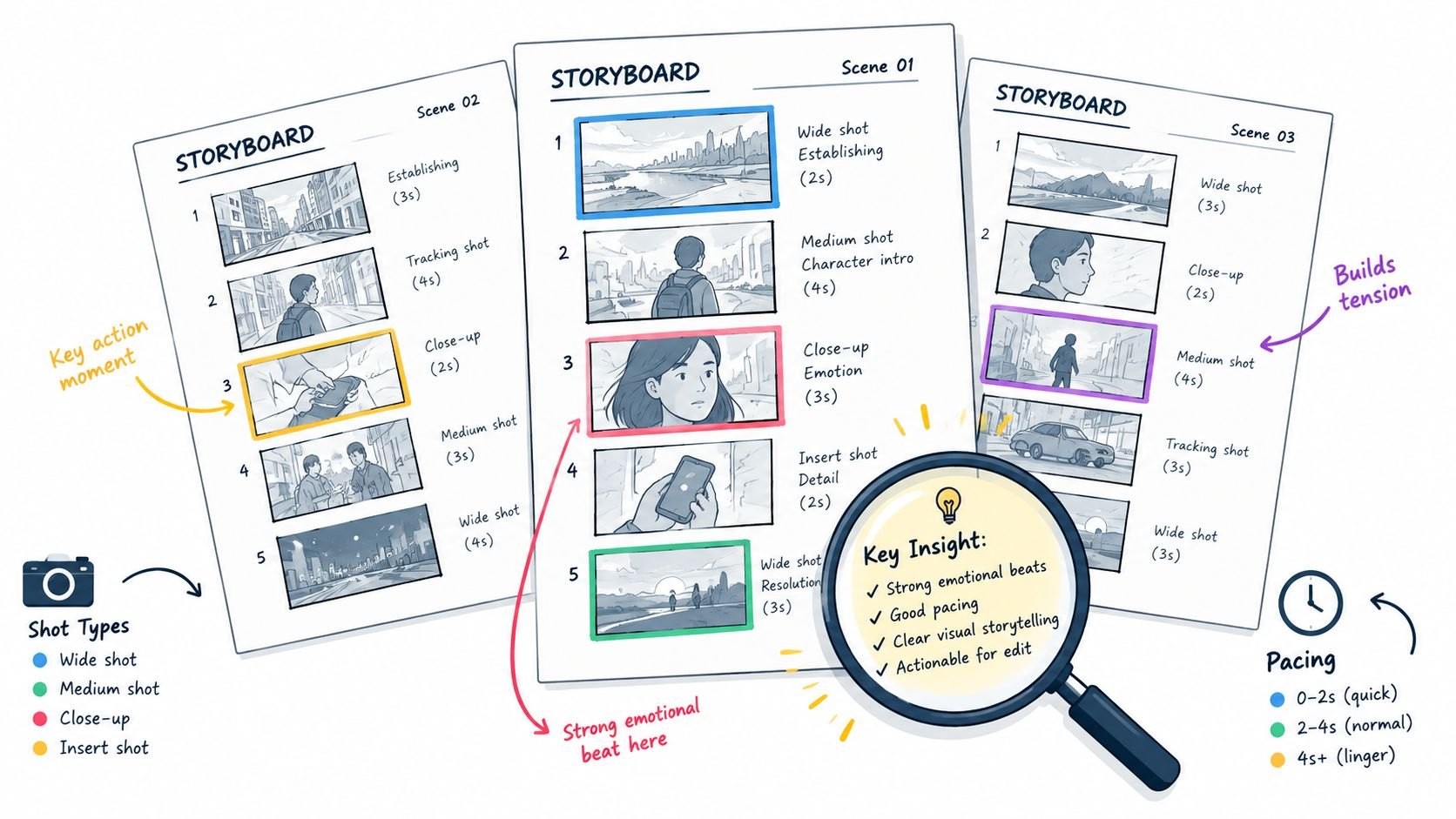
The storyboard examples I would study first are Pixar’s rough boards for the “Abstract Thought” scene in Inside Out (2015), Bridget Underwood’s fast, rough boards for the “Golden” music video in KPop Demon Hunters (2025), and Blender Studio’s thumbnail sheet for an early establishing shot of Charge (2022). After those come a tonal story reel from The Wild Robot, a polished color board from Vivo, a fight from Arcane, a live-action Netflix show, a Star Wars 3D animatic, a 2D animatic for a music video, a pencil timing sheet for a commercial from about 1991, and one Mickey Mouse page from 1928.
Most video projects at Moonb, the studio I co-founded, go right or wrong at the board, so I get picky about the examples people pass around. What annoys me about most “storyboard examples” pages is the invented sample panels. They teach you nothing about how a real team boards on a deadline.
The style names get used loosely. When I say thumbnails I mean tiny, fast sketches for trying options. Rough boards lock the action and the camera with loose drawings, and polished boards add clean line, tone or color so a crew or client can read them without you in the room. An animatic cuts the panels to time with sound, so you can feel the pacing. For why boards exist at all, start with what a storyboard is for.
1. Inside Out, “Abstract Thought” (Pixar, 2015)
In Pete Docter’s Inside Out, Joy, Sadness and Bing Bong wander into a part of the mind that takes them apart in stages. They go cubist first, then flat and 2D, then down to simple colored shapes.
I would never green-light that from a script. “The characters turn into abstract art” means something different to everyone who reads it. Pixar’s side by side on its own channel cuts between the story artists’ rough line boards and the finished film, and those loose drawings settle which character breaks down first and where the joke is.
None of it is cleaned up. Those panels only had to show that a strange idea would read, and be funny, before anyone built it.
2. KPop Demon Hunters, “Golden” music video boards (Sony Pictures Animation, 2025)
My favorite entry, mostly because of one apology.
In KPop Demon Hunters, the 2025 Sony Pictures Animation film directed by Maggie Kang and Chris Appelhans, the song “Golden” first appears as a music video released by the film’s girl group. Netflix’s oral history of the song credits the boards, “Storyboarding the ‘Golden’ music video was a unique challenge for story artist Bridget Underwood.” Underwood had fun with it: “There are so few limits on what can be in a music video, it was a blast getting interpretive and vibey with it.”
Underwood posted the boards on their own channel, with this in the description: “Please forgive the roughness, most of this came together in about two days during a fast period in production.” I love that line.
The panels themselves are loose sketches with washes of pink, blue and yellow and a few quick dance poses. The animation team needed “background snippets of a music video”, in Underwood’s words, on a tight turnaround, and one flat wash of color per panel gives the mood of each beat faster than any written note. For social cut-downs and launch videos on a short clock, I’d rarely board more than this.
3. Charge, an establishing shot (Blender Studio, 2022)
This is the sheet I’d show a client who asks what thumbnails are actually for.
Blender Studio calls Charge its “14th Open Movie”, a “high-visual-impact, action-packed 3-minutes-long animation inspired by the game cinematics and realtime demos formats.” In February 2022 the team published one sheet of thumbnails for the shot where the main character, Einar, first appears. The sheet is under a Creative Commons license.
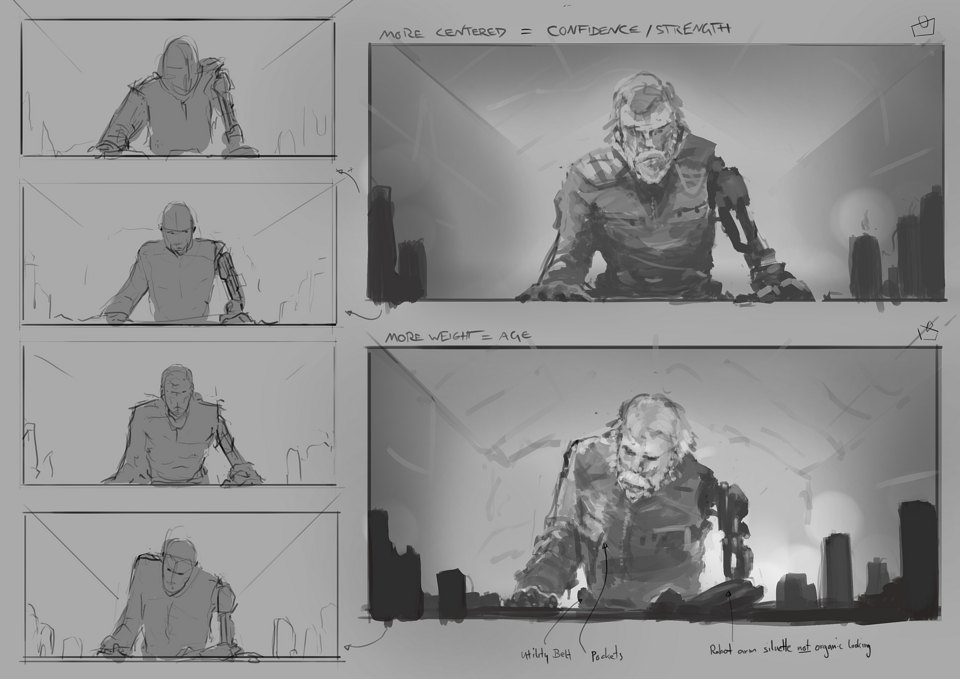
The original description calls it “A series of thumbnails and two rough cleanups to get a better idea of the character.” That shot “has to carry a lot of information that the viewer has to pick up upon seeing him at first glance”, so the team was working out how the prosthetic arm affects his posture and how much age he shows. The answers are written right on the sheet, “More centered = confidence / strength” and “More weight = age.”
4. The Wild Robot, storyboard side by side (DreamWorks Animation, 2024)
Chris Sanders wrote and directed The Wild Robot for DreamWorks Animation in 2024, based on Peter Brown’s 2016 novel, and Universal Pictures Home Entertainment posted a storyboard side by side on its official channel, cutting between the story reel and the final film.
It’s a tonal story reel, soft grayscale panels with the light and dark already worked out, so it times the film and sets the emotional temperature of each scene at once. A bear looming out of the dark reads as a threat before any lighting artist has touched it.
On our boards I ask for three values (light, mid, dark) on any panel where the mood matters more than the choreography.
5. Vivo, “My Own Drum” (Sony Pictures Animation, 2021)
“My Own Drum” is where Vivo jumps into a flat, graphic style full of bright color. The girl Gabi sings it, in a 2021 Sony Pictures Animation musical directed by Kirk DeMicco with songs by Lin-Manuel Miranda. The studio posted a split screen with the storyboards above the final frames, and the video credits the storyboard art to Carlos Romero.
About as far from the Golden sketches as boards get. These are polished boards, clean line on saturated backgrounds, and the style change is designed into the panels, so everyone downstream sees where the song leaves the look of the rest of the film.
6. Arcane season 2, episode 3 (Fortiche and Riot Games, 2024)
The French studio Fortiche produces Arcane under the supervision of Riot Games; its second and final season came out in November 2024. Etienne Guignard, whose Coloso course page lists “Storyboard Artist at Fortiche Productions (Arcane Season 2)”, posted part of his board for season 2, episode 3 on his own channel, next to the finished shots and marked as used with permission.
For a show that looks this finished on screen, the board is plain. An action board mostly has to protect screen direction and eyelines while the hits come fast, and on any quick sequence the first thing I check is that the subject keeps moving the same way across the frame from panel to panel, unless the flip is deliberate. Guignard draws the fight in fast, clean line with no tone at all.
7. Locke & Key, storyboard to screen (Netflix, 2020)
Locke & Key, a fantasy show and the only live-action series on the list, premiered on Netflix on February 7, 2020. Netflix’s official channel published a “From Storyboard to Screen” feature that stacks the pencil boards over the matching shots.
These rough boards carry very little: faces, eyelines, a few arrows for camera moves, a rough sense of the set. For effects-heavy scenes they plan coverage and camera moves, and the actors, lighting and production design take care of the rest on the day.
8. Star Wars: The Bad Batch, “Riot Racing” (Lucasfilm Animation, 2023)
Lucasfilm Animation’s The Bad Batch, created by Dave Filoni, premiered on Disney+ on May 4, 2021. In May 2026 the official Star Wars channel posted a side by side of the riot racing sequence from season 2, episode 4, “Faster” (first aired January 18, 2023), labeled “Early Animation vs Episode”.
On the left is the 3D animatic that timed the vehicle sequence and its cameras before final animation. Characters are textured and the camera is placed, but the lighting is flat and some backgrounds are still placeholder grids. In a race that doesn’t matter. You’re judging speed and the order of cuts, and you can’t feel either in still drawings. A product spin or a fast drone move has the same problem, so I get off panels early there and cut a rough moving version. My guide on how to make an animatic walks through the steps.
9. James and the Shame, “Give a Damn” (Micah Buzan, 2022)
Rhett McLaughlin of Good Mythical Morning records solo as James and the Shame. According to a September 20, 2022 press release from SRO PR, “Give a Damn” was the third single from the debut album Human Overboard, and it came with an animated video. Micah Buzan, the animator, published his 2D animatic next to the final animation on his channel.
Buzan kept the animatic to simple line work and a few color accents and cut it to the track, which locked the timing for the whole music video. On a schedule like his that mattered, and his project page spells it out. “We had 6 weeks to finish this 3:30 minute animation, which was a very tight deadline. Rhett McLaughlin wrote a shot-by-shot script which helped expedite the storyboarding process.”
That second sentence is the part I’d copy. If a client can write one line per shot before boarding starts, I ask them to, and the board artist spends the time drawing.
10. Fit Food commercial, New Zealand Cancer Society (Barry Thomas, c. 1991)
I’d pin this one above every producer’s desk. The Wikimedia Commons file, released by its uploader under CC0, is titled as a morphing with motion control storyboard from about 1991, by director and producer Barry Thomas with animator Stephen Regelous, for a fresh food commercial for the New Zealand Cancer Society.
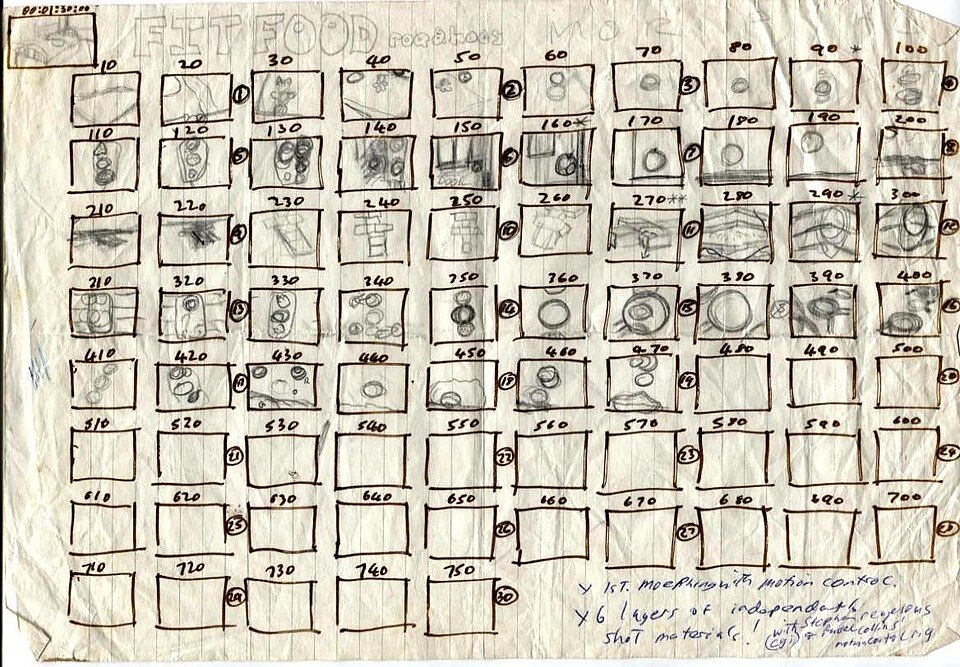
The drawings are barely more than circles. The numbering is the interesting part. Every tiny panel is labeled in steps of ten, from 10 to 750, and circled numbers from 1 to 30 sit between the panels, one about every 25 frames. The handwritten note at the bottom mentions morphing with motion control and six layers of independently shot material, which is why the frame count mattered so much.
You’re probably not shooting six layers on motion control, but on a 15 or 30 second ad, numbering panels by second still tells you early whether the idea fits the slot. Our guide on how to make a commercial covers the rest.
11. Plane Crazy (Walt Disney and Ub Iwerks, 1928)
Walt Disney and Ub Iwerks directed Plane Crazy in 1928, and Wikipedia notes it was the first produced short to star Mickey Mouse. The page, credited to Ub Iwerks, is held by the Library of Congress and is in the public domain.
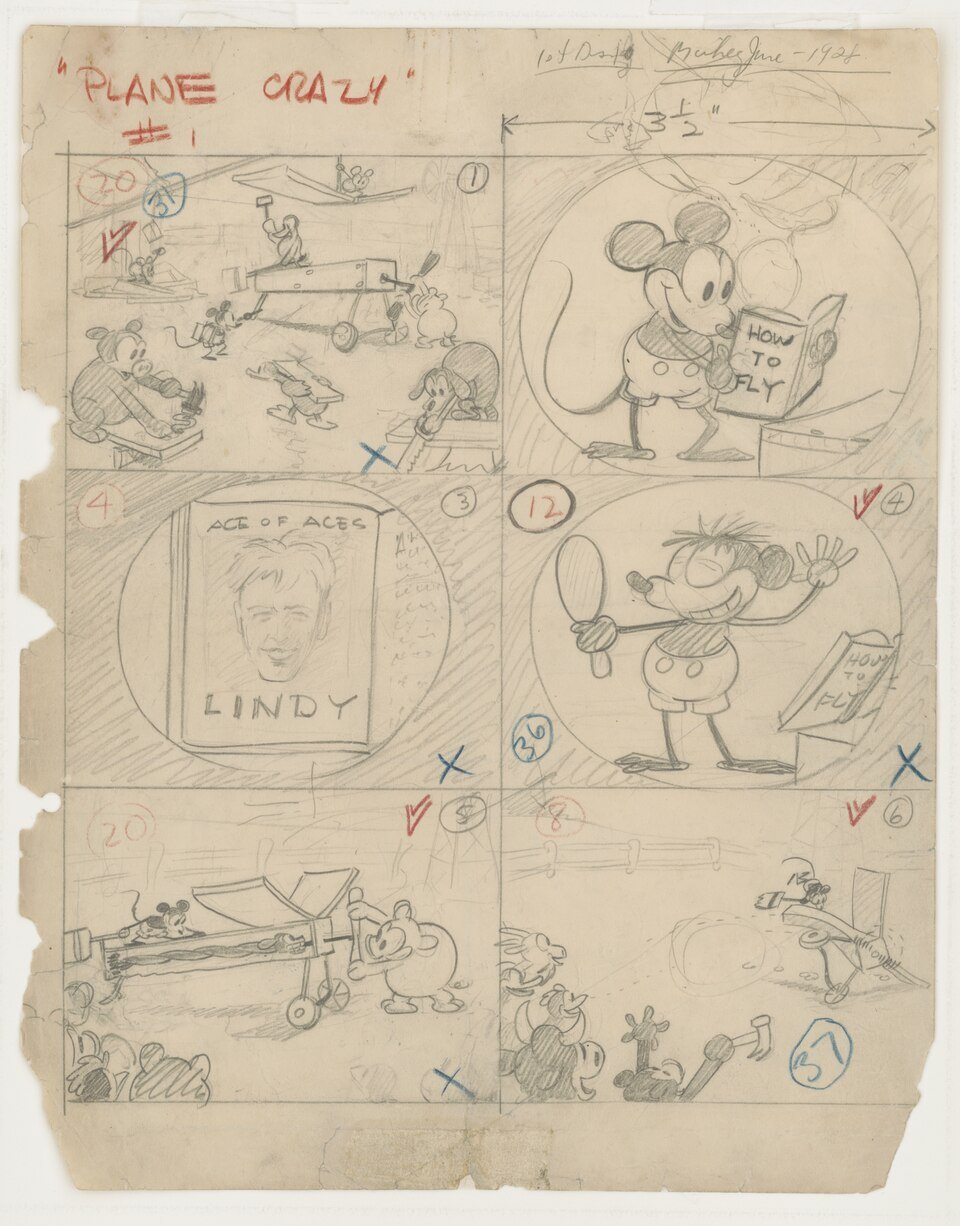
Iwerks planned the gags and the shot order in six numbered pencil panels, and the page is covered in red checks, blue crosses and circled numbers in two colors. You can watch the decisions get made. For where this stage sits in the pipeline, see the animation process, stage by stage.
All 11 storyboards compared
| Project | Who made it | Year | Style | What the board was for | What to copy |
|---|---|---|---|---|---|
| Inside Out, “Abstract Thought” | Pixar (dir. Pete Docter) | 2015 | Rough | Proving a strange visual idea reads | Board the transformation first |
| KPop Demon Hunters, “Golden” music video | Bridget Underwood, Sony Pictures Animation | 2025 | Rough with color washes | Fast background snippets for a music video | A color wash per panel for mood |
| Charge, establishing shot | Blender Studio | 2022 | Thumbnails and rough cleanups | Choosing a character’s first pose | Write the reason next to the chosen frame |
| The Wild Robot | DreamWorks Animation (dir. Chris Sanders) | 2024 | Tonal story reel | Timing and mood | Three values of light and dark |
| Vivo, “My Own Drum” | Sony Pictures Animation | 2021 | Polished, color | Designing a style shift in a song | Change the board’s look where the video does |
| Arcane S2, episode 3 | Etienne Guignard for Fortiche and Riot Games | 2024 | Rough line, action | Blocking a fight | Protect screen direction in fast cuts |
| Locke & Key | Netflix | 2020 | Rough, live action | Coverage and camera moves | Draw where the lens is, keep faces simple |
| The Bad Batch, “Riot Racing” | Lucasfilm Animation | 2023 | 3D animatic | Timing a vehicle sequence | Move to a moving draft when motion is the idea |
| “Give a Damn” music video | Micah Buzan for James and the Shame | 2022 | 2D animatic | Locking timing on a six-week schedule | Get a shot-by-shot script first |
| Fit Food TV commercial | Barry Thomas with Stephen Regelous | c. 1991 | Thumbnail timing sheet | Frame-accurate technical spot | Put seconds on the board |
| Plane Crazy | Ub Iwerks for Walt Disney | 1928 | Rough, pencil | Gags and shot order | Review marks right on the panels |
How much detail a storyboard needs before a shoot
Usually less than people expect. Adobe’s storyboarding guide sets the floor with “There’s no set number of frames for a storyboard.” You need “at least one frame for every shot.” I work to exactly that. One panel per shot, and a second only when the camera or the subject changes enough inside the shot to need it. I add more than that in four cases.
- Tone or color when the crew has to build or light something specific, as on The Wild Robot and Vivo.
- An animatic when the idea lives in movement or speed. The Bad Batch and “Give a Damn” both went there.
- Rough line and nothing more when the question is only what happens and in what order, which is all Locke & Key and Arcane needed.
- Time on every panel if the spot has a fixed length, like the Fit Food sheet.
Match the frame to the delivery format. Boords’ template guide makes the point that “Your storyboard should match the aspect ratio of your final output”, with 16:9 for YouTube and presentations and 9:16 for TikTok, Reels and Shorts. A composition that reads on a wide board often falls apart on a phone, so if you’re planning vertical video content, draw the vertical frame from the first panel. My vertical video dimensions guide has the exact sizes, and short video ads covers how the hook changes in that format.
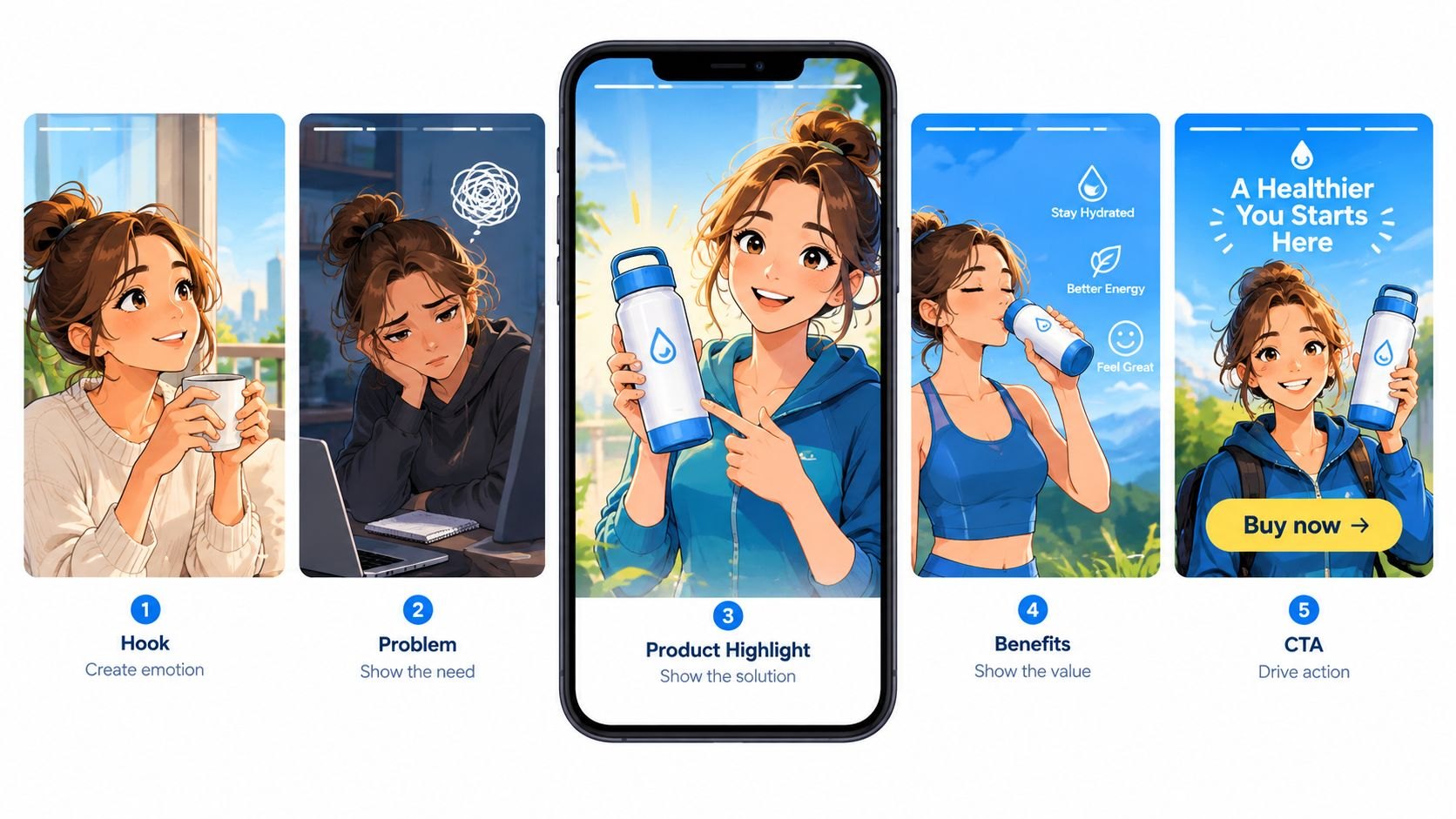
Then the notes. Under each panel I want the shot size, any camera move, the line of dialogue or voiceover, and a sound cue if there is one. A brief that already answers the obvious questions makes the board shorter; if your team has never written one, a storyboard brief checklist is a reasonable start.
For a blank to draw on, our free storyboard template makes a printable PDF where you pick the frame ratio, panels per page and note lines. If you’d rather hand the whole stage to a team, that’s what our storyboarding service does.
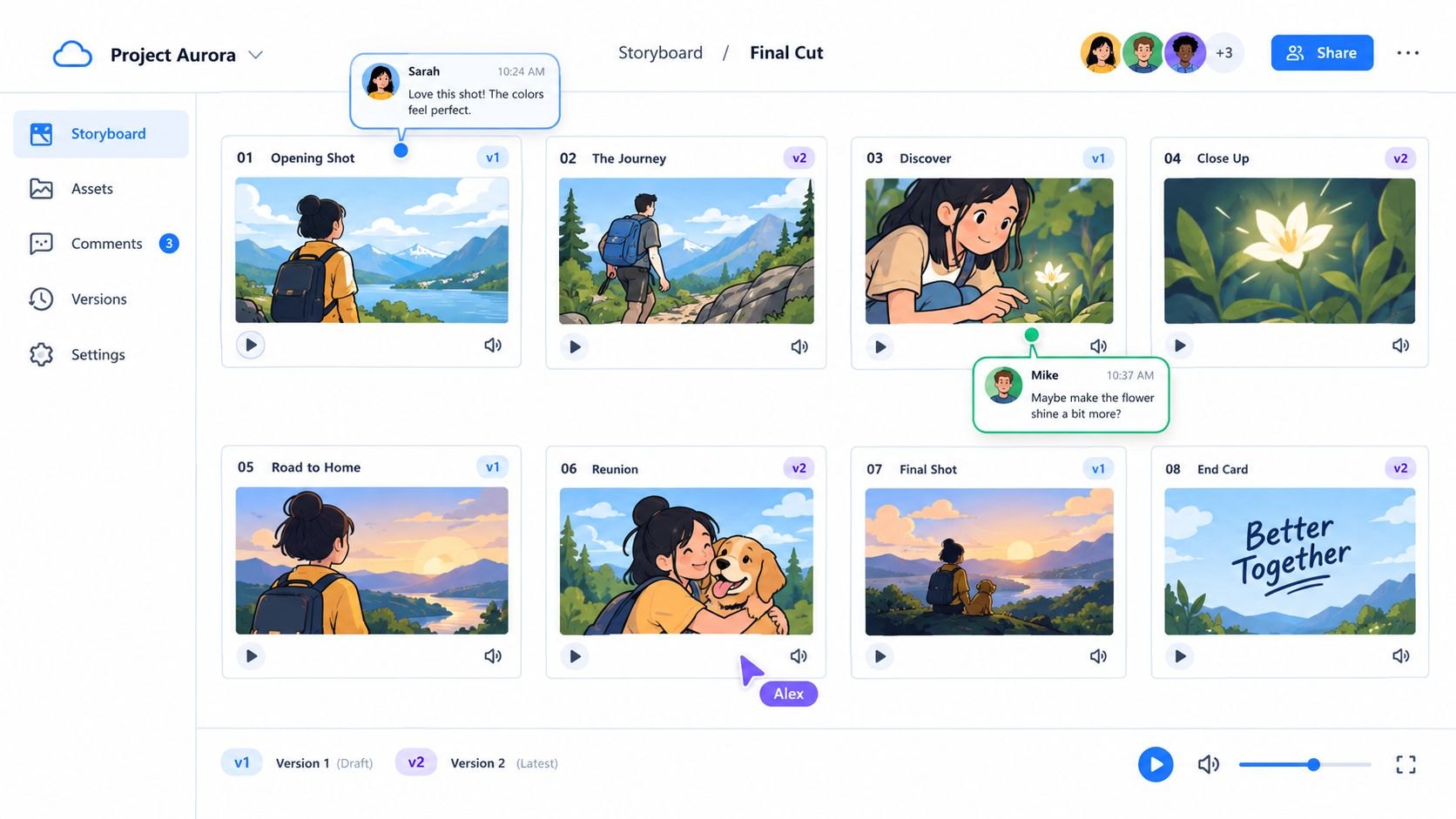
Pin comments to specific panels, as on the Plane Crazy page in 1928, and skip the long email thread. A lot of teams now rough out reference frames with AI image tools before anyone draws. ImagineArt, one of those tools, publishes its own film storyboard guide, there’s a write-up on building an AI storyboard for product ads, and tools like this cinematic AI video creator turn a script straight into video.
Frequently asked questions
Go to the official channel of the studio or streamer that made the work. Pixar, Sony Pictures Animation, Netflix and the Star Wars channel all post storyboard side by sides that cut between the board and the finished scene. Story artists often post their own boards as well, sometimes with a permission note. If you want boards you can reuse or print, Wikimedia Commons has public-domain and Creative Commons ones, including a 1928 Plane Crazy page from the Library of Congress and Blender Studio's open-movie boards.
Rough. Loose drawings are enough to settle what happens and where the camera sits, and every project needs that settled first. I only polish the panels where someone downstream needs more, like tone for a scene that depends on lighting, or clean product frames for a client who will judge the look. Lots of professional boards never get cleaned up at all. Bridget Underwood's Golden boards for KPop Demon Hunters went to the animation team as loose sketches with color washes.
As soon as the idea depends on timing. Still panels won't tell you if a joke hits the beat or a car chase feels fast, and they won't tell you if a 30-second spot really fits in 30 seconds. Cut the panels to a scratch voiceover or the music track and watch it with whoever signs off. Fix the pacing there, before anyone animates or shoots a frame.