18 Corporate Training Videos Worth Studying
A hands-on breakdown of 18 corporate training videos, from safety and onboarding to service and phishing, and the craft choices that make each one actually work.

I have watched a lot of training videos that people were forced to sit through, and most of them fail the same way. They mistake completeness for teaching. Someone points a camera at a manager, the manager reads a policy off a page, and everyone in the room learns nothing except how to look busy while their mind wanders. A training video has one job. It has to change what a person does the next time they are on the floor, on a call, or in front of a screen. If it does not change behavior, the runtime was wasted no matter how thorough it was.
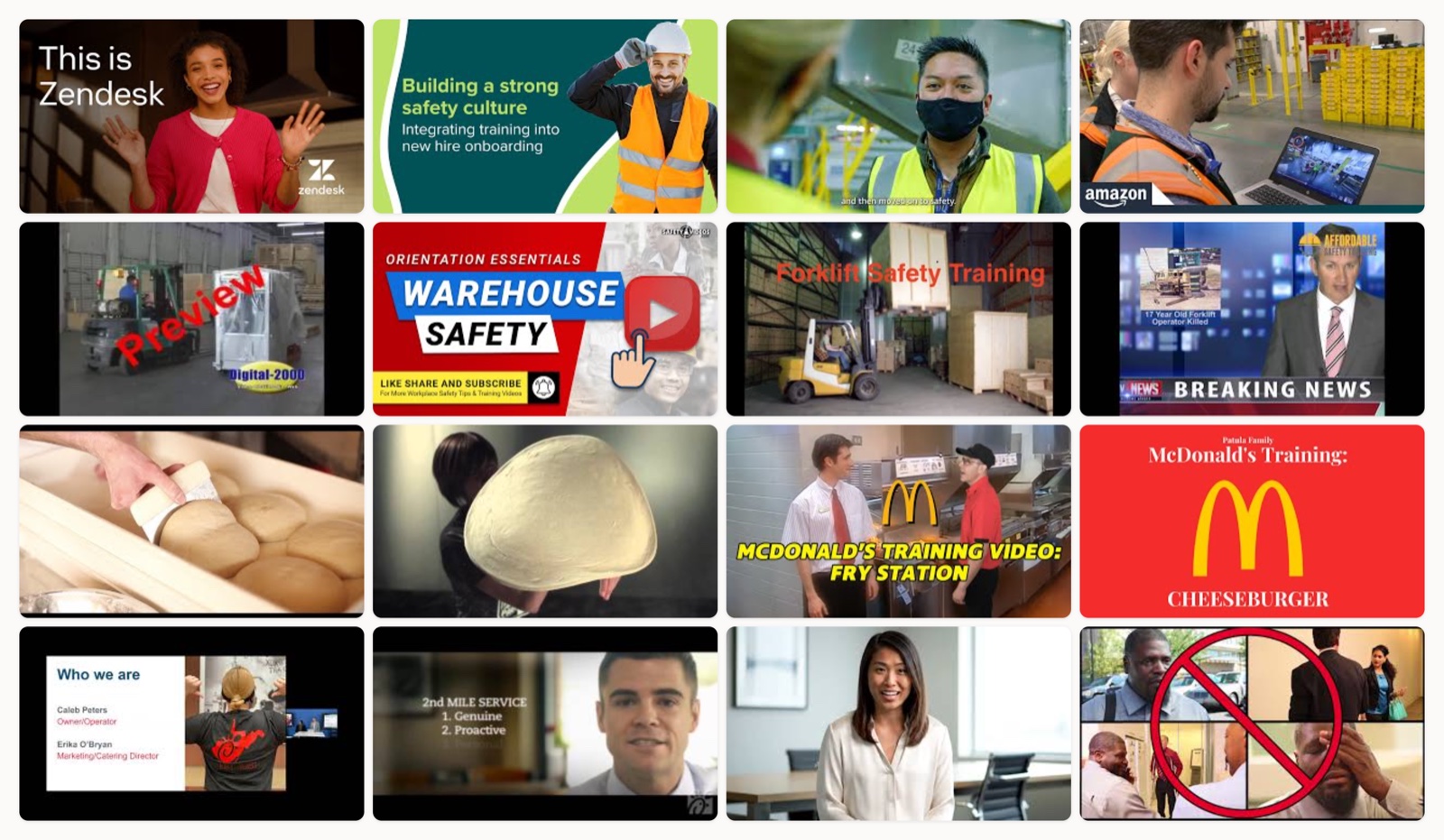
So I collected 18 videos that get this right, and I want to walk through what each one is actually doing. Some are polished culture films with real production behind them. Others are plain talking-head explainers or animated shorts that cost very little to make. That range is the point. Good training craft is not about the money on screen. It is about matching the format to the lesson and respecting the viewer’s attention. If you plan to hire out the production, our comparison of training video production companies sorts them by the job the video has to do.
How I picked these
I looked for videos that teach a specific thing to a specific audience, and that use the medium instead of fighting it. A demo should show me the technique from the angle I would actually need. A compliance piece should make an abstract rule feel like a real moment I might face. A culture film should make me want to belong before it tells me the rules. I checked that every one of these still plays, and I put them in an order that moves from setting the tone, through safety and process, into service, and finishes with the harder compliance topics. If you want the practical build steps behind these, I wrote a separate piece on how to make training videos for employees.
Culture and onboarding
Zendesk, a documentary-style culture film
This one does not teach a task at all, and that is deliberate. It is real employees talking straight to camera about what the place feels like, shot with the warmth of a short documentary rather than a corporate promo. I like it as the first thing a new hire sees because it earns belonging before anyone starts listing rules. The direct address does the heavy lifting. Hearing a peer say it lands harder than any slide.
Safety and compliance
Safeti, safety training built into onboarding
A simple talking-head explainer, and I include it for the framing more than the format. The argument is that safety training should live inside week one, not sit in a separate binder people open once. It is low production by design, which suits the message, and it shows you that a clear point of view can carry a video that has almost no visual budget behind it.
Amazon, safety as an employee journey
Here the policy gets a face. Instead of listing rules, it follows a real person through her work and lets the safety practices show up as part of her day. That narrative choice is what makes a dry subject stick, because I am watching someone I can picture myself as, not reading a compliance checklist. It runs long, and it earns the length by staying with one human thread.
Amazon, a process demo built on motion graphics
This is the counterpart to the piece above, and it solves a different problem. Some safety systems are invisible in a live shot, so the video uses clean infographics and animated diagrams to show how the technology actually works. I reach for motion graphics exactly here, when a camera cannot show the mechanism and a well-built diagram can.
SafetyVideos.com, scenario-driven hazard training
Live-action scenarios in a real warehouse, showing hazards as they happen rather than describing them. The value of dramatizing the wrong move is that a viewer feels the consequence before they ever face it themselves. For new hires who learn by watching, this beats a bulleted list of prohibitions every time.
SafetyVideos.com, a structured orientation walkthrough
Where the previous video dramatizes, this one organizes. It walks through core safety rules in a clear, sectioned rhythm that a viewer can follow and a trainer can pause on. I appreciate how legible the structure is. You always know which rule you are on and how many are left, which takes the anxiety out of a long orientation.
OSHA forklift safety, compliance-grade pacing
The pacing here is intentionally slow, and I want to defend that choice. When a procedure has legal weight, rushing it is a liability, so the video gives each step room to be seen and repeated. It is not entertainment and it does not pretend to be. For certification content, that measured tempo is the feature, not a flaw.
Forklift operator training, mapped to the standard
This one ties its visuals directly to the OSHA 1910.178 standard, which is a smart move for anyone who has to prove their training covered the regulation. Naming the standard on screen turns a general safety video into an auditable record. If you operate in a regulated environment, that traceability is worth more than slicker production.
Skills and standards
Pagliacci Pizza, an expert skills demo
A hands-on technique demo, and the camera work is the whole lesson. It shoots the dough toss in tight close-up from the angle the learner needs, so you see exactly how the hands move and where the weight shifts. This is the rule I keep coming back to for any skills video: frame the shot from the trainee’s point of view, not the observer’s.
Pagliacci Pizza, the craft made aspirational
Same subject, opposite intent. Where the demo teaches the mechanics, this uses slow motion to make a repetitive kitchen task look like a craft worth mastering. I think this pairing is underrated in training. One video shows people how, and a second makes them want to. Pride is a training outcome too.
McDonald’s, a standardized station procedure
The fry station broken into consistent, repeatable steps. What impresses me is the discipline of it. Every action is shown the same way it will be performed, so a crew member in one location does it identically to a crew member across the country. When your product has to be the same everywhere, this kind of procedural clarity is the actual brand.
McDonald’s, a step-by-step build sequence
A first-person build of a cheeseburger that even names the parts of the bun so the vocabulary carries over to the floor. The point of view puts you inside the station, learning the layout as you assemble. I like how it treats language as part of the training. Give people the right words and they follow instructions faster.
Service and hospitality
Chick-fil-A, service modeled through scenarios
Service is hard to teach in the abstract, so this shows it as behavior. You watch staff model the exact interactions the company wants, which gives a new hire a concrete picture to copy instead of a list of adjectives. For anything human-facing, I would rather show a good example in motion than describe the values behind it.
Chick-fil-A, values plus front-line technique
This one blends the why with the how, tying the hospitality mindset to the specific things people do at the counter. I find that combination sticks better than either half alone, because the technique gives the values something to hold onto. Explain the standard and then show the small action that meets it.
Harassment and security
Traliant, dramatized compliance vignettes
Harassment training usually dies on contact with a policy document, so this dramatizes real workplace moments instead. Seeing a situation play out makes the line between acceptable and not feel concrete rather than legalistic. The acting does not have to be perfect. It just has to make the viewer recognize the moment when it happens to them.
EEOC, the authoritative plain-language explainer
A government explainer that leans on clarity and authority rather than production. There is a place for this register, especially when people need the definitive version of what the law expects. I would pair it with the dramatized Traliant piece above. The vignette makes you feel the situation and the explainer tells you precisely what to do about it.
Traliant, a phishing decision simulation
Instead of listing phishing red flags, this puts you inside the decision, modeling the moment where someone clicks or does not. Security training works best when it rehearses the choice, because that choice is exactly what fails in real life. Simulation turns a warning into practice.
Security Quotient, an animated story hook
Animation and a story hook carry a topic most people tune out. By framing phishing as a game of deception with a narrative pull, it holds attention long enough for the lesson to land. When a subject is dull on paper, I would rather spend the effort on a hook than on realism, and this shows why.
What the best ones share
Watch all 18 and a few patterns repeat. They pick one audience and one behavior, and they refuse to cover everything at once. They match format to lesson, so a demo shoots the hands, a process piece uses diagrams, a compliance topic gets a scenario. They respect the viewer, which shows up as tight editing and a clear structure you can follow without effort.
The other thing I notice is that production value tracks the goal, not the ego. A culture film like Zendesk earns its polish because feeling is the point. A safety explainer stays plain because clarity is the point. Nobody wins by making a forklift certification video cinematic. The best examples spend exactly where the lesson needs it and nowhere else. If you want more range across formats, I collected a wider set in corporate video examples.
How to get this right
Start from the behavior you want to change, then work backward to the format. If the lesson is a physical skill, plan the shots from the trainee’s point of view before you think about anything else. If it is a rule or a policy, build a scenario that dramatizes the moment the rule matters, and keep the explainer version handy for the precise wording.
Keep each video short and single-topic so people can find the one thing they need and rewatch it. Write scripts the way you would explain something to a colleague, not the way a handbook reads. And plan for the boring part up front. These videos get reused for years, so make them easy to update when a policy or a station layout changes. A video that costs a lot to revise gets left stale, and stale training is worse than none.
Where this leaves you
If you are about to commission training content, the takeaway is not that you need a bigger production. It is that you need to be clear about what each video is for, and then match the craft to that one job. The examples above work because someone made that decision on purpose, video by video.
That clarity is most of the battle, and it is the part I care about most when my team at Moonb takes on a training series. Pick the behavior, pick the format that teaches it, and let the production follow. Do that consistently and your people will actually watch, and they will do the thing differently afterward.
Frequently asked questions
Short and single-topic. Aim for under five minutes covering one specific task, rule, or scenario, so people can find exactly what they need and rewatch it without scrubbing. Compliance content that has to walk through a full procedure can run longer, but even then, break it into clearly labeled sections a viewer can navigate. Length should follow the lesson, not the other way around.
An expert demo shot from the trainee's point of view, with tight close-ups on the technique. The Pagliacci dough-toss and McDonald's station videos above work because the camera shows the action from the angle the learner will actually need, not from an observer's seat across the room. Pair a clear how-to demo with a shorter aspirational piece if you also want people to take pride in the skill.
Only where the goal calls for it. A culture film earns polish because feeling is the point, while a safety explainer or a compliance walkthrough is better off plain and legible. Several of the most effective examples here are simple talking-head or infographic pieces that cost very little. Spend on production where it changes whether the lesson lands, and keep it minimal everywhere else.