Car dealer video marketing: a playbook for the lot
How a dealership marketing manager runs video week to week: walkarounds, personalized lead videos, service explainers, staff intros and testimonials, what to shoot on a phone, the FTC pricing rules for video, and where each clip runs.

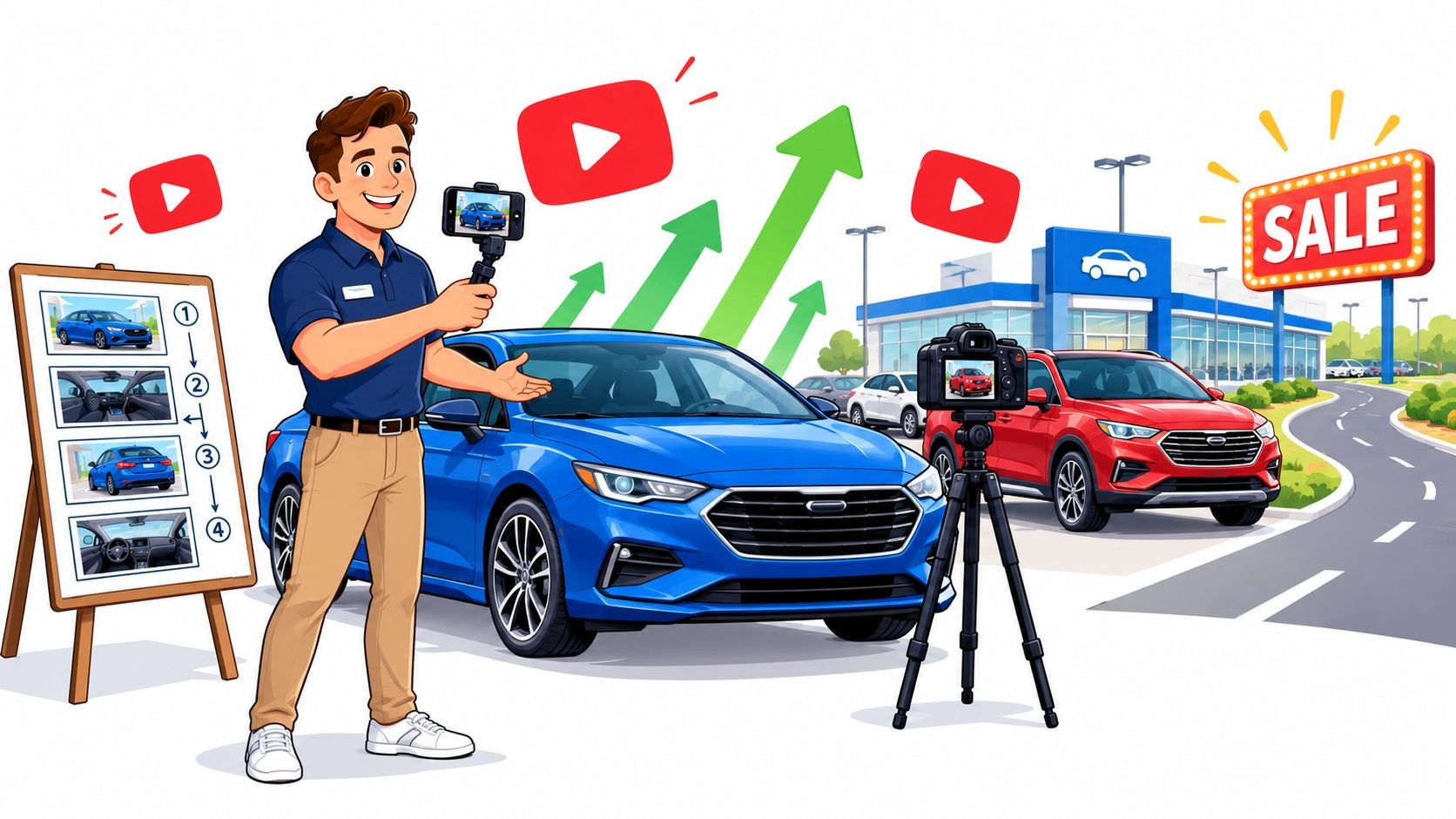
Car dealer video marketing means filming one store’s cars, people and service drive every week, and putting each clip where a shopper is already deciding: the vehicle listing, the reply to a lead, the service reminder, the social feed.
Most dealership briefs that reach Moonb, the studio I founded, ask for a launch film. It’s the fun one. The stores that sell more from video want something duller and harder: a walkaround on every new arrival within a day of it hitting the lot, a 40-second reply to every internet lead, and a price on screen that matches the listing to the dollar. This guide is the weekly grind. TV spots, brand films and the famous car ads live in our automotive video advertising guide.
Why dealership video is now part of inventory work
Shoppers show up less decided than they used to. Cox Automotive’s 2025 Car Buyer Journey Study surveyed 2,300 people who had bought a new or used vehicle in the previous 12 months, and 71% of them went in unsure which vehicle they would buy. They visited 4.6 websites on average (75% used third-party sites, 59% dealership sites, 26% social media). Only 7% bought entirely online, and 63% said the ideal process mixes online and in-person steps.
So a dealer video has two jobs: help an undecided person compare one unit against another on a listing site, then give them a reason to come and see it. Google’s Dealer Guidebook, built on shopper research from 2015 to 2017, reported that more than 40% of shoppers who watched a video about cars or trucks visited a dealer as a result.
I’d run the lot as the content calendar. A car arrives, it gets a walkaround. A lead comes in, it gets a reply video about that exact unit. When the service desk hears the same question five times, somebody films the answer once. Anything that doesn’t help a shopper with a specific car goes to the bottom of the pile.
The video types a dealership needs
Five formats do almost all the work.
Walkarounds are the backbone, and the first thing I’d fix if a store’s video were a mess. They show condition, trim and features, plus what a photo set can’t: how the car looks as someone moves around it. On a used car the shopper is judging this exact vehicle, scratches and all.
Personalized lead videos are short replies the salesperson or BDC agent records for one shopper. Their name, the unit they asked about, a walk over to the detail they mentioned in the form, one next step. A minute to record, and they tell the lead a real person at this store will look after them.
Service explainers cover what people would rather not ask at the counter, like what a warning light means or what a brake service includes. They stay useful for years. Per minute of footage, I think they’re the best value on this list.
Staff introductions put a face on the store before anyone visits: the salesperson who’ll hand over the keys, the service advisor, the finance manager. Our guide to employee testimonial videos goes through the interview side.
Film customer testimonials at delivery, while the buyer is happy and still on the lot, and keep them short. Our roundup of testimonial video examples helps with structure.
Test-drive clips and event coverage (a launch weekend, a charity drive on the lot) are seasonal extras. The five above are weekly.
New makes are where the routine bends. When a brand with an unusual pitch lands on your lot, the walkaround is the first place a local shopper sees how the thing works, so script that one more carefully than the rest. Some newcomers skip the lot altogether: ELECTE’s write-up of Slate Auto’s marketing says its modular pickup that converts into an SUV will be sold through direct online sales.
Who makes what, and where it goes
I’d pin this in the BDC office. Most dealer video programs stall on these four questions before anything gets filmed.
| Video type | Who shoots it | Phone or crew | Where it runs | When to make it |
|---|---|---|---|---|
| Walkaround | Lot porter or a trained salesperson | Phone on a gimbal | Vehicle listing, third-party listing sites, YouTube | Within a day of the unit arriving |
| Personalized lead video | The assigned salesperson or BDC agent | Phone, handheld | Email or text reply to that lead | Same day as the lead |
| Service explainer | Service advisor or technician, with marketing | Phone, with a lav mic | Service pages, reminder emails, YouTube | When a question repeats at the counter |
| Staff introduction | Marketing manager | Phone on a tripod, or a crew for a batch day | About page, salesperson profiles, lead replies | Hire date, then refreshed yearly |
| Customer testimonial | Salesperson at delivery, marketing for longer cuts | Phone at delivery, crew for a campaign | Social, reviews page, paid retargeting | At delivery, with a signed release |
| Brand or launch spot | Outside crew | Crew | Paid social, YouTube ads, local TV | Model launch or a new store opening |
What to shoot on a phone and what needs a crew
Phones should carry most of the volume. A current phone on a gimbal, a clip-on light and a wireless lav mic will handle walkarounds, lead replies, staff intros and service tips. Polish matters less than speed here. A walkaround that goes live after the car has sold helps nobody.
Pay for a crew on work that runs for months in front of people who have never heard of you: the store brand film, a model launch spot, a batch day of staff introductions shot in one afternoon, a testimonial series for paid social. If there’s media money behind a clip, I want the stronger setup behind it too.
For walkarounds, give everyone the same shot order so units are easy to compare:
- Front three-quarter exterior.
- Driver-side profile, then the rear.
- Wheels and tires, and any marks worth showing on a used unit.
- Driver seat, dashboard and odometer.
- Infotainment and driver-assist features.
- Rear seats and cargo area.
- A closing card with the stock number, the price that matches the listing, and how to book a test drive.
For gear and release forms, start from our video production checklist.
Keep the lot footage consistent
Shoppers compare your listings side by side, so every walkaround should look like it came from the same store. Film in one or two spots on the lot with a clean background, at the same time of day. Lock exposure and white balance on the phone, or a silver car turns champagne in the next clip (this one drives me mad). Same opening frame, same end card, and a thumbnail that is one clear three-quarter shot of the car with nothing else in it.
Name files by store, stock number, video type and date, so pulling every clip for a sold car takes a minute.
A weekly workflow that keeps up with inventory
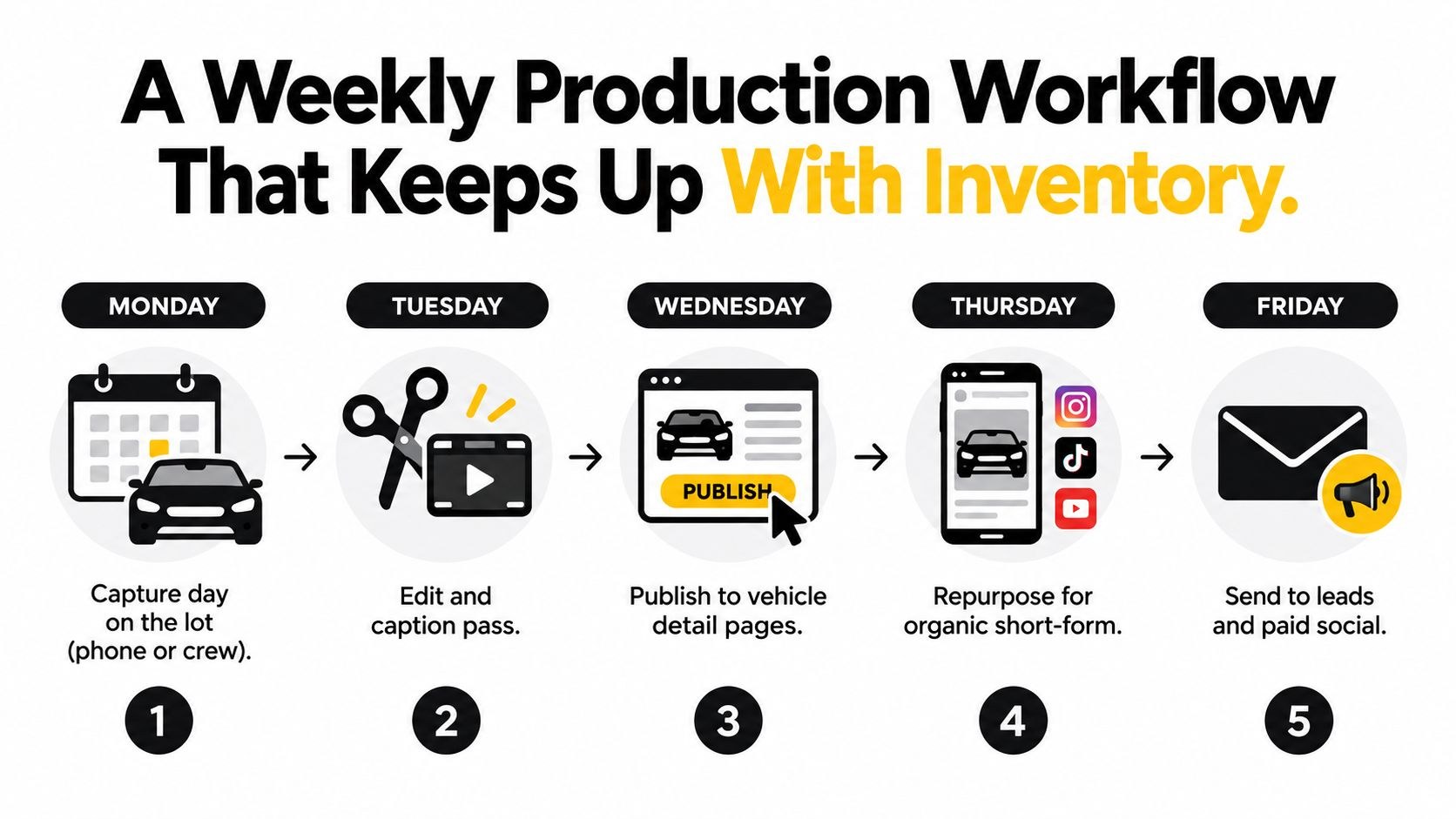
Monday is capture: the new arrivals’ walkarounds, plus one service explainer or staff intro while people are on site.
Tuesday goes to the edit: trim the walkarounds, add the end card, burn in captions so each clip works on mute, and check every on-screen price against the listing. I wouldn’t let anyone skip that last check.
On Wednesday the full walkaround goes on the vehicle detail page and the third-party listings, and the salesperson and BDC get the link so their lead replies point to the exact unit. Thursday, cut the strongest 15 to 30 seconds of the week into vertical clips; in a light week, a service tip or a staff intro fills the gap.
Friday is for leads, paid social and review. The week’s best clips go into paid retargeting. Then check which units got views and replies, pull anything tied to a sold car, and build Monday’s capture list.
Where each video runs and how to cut it
A vehicle listing gets the full walkaround in landscape, price card at the end. A lead reply needs the shopper’s name in the first seconds, the exact unit and one clear next step. Organic short-form needs the car on screen immediately; paid social needs that plus a separate link per campaign, so you can see what happened after the view.
For Reels, Shorts and TikTok, cut a proper vertical version instead of cropping the landscape master. Our vertical video dimensions guide has the exact sizes and safe zones. Trendy’s breakdown of different video formats goes through Reels, TikTok, Shorts, Stories and vertical live one by one, and lands where I do: keep the master, then cut a version for each platform.
Prospecting and retargeting cuts do different jobs. A prospecting cut introduces the store, the model or the service problem. A retargeting cut answers whatever the shopper wondered after looking at a listing: what the cargo space looks like, whether the price is real, who they’ll meet.
Pricing and disclosure rules for dealer video
This is the part that gets stores in trouble, and in 2026 the FTC got a lot more specific about it.
Start with the CARS Rule, which is not in force. The FTC published it in January 2024, the Fifth Circuit vacated it on January 27, 2025, and the FTC formally withdrew it in a Federal Register notice on February 12, 2026. None of that loosened anything that matters for your videos, because the FTC Act itself still bans deceptive pricing. In March 2026 the FTC sent warning letters to 97 auto dealership groups, and in September 2026 its staff published pricing transparency FAQs for the auto industry. They’re staff views and not binding. I’d still read them as the agency telling you how it reads a dealer ad.
Six points in them apply directly to video.
- The advertised price has to be a price any consumer can walk in and pay. Only charges the government requires the consumer to pay can be left out. In the FAQs’ example, a $40,000 car with a required $85 document fee must be advertised at $40,085.
- The FAQs name websites, social media, print, roadside signs, and phone calls and text messages with dealership staff. So a price a salesperson says in a lead reply video counts.
- On listing pages, the actual price must be the most prominent amount. You can still show the MSRP, or a discount for some buyers (the FAQs use a $1,000 first-responder discount), as long as the walk-in price stays the most prominent figure and the terms of the discount are clear.
- A car in transit or stored offsite can be advertised, but the ad must plainly say it is not on the lot. Advertising a car that is no longer available to draw people in is deceptive.
- The FAQs talk about photos, and I’d hold footage to the same test. A representative photo is allowed when it matches the car for sale in make, model, condition and every other material way, and a shopper would understand it’s illustrative. For used cars, they say it’s reasonable for shoppers to expect the photo to show the exact car offered for sale. So never reuse a walkaround from a similar used unit.
- Everyone with control over the ad is responsible, third-party advertisers included, and the FAQs tell dealers to give those third parties the actual price. Hand it to your editors too, and check it before anything goes live.
Lease and finance terms have their own rules. The FAQs note that the FTC Act does not change a dealer’s obligations under the Consumer Leasing Act and Regulation M or the Truth in Lending Act and Regulation Z, so a monthly payment on screen needs the disclosures those rules require. Payment-led videos go past the store’s compliance person first.
I’d play the FTC’s own consumer video on spotting deceptive car ads at a sales meeting. It’s from 2016 and made for shoppers, and the ad lines it puts on screen (a guaranteed $2,000 for your trade-in, over $5,200 in rebates, 0% APR for six years) are the kind your own ads need to back up:
Testimonials and staff videos fall under the FTC’s Endorsement Guides. The FTC’s answers to common endorsement questions say that when an endorser is an employee or a relative of the business, the ad is misleading unless that connection is made clear. A salesperson praising the store’s service department in a “customer” style clip is exactly that case. The page also says an incentive with no cash value, such as the chance to appear in an ad, can need a disclosure. Paying a customer for a testimonial, in cash or in free service, usually needs one too.
Placement counts as well. Per the same FTC page, a disclosure in the YouTube description is not enough on its own, it has the best chance of being clear when it’s in the video itself, and an endorsement made both on screen and out loud should be disclosed both ways. LegesGPT’s guide to FTC disclosure rules for influencers covers wording and placement per format, and it applies just as well when the “influencer” is your own customer or a local creator you paid to review the store.
Local TV picked up the pricing push too. FOX59 News posted this segment on the warning to dealers ten days after the FTC announced the letters:
Measuring what the videos do
Views alone tell you little. I care about two things: whether a unit with a walkaround moves differently from one without, and whether leads that got a video reply book more appointments than leads that only got a text.
Test both for a month. Split similar units, with and without walkarounds, and compare listing page time, calls, form submissions and days on lot. Do the same with lead replies. Keep price and salesperson as steady as you can so the video is the main thing that changed.
Once the store has a gimbal, a light and a mic, phone-shot walkarounds cost little beyond staff time. A crew day makes sense for a brand film or a testimonial batch that will run in paid media for months. If you bring in an outside team, agree on the output per week before the first shoot. Our video marketing ROI guide has the full method.
A 30-day starting plan
Starting from nothing, I’d run it in this order.
| Week | What to film | Where it goes | What to check on Friday |
|---|---|---|---|
| 1 | Walkarounds for the 10 units you most need to move, plus one staff intro | Vehicle listings and third-party listing sites | Every on-screen price matches the listing, files named by stock number |
| 2 | Vertical cuts of the best walkarounds, two service explainers | Reels, Shorts, TikTok, service pages | Which clips got watched past the first few seconds |
| 3 | Personalized replies for every new internet lead | Email and text replies | Reply and appointment rates against leads without a video |
| 4 | Testimonials at delivery, a retargeting cut of the top walkaround | Paid social, reviews page | Sold-car clips pulled, signed releases on file, keep or cut each format |
By the end of the month you’ll know which of the five formats your store can keep up, and which were wishful thinking.
Frequently asked questions
I aim for one to two minutes on the listing, with a fixed shot order. That full version belongs on the vehicle detail page, where the shopper is already comparing; social gets its own 15 to 30 second vertical cut. When a walkaround runs long, the shot list is normally the problem, because rambling commentary is what stretches it.
For new units, possibly. The FTC's 2026 pricing FAQs allow a representative photo when it matches the car for sale in make, model, condition and every other material characteristic, and a reasonable shopper would understand it's illustrative; I'd hold reused footage to that same test. Used cars are a different story: the FAQs say shoppers can reasonably expect the photo to show the exact car offered for sale, so each used unit gets its own footage. And if a car is in transit or stored offsite, the ad has to say plainly that it is not on the lot.
Yes. The FTC's auto pricing FAQs put phone calls and text messages with dealership staff on the same list as websites and social media, and say every one of those touchpoints is subject to the FTC Act, so a price a salesperson says in a reply video is covered. Quote the same all-in price as the listing, dealer-required fees included, and leave out only charges the government requires the buyer to pay.


