The 16 Best SaaS Video Ads, and the One Device Each of Them Runs On
Sixteen SaaS video ads from the brands' own channels, 2015 to 2026, each broken down to the single device that makes it work and what a marketing team can borrow from it.

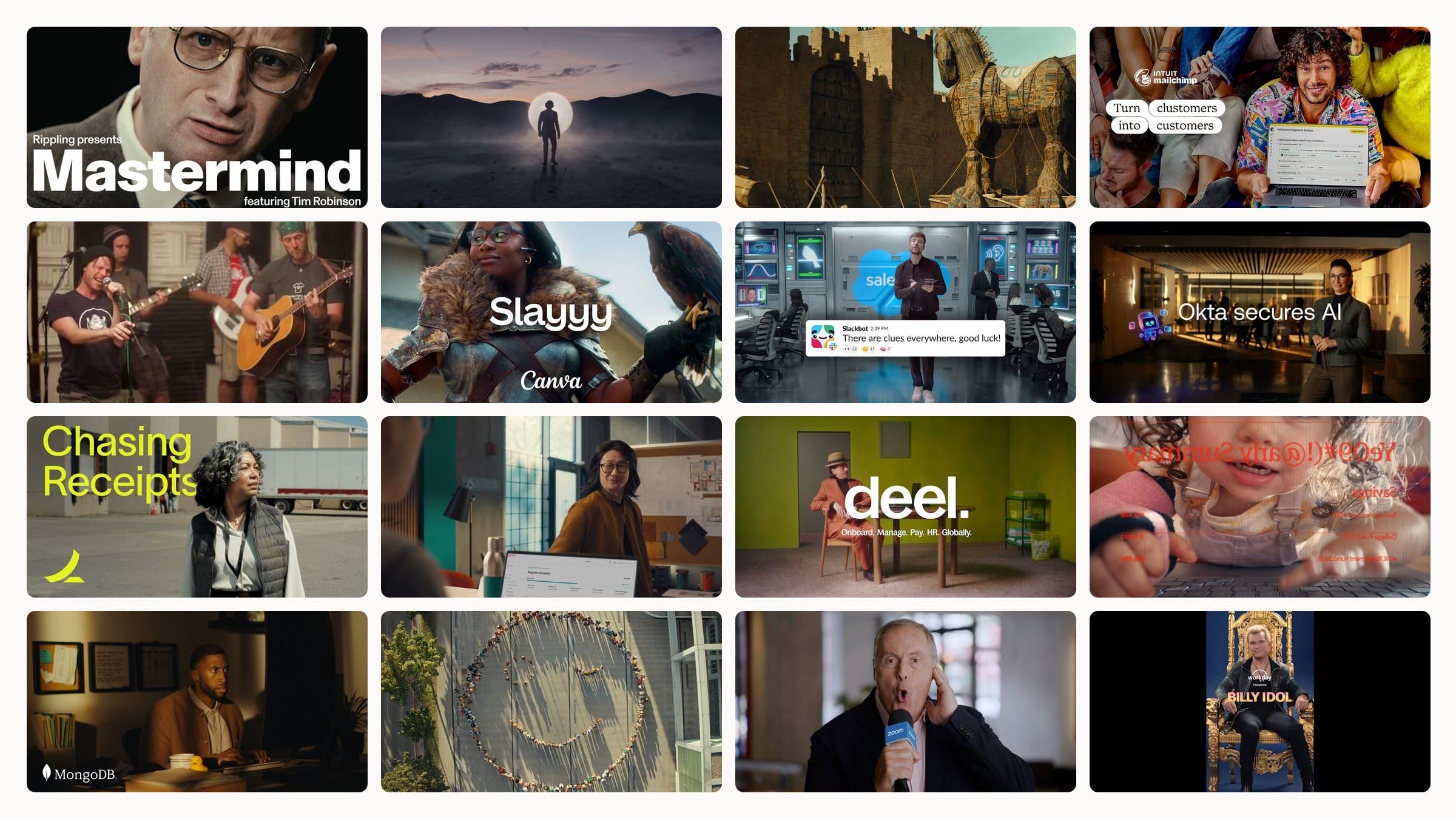
The best SaaS video ads are not the funniest or the most expensive. They are the ones built on a single device you can name in a sentence: a Trojan horse that gets scanned, a made-up word for a marketing problem, a fake band that owns a search phrase, a monster that cannot attack a city because it was never onboarded. Sixteen of those are below, all pulled from the brands’ own YouTube channels, dated from 2015 to this year’s Super Bowl, with the device, the goal and the one thing worth borrowing for each.
I work at Moonb, where we make video for marketing teams, and I picked these the way we brief our own work: what is the one idea, and does the product earn its place in it? Every claim about how a spot was made comes from the brand’s own video description or from named trade coverage, and where a detail is not published I say so. None of these were made by us, and I have no relationship with any of the brands.
What separates a good SaaS ad from an expensive one
Software is abstract. A CRM does not look like anything, and “AI agents” look like even less. So the ads that work translate the product into a scene that already exists in the viewer’s head: a first day at work, an expense report, a returns desk after Christmas. The ones that fail describe features over stock footage of people smiling at laptops. Read the sixteen with that in mind, and notice how often the device is a single word or a single object.
To find your own device: if the product is abstract, cast it as a person, the way Okta uses a new hire and Rippling a monster. If the pain is a recurring ritual, dramatise it, the way Ramp stages the receipt chase and Adobe the rescued report. If you are fighting a category leader, own the comparison search, the way Zendesk built a band named after the alternative. And if the brand is changing, keep the old joke and change the opponent, the way Workday did.
The 16 best SaaS video ads
1. Rippling: “The Mastermind” (2026)
Rippling’s first Super Bowl ad puts Tim Robinson in a villain’s boardroom with a plan to drop a monster called Baby Breck on a city. The plan fails because Breck was never onboarded, was never issued a laptop, and his harness is stuck in finance. The payoff line, “Don’t let bad software ruin your plans,” lands because every gag is a real HR, IT or finance failure wearing a cape. Follow-up cuts for the IT and Global Payroll product lines are on the same channel, per the video descriptions and Business Wire’s launch release.
- Category: HR, IT and payroll
- Length: 30 seconds
- The device: an evil plan defeated by admin
- Worth borrowing: list your product’s three dullest jobs, then write a scene where failing at them has absurd stakes
2. Squarespace: “The Singularity” (2023)
One recursive joke, carried entirely by Adam Driver: Squarespace is “a website that makes websites.” The spot runs the idea to its end and then keeps going on a matching microsite, so the gag does not stop when the 37 seconds do. It is the cleanest example on this list of a product truth becoming the whole concept.
- Category: website builder
- Length: 37 seconds
- The device: a recursive product truth
- Worth borrowing: the campaign landing page continues the joke rather than switching to a sales tone
3. CrowdStrike: “Troy” (2023)
CrowdStrike re-stages the Trojan Horse. One guard wants to open the gate; the other calls CrowdStrike to scan it; the horse is found unsafe and rolled off a cliff. The line “Not all adversaries are so easy to recognize” turns the company’s “adversary-focused” positioning into a story a hundred million people already know. Adweek and AWN credit Framestore, RadicalMedia and Union on the production, and it was the company’s first Super Bowl ad.
- Category: cybersecurity
- Length: 30 seconds
- The device: a myth everyone knows, with the product as the twist
- Worth borrowing: borrow a story with a known ending and change the ending
4. Intuit Mailchimp: “Turn Clustomers into Customers” (2023)
Mailchimp invents a word, the “Clustomer,” and shows it: a tangled blob of undifferentiated customers that untangles as segmentation kicks in. Naming the problem is the whole trick, because once you have seen a Clustomer you cannot unsee one in your own database. The newsroom release credits Mailchimp’s in-house agency Wink Creative and director Calmatic, and the campaign launched in September 2023 to move the brand upmarket.
- Category: email and marketing automation
- Length: 30 seconds
- The device: a coined word for the pain, visualised
- Worth borrowing: name the problem before you name the feature
5. Zendesk: “Zendesk Alternative” (2015 upload)
Zendesk built a fictional Seattle band literally named Zendesk Alternative, with its own website, band pages and merch, so that the brand owns the competitor search phrase “Zendesk alternative” with a three-minute mockumentary instead of a comparison page. It has been written up on Hacker News and in several marketing case studies, and it is still the smartest answer to “alternatives” search intent I have seen from a software company. The original campaign year is not confirmed in the sources I checked; the channel upload is from 2015.
- Category: customer service software
- Length: 3 minutes 13 seconds
- The device: own a search phrase with a piece of entertainment
- Worth borrowing: look at the searches your competitors’ customers make and answer one with a story
6. Canva: “Slayyy” (2026)
One small-business character, Barb the realtor, and one unglamorous hero object, her flat open-house signs. The product fixes the signs, and the spot never widens beyond that. It has 24.8 million views on Canva’s own upload, which for a 30-second small-business ad tells you how far a single specific character travels.
- Category: design and marketing tools
- Length: 30 seconds
- The device: one named customer, one boring object, one fix
- Worth borrowing: pick the least glamorous thing your product improves and make it the star
7. Salesforce: “MrBeast’s Vault” (2026)
The Super Bowl 60 spot is itself a game: it launches MrBeast’s “$1 Million Dollar Puzzle,” hides clues inside the ad, and tells viewers to watch in full and register on a Salesforce landing page, with Slack shown as the tool the pros use. Awareness ads rarely produce a measurable action; this one was built to produce registrations. A companion piece on the same channel, “MrBeast’s Secret Slack Communication System,” runs the stunt from the Pyramids and six feet underground.
- Category: CRM and collaboration
- Length: 32 seconds
- The device: the ad is the first level of a game
- Worth borrowing: give a brand spot a job it can be measured on
8. Okta: “AI’s First Day” (2025)
“Identity for AI agents” is close to impossible to picture. Okta pictures it as a new hire on day one: the agent needs access to do its job, and it needs guardrails, so the abstract product becomes an onboarding scene everyone has lived through. For an enterprise security spot, eight million views on the brand upload is a lot, and the onboarding metaphor is why.
- Category: identity and security
- Length: 30 seconds
- The device: an abstract product as a familiar workplace moment
- Worth borrowing: when the product is invisible, cast it as a person
9. Ramp: “Chasing Receipts” (2025)
Ramp turns the end-of-month receipt chase into the entire story, and it has 19.8 million views on the brand’s own upload. Its companion 15-second spot, “Expenses Should Do Themselves,” casts Saquon Barkley’s “toughest opponent to date” as manual expense reports. Both work because every finance team has a version of the scene in its own calendar.
- Category: spend management
- Length: 30 seconds
- The device: a recurring monthly ritual, dramatised
- Worth borrowing: find the thing your users dread on a schedule
10. Gusto: “Stop Pulling Your Hair Out” (2025)
Part of the four-spot “A Future With Gusto” series shot by Epoch Films in 2025, per Ads of the World, each showing a business owner before and after Gusto as an exaggerated version of themselves. The format is repeatable, which is the point: four spots, one structure, one joke per pain. This one has 4.7 million views on the brand upload; a sibling, “Cooler Than a Guy in a Leather Jacket,” is on the same channel.
- Category: payroll and HR for small business
- Length: 30 seconds
- The device: a before-and-after with the “before” turned up to eleven
- Worth borrowing: build a format you can shoot four times, not a one-off
11. Deel: “Deel makes global HR actually fine” (2024)
The title riffs on the “This is fine” meme, and the spot frames payroll, hiring and HR admin across countries as fires to put out with one platform. Meme references date fast; this one survives because the fires are literal and specific. It has 6.2 million views on Deel’s channel.
- Category: global HR and payroll
- Length: 30 seconds
- The device: a meme made literal
- Worth borrowing: if you borrow internet culture, make the product the resolution, not the punchline
12. Adobe Acrobat: “Baby Proof” (2022)
A financial advisor rescues a client report from his toddler by fixing it, converting it to PDF, password-protecting it and sharing it. Four product features become four plot beats, in order, without a single feature name on screen. A document tool does not usually pull ten and a half million views; the toddler and the rescued report do.
- Category: documents
- Length: 30 seconds
- The device: features as plot beats
- Worth borrowing: write the feature list as a sequence of things going wrong, then right
13. MongoDB: “The Source” (2023)
MongoDB’s first fully animated brand campaign, built on a visual language of infinite data and the line “Behind every piece of technology… one common source,” meaning developers. It launched around MongoDB.local NYC in 2023, per the company’s blog. Developer tools rarely run brand campaigns at all; this one works because it flatters the buyer instead of describing the database.
- Category: developer tools
- Length: 30 seconds
- The device: an animated love letter to the user
- Worth borrowing: for a technical audience, make the audience the hero and keep the product implicit
14. Atlassian: “Impossible Alone” (2023)
Atlassian’s first brand-level campaign, per The Drum in April 2023, strings together team feats “from pizza delivery to space missions” as things that are impossible alone. It never shows Jira. That restraint is the lesson: a company known for product ads bought sixty seconds to say what it believes, and let the products stay in the product pages.
- Category: collaboration and developer tools
- Length: 60 seconds
- The device: a belief statement built from other people’s achievements
- Worth borrowing: separate the brand film from the demo and let each do one job
15. Zoom: “More than Zoom” (2023)
Zoom casts soccer announcer Andrés Cantor so that “goals” becomes his trademark “gooooooals,” and uses the gag to list Team Chat, Phone and AI Companion. It is a repositioning ad: the company that became a verb for meetings needed people to know it sells a platform. Six million views on the brand upload.
- Category: collaboration
- Length: 57 seconds
- The device: a celebrity’s signature line repurposed as the product list
- Worth borrowing: when you need to widen what people think you sell, hire a voice that makes a list feel like a performance
16. Workday: “What’s Cooler: Billy Idol or AI?” (2025)
A celebrity-versus-product gag that extends Workday’s long-running rock-star platform into its AI-agents pitch. It is on the list for the discipline of continuity: rather than resetting the brand for the AI era, Workday kept the joke and gave it a new opponent. A companion cut, “Billy Idol vs. AI: The Showdown,” is on the same channel.
- Category: HR and finance
- Length: 30 seconds
- The device: the old brand platform versus the new product
- Worth borrowing: when the product changes, keep the brand’s joke and change the opponent
Patterns across all sixteen
- Eleven of the sixteen are thirty seconds or under. The device has to fit in one breath. Where a spot runs longer, Zendesk’s band or Atlassian’s film, it is because the device is a world rather than a gag.
- Eight translate the product into a scene from working life, a first day, an expense report, a report rescued from a toddler, a stack of open-house signs. That is the SaaS-specific move: make the invisible thing happen to a person.
- Five invent something to own, a word (Clustomer), a band, a game, a monster, a microsite. The invented thing outlives the media buy.
- The interface is rarely the star. In almost every spot the product appears to resolve the scene, not to be demonstrated, and the demo lives on the landing page instead.
If you are costing your own spot, the guide to what a commercial costs to make covers the production side, and the wider commercial advertisement examples roundup puts consumer brands beside these. For the platform-specific version, my colleague’s LinkedIn video ad examples piece looks at what works in a B2B feed, and if a demo rather than a brand spot is the brief, the product demo video companies guide is the right next read.
Every ad in one table
| # | Brand | Ad | Year | Length | The device |
|---|---|---|---|---|---|
| 1 | Rippling | The Mastermind | 2026 | 0:30 | An evil plan defeated by admin |
| 2 | Squarespace | The Singularity | 2023 | 0:37 | A recursive product truth |
| 3 | CrowdStrike | Troy | 2023 | 0:30 | A known myth with a new ending |
| 4 | Intuit Mailchimp | Turn Clustomers into Customers | 2023 | 0:30 | A coined word, visualised |
| 5 | Zendesk | Zendesk Alternative | 2015 upload | 3:13 | A fake band that owns a search phrase |
| 6 | Canva | Slayyy | 2026 | 0:30 | One customer, one boring object |
| 7 | Salesforce | MrBeast's Vault | 2026 | 0:32 | The ad as level one of a game |
| 8 | Okta | AI's First Day | 2025 | 0:30 | An abstract product as a new hire |
| 9 | Ramp | Chasing Receipts | 2025 | 0:30 | A monthly ritual, dramatised |
| 10 | Gusto | Stop Pulling Your Hair Out | 2025 | 0:30 | Exaggerated before-and-after |
| 11 | Deel | Global HR actually fine | 2024 | 0:30 | A meme made literal |
| 12 | Adobe Acrobat | Baby Proof | 2022 | 0:30 | Features as plot beats |
| 13 | MongoDB | The Source | 2023 | 0:30 | An animated love letter to developers |
| 14 | Atlassian | Impossible Alone | 2023 | 1:00 | A belief statement, no product |
| 15 | Zoom | More than Zoom | 2023 | 0:57 | A signature line as the product list |
| 16 | Workday | Billy Idol or AI? | 2025 | 0:30 | Old brand platform vs new product |
Frequently asked questions
Most of the spots on this list run 30 seconds or less, because a single device fits in one breath and the media they were made for sells 15 and 30 second slots. Go longer only when the idea is a world rather than a gag, the way Zendesk's band or Atlassian's film are, and cut a 15 and a 6 from the master regardless.
Five of the sixteen lean on one, eleven do not, and the strongest devices, the Clustomer, the Trojan horse, the monster that was never onboarded, would work with unknown actors. A celebrity buys attention in a Super Bowl window. The device is what people remember the week after.
The same device works at any budget. YouTube pre-roll and LinkedIn feed placements reward the first three seconds, so open on the scene, not the logo. Gusto shipped four spots on one structure, and Ramp cut a fifteen and a thirty from the same idea; that pattern, one idea in several lengths, is the practical template for a mid-size budget.