Case study template.
Eight fields for a customer story buyers will trust, from the interview to the customer's sign-off. Type straight into the PDF, or use the Word file.
Free, no sign-up, no email.
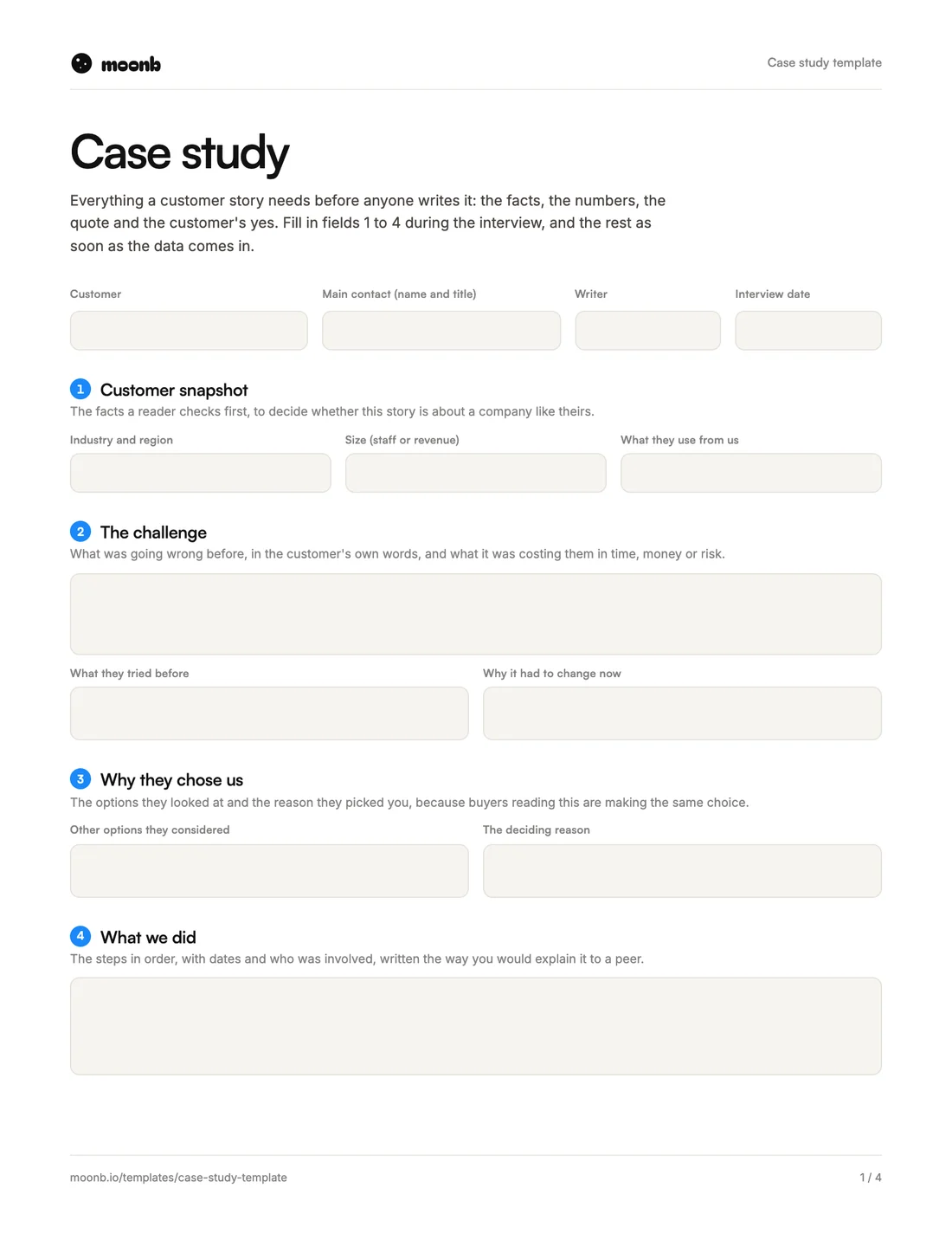
- Page 1
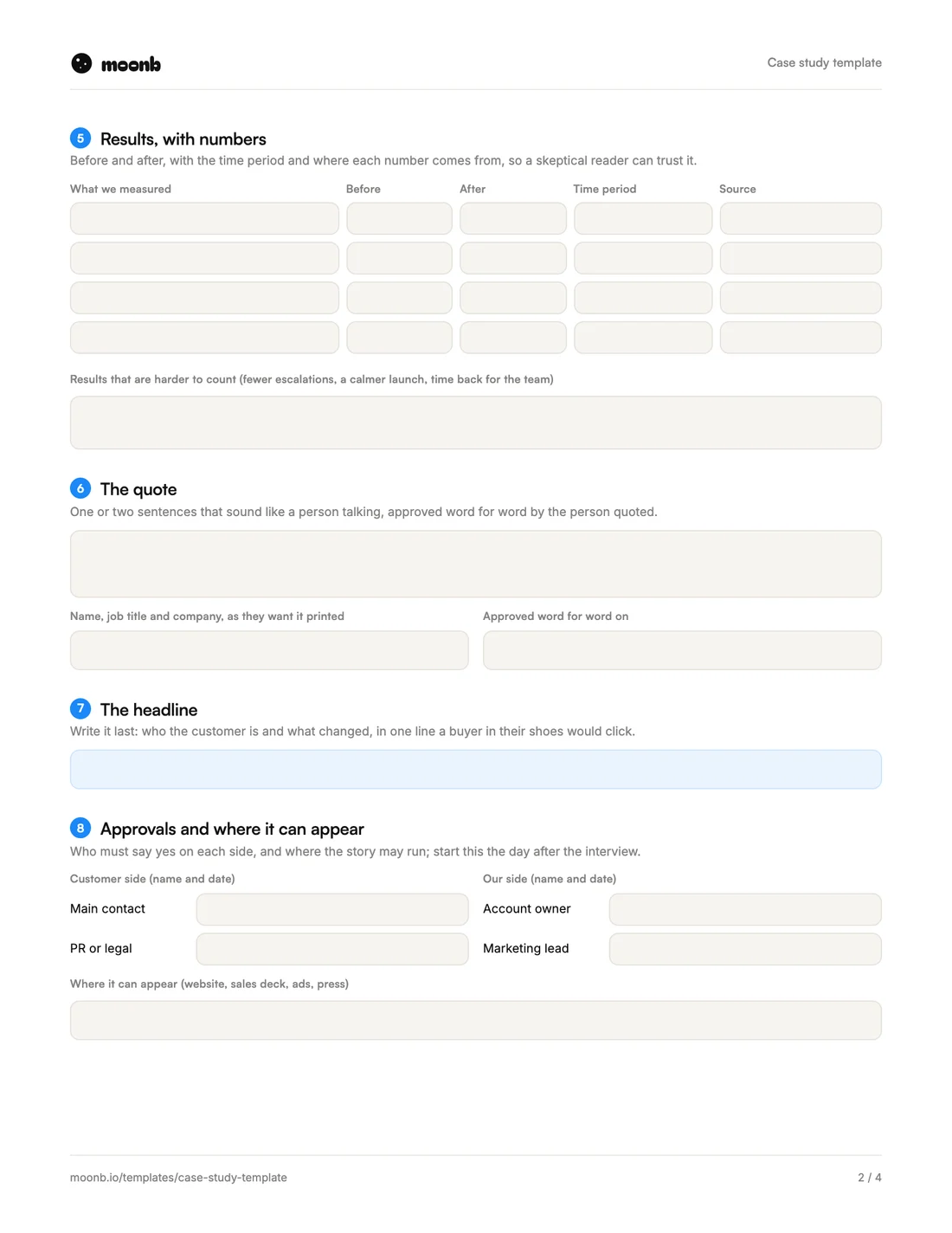 Page 2
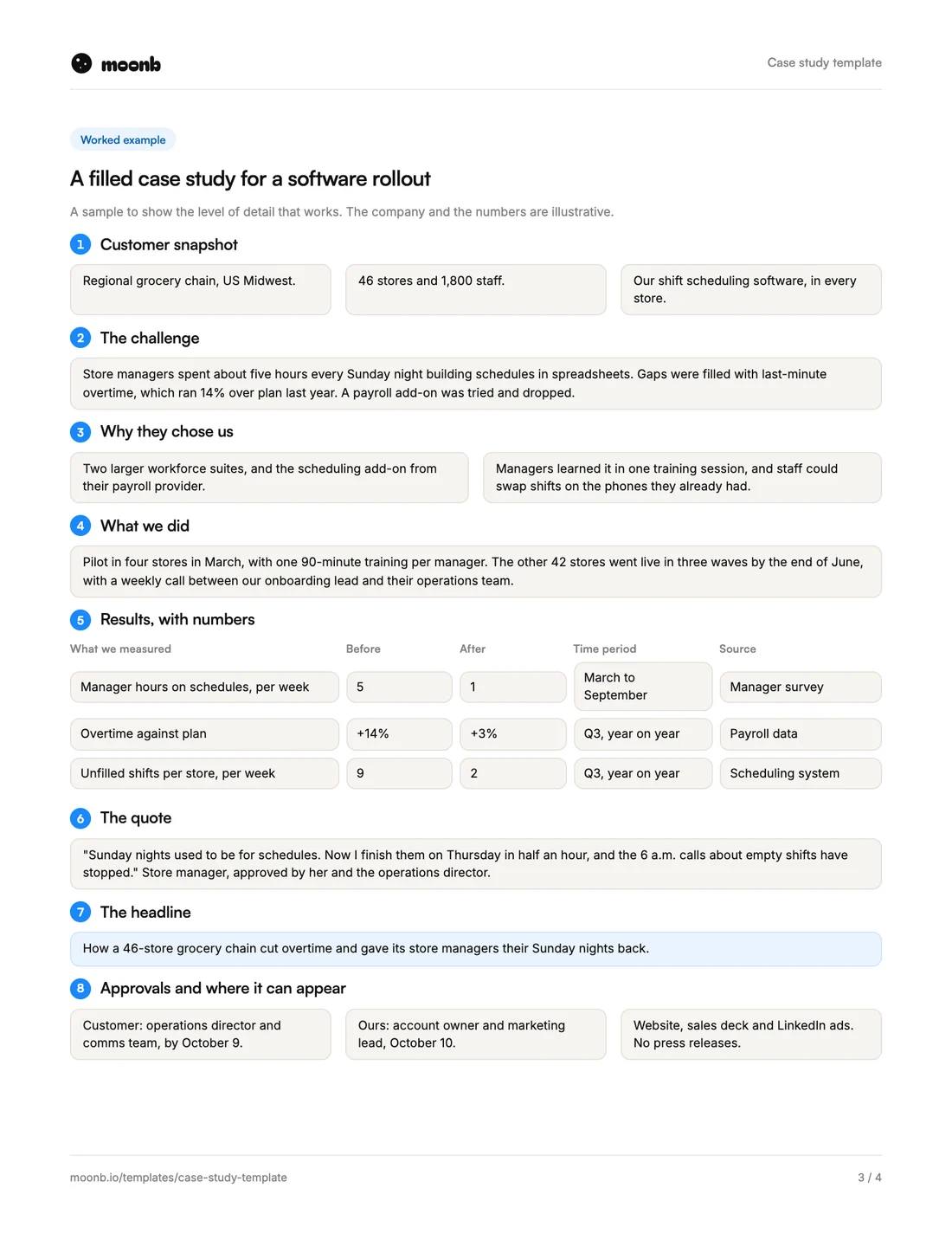 Page 3
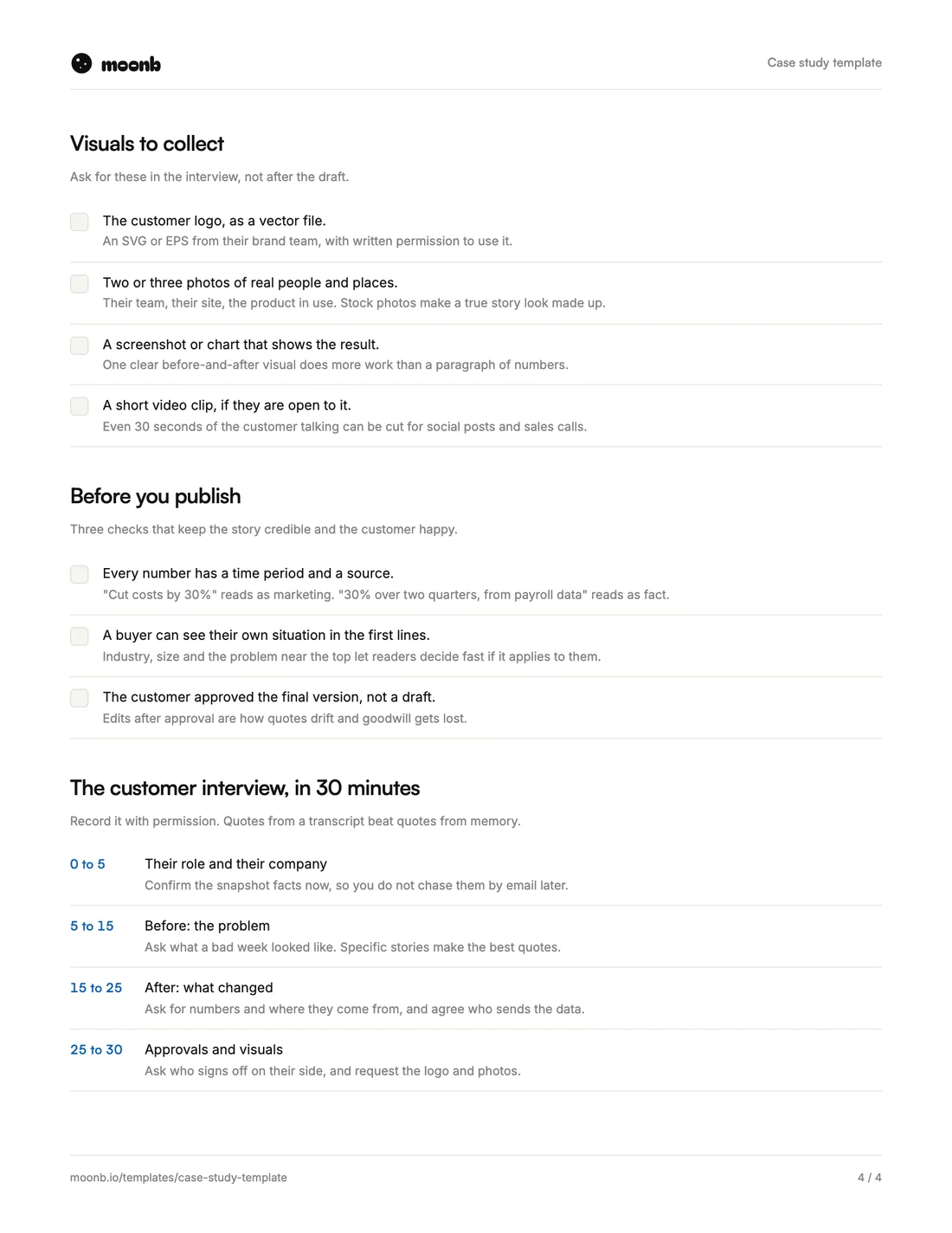 Page 4
A case study is a customer’s story about a problem you helped fix, told with numbers they’re happy to see in print. Buyers read them to answer one question: did this work for a company like mine?
This template collects everything the story needs before anyone starts writing. It has eight fields, a filled-in example on page three, and a last page with the visuals to ask for, three checks before you publish, and a 30-minute interview plan.
What is in it
| Field | What goes in it | The usual mistake |
|---|---|---|
| 1. Customer snapshot | Industry, region, size, what they use | Leaving out size, so readers can’t compare |
| 2. The challenge | What was wrong, what it cost, what they tried | Your sales pitch instead of their problem |
| 3. Why they chose you | The other options and the deciding reason | Skipping it because it feels awkward to ask |
| 4. What you did | The steps, with dates and people | A list of features |
| 5. Results | Before, after, time period and source | “Improved efficiency” with no number |
| 6. The quote | One or two lines, approved word for word | A quote that sounds like a press release |
| 7. The headline | The customer and the result, in one line | “Company X partners with Company Y” |
| 8. Approvals | Who signs off on both sides, where it can run | Asking after the design is done |
How to fill it in
- Interview first, write second. Fill in fields 1 to 4 on a 30-minute call with the customer. The agenda is on page four.
- The challenge. Use their words. Ask what a bad week looked like, and what it cost them in hours, money or risk.
- Why they chose you. Ask what else they looked at. Buyers reading the story are making the same choice right now.
- Results. Every number needs a before, an after, a time period and a source. If the customer can only share percentages, use percentages.
- The quote. Pick the line that sounds most like a person talking. Send it back and get it approved word for word.
- The headline. Write it last, once you know the result. Customer type plus outcome works: “How a 46-store grocery chain cut overtime.”
- Approvals. Start them the day after the interview, and ask where the story can appear: website, sales deck, ads, press.
Why it’s worth doing properly
Customer stories are some of the content B2B marketers rate highest. In the Content Marketing Institute’s B2B research for 2025, 53% of marketers named case studies and customer stories among their most effective content types, second only to video at 58%.
The two work well together, because one customer interview can feed both. Our list of testimonial video examples shows formats that start from exactly this kind of call. If you want the story on camera as well as on the page, Moonb makes testimonial videos with in-house marketing teams.
Frequently Asked Questions
Long enough to show the before, the after and the proof. For most stories that's one page, or 600 to 900 words. Write a three-line version too, with the headline result, for sales emails and decks.
Ask for percentages instead of totals, or for an everyday number like hours saved per week, which is rarely sensitive. If nothing can be shared, keep the story short and lean on a named quote. Without numbers it works better as a testimonial than as a case study.
Yes, in writing, and for each place it will appear. Some customer contracts limit how you can use their name or logo, so check the contract before you book the interview. Large companies usually route this through their communications or legal team, so ask early.
More free templates
Briefs, plans and production sheets, built the way we use them.
- PDF + WordBrand guidelines templateLogo, colors, type, voice and imagery rules, in one fillable document.
- PowerPoint + PDFPitch deck templateA twelve-slide deck that tells the story in the order buyers ask.
- PDF + WordCreative brief templateEight fields that turn a vague request into work you can sign off.
The templates are free. The team isn't.
Need the video, design or motion actually made? Tell us what you're working on.