15 scriptwriting services compared
I compared 15 scriptwriting services on their own sites: freelance marketplaces, script studios, video companies that write in house, and script software, with what each one charges and where it falls short.


Most scripts that reach me already have a problem baked in. Somebody squeezed the whole product deck into ninety seconds of narration, or the voiceover describes exactly what the picture already shows. I don’t blame the writers. It happens when one gets hired before anyone has decided what the video is for and who signs it off.
If you’re hiring, you’ll end up at a freelance marketplace (Freelancer.com, PeoplePerHour, Contra), a script and copy studio (VID, JaZzyMaE Media, Prose), a video production company that writes in house (Kicker, Cerebral Lounge, OpenLight Films, FUGO Studios), or, if your team writes its own, software (Final Draft, Celtx, Arc Studio, StudioBinder). The prices and turnaround times quoted below are what the providers’ sites said in November 2026. Entry one is Moonb, the creative team I run, which makes me the least neutral person on this page about it.
For a yardstick, the U.S. Department of Labor’s O*NET profile for writers and authors describes the job as preparing “written material, such as scripts, stories, advertisements,” and puts the 2025 median wage at $36.98 an hour, or $76,910 a year. Hold the quotes below up against that. And if you’d like to take a run at the script yourself first, my guide to writing a video script starts there.
My own team first
1. Moonb
How scripts reach us
What reaches us might be a finished draft or a recorded sales call somebody wants turned into a demo. We write from whatever we get, in the same workspace where the video is storyboarded and cut, so pacing and on-screen text get decided while the words are still easy to change. The turnaround and retention numbers are ours; the Clutch reviews are public.
Freelance marketplaces
Marketplaces are the quickest way to get a writer started, often by the next day, though sorting through profiles for a good one is your job. Upwork and Fiverr are left out because I couldn’t load their script pages this month; the three below show their prices and terms on their own pages.
2. Freelancer.com
Timelines and milestone payments
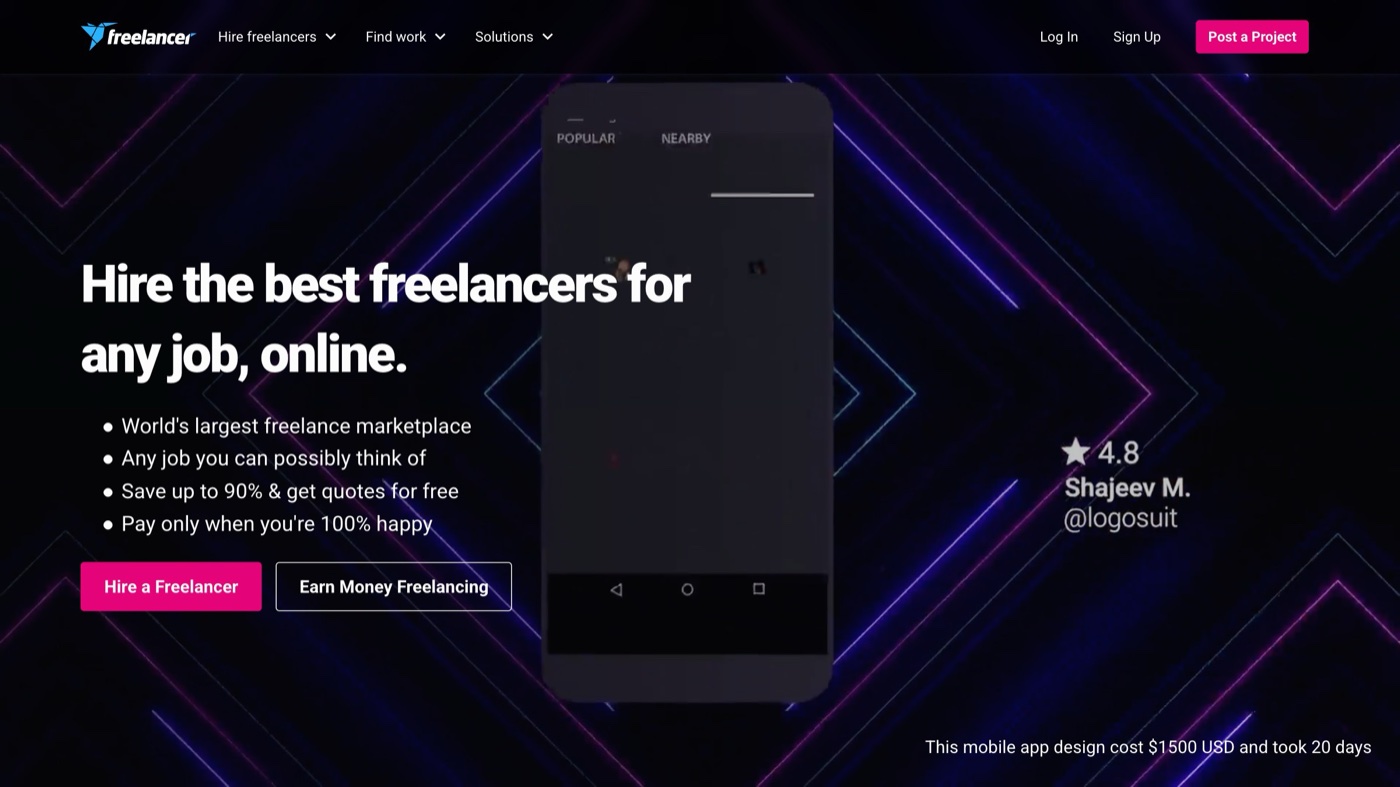
Freelancer.com's own hiring guide for this category says a short video or ad script can be drafted within a few days, while a feature screenplay or pilot typically takes several weeks. The same guide recommends tying milestone payments to the outline, the first draft, and the final delivery, so money only moves when a stage is approved. When you read a writer's client reviews, skip the star rating and look for anything said about revisions.
I’d use it for a one-off with a tight spec, and I’d pay three bidders to write the same 30 seconds so I could compare them side by side.
3. PeoplePerHour
Two ways to buy
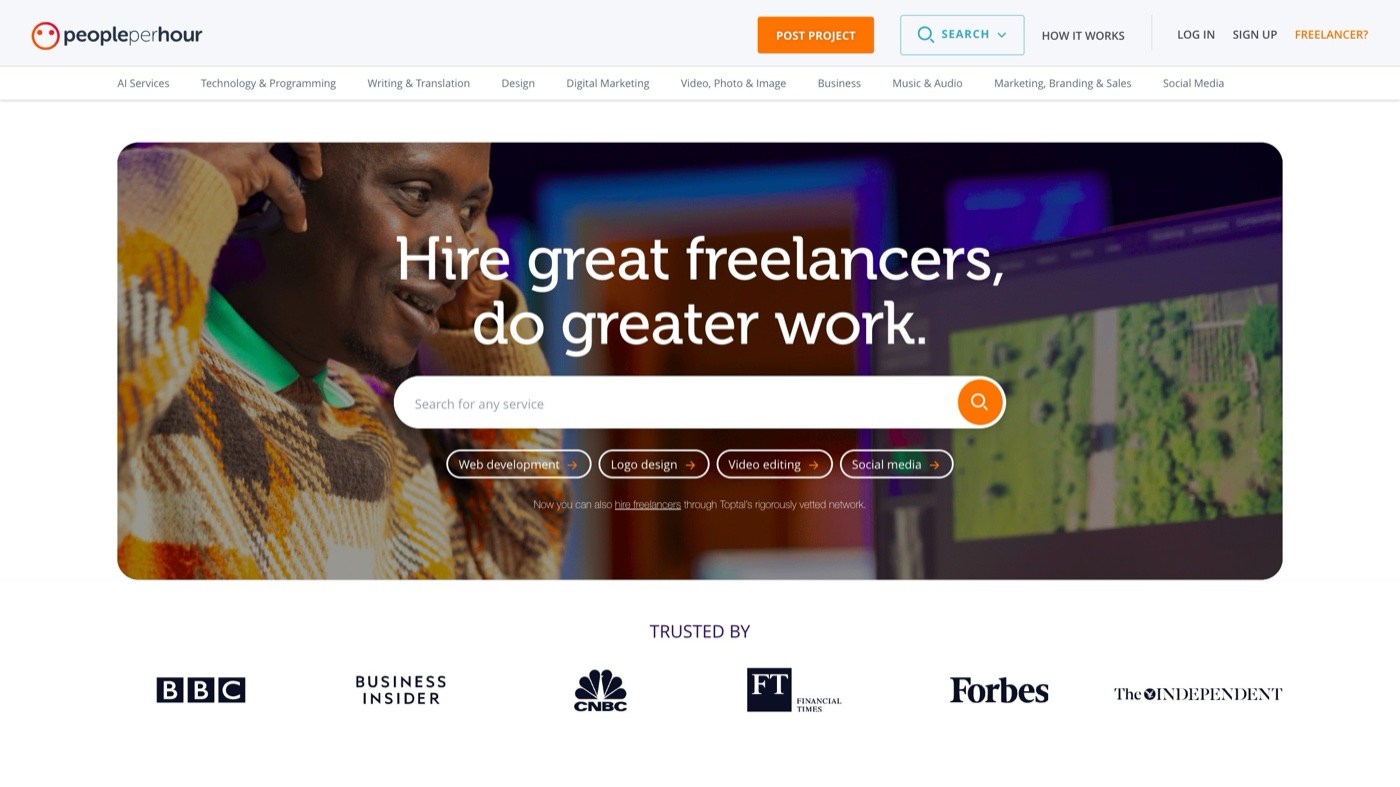
PeoplePerHour runs two routes side by side. Its own copy says you can complete work quickly and at a fixed price by buying a pre-packaged offer from a freelancer, or search freelancers and request a proposal. Other packages on the script page when I looked included two pages of a screenplay at $20 and a short film script at $585.
I wouldn’t put a $15 commercial script in front of a customer. As a rough draft you plan to rewrite anyway, fine. For anything with your logo on it, go the proposal route.
4. Contra
Its brief checklist
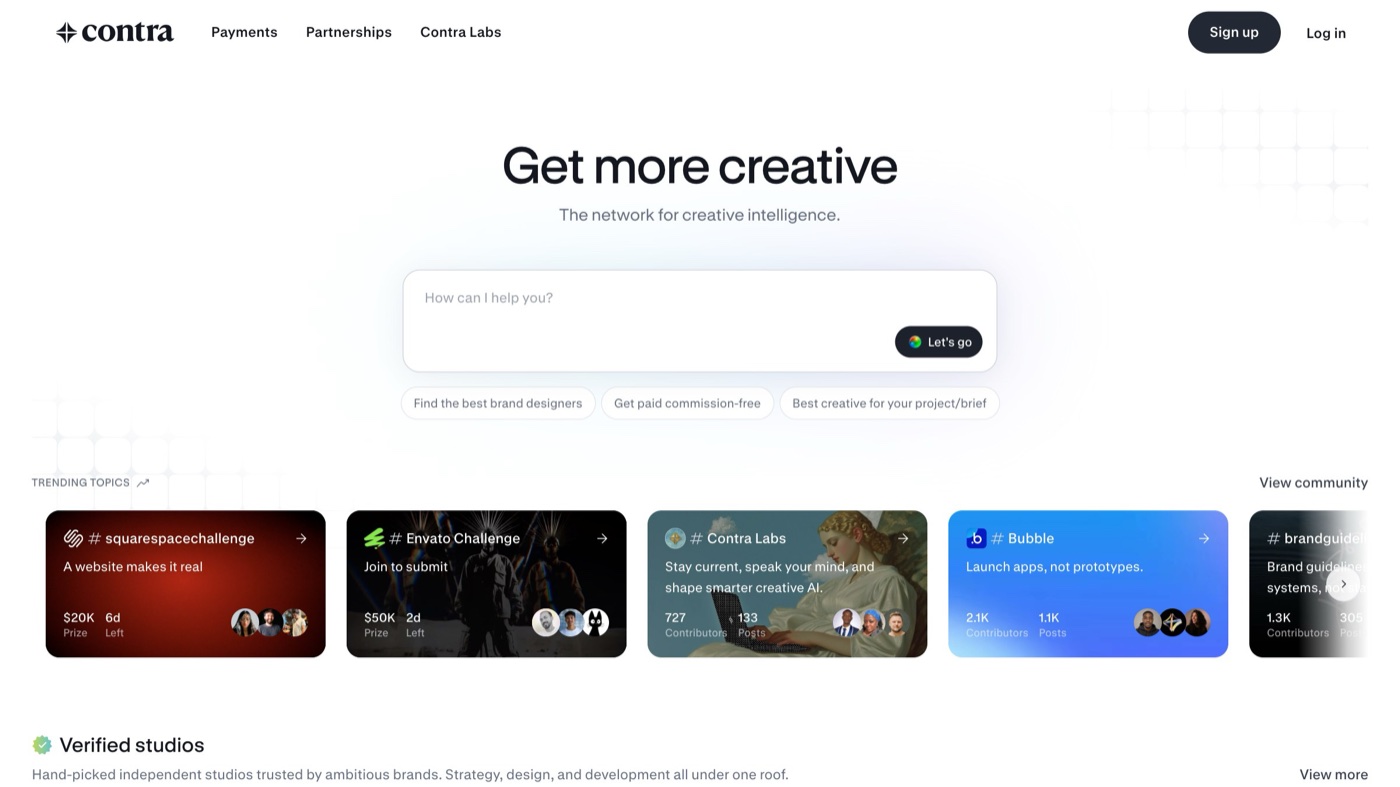
Contra's hire page for script writers reads like a brief checklist: tone, the audience's age and interests, length, deadline, and the drafts you want to review. Its FAQ also tells you to agree on the final script format (screenplay, teleplay, or stage script) up front, which saves an argument later. The portfolios mix brand and social video with the odd podcast and short film.
This is where I’d go looking for a writer with an actual voice. You run the schedule yourself, though.
Script and copy studios
These three sell the writing with no crew attached: a B2B video studio with a productized script service, one experienced writer with her own shop, and a staffing firm that rents you a writer by the week.
5. VID
The brief and the Google Doc
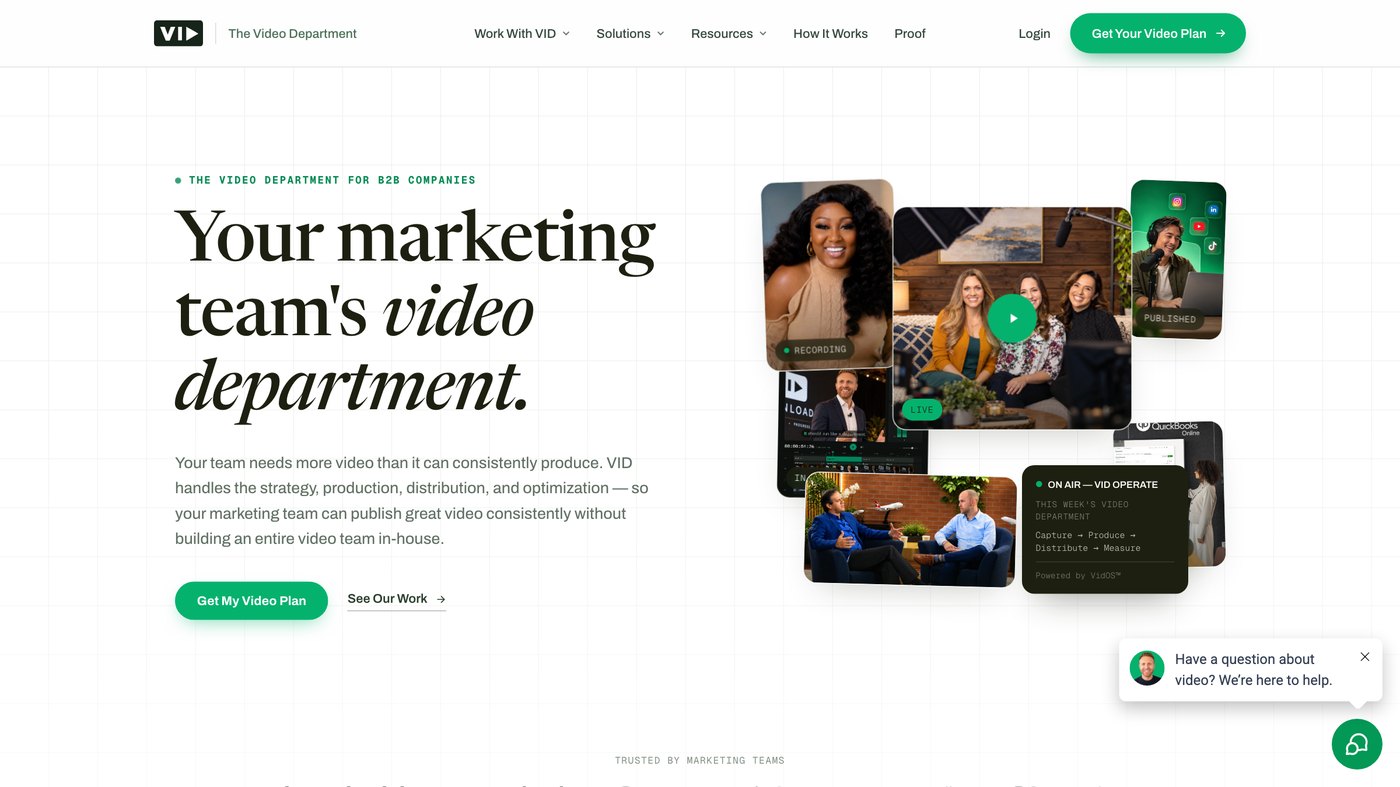
VID starts every script from a brief that asks who is watching, what they already believe, what objection they bring, and what they should do when the video ends. You get a template brief when you sign up. Drafts arrive as a Google Doc where you tag the team on changes, and edits come back in 1 to 5 business days depending on complexity. It will also write a new voiceover for footage you already have, useful when an old video needs a new message.
It’s built for B2B. For consumer comedy, or a brand film with no product in it, I’d look further down.
6. JaZzyMaE Media
Three lanes, one writer
The scripts page splits the work into three lanes: marketing (message clarity), education (making complex material accessible), and entertainment (dramatic narrative). Someone who has written museum exhibits and instructional films is usually good at the dull, necessary job of explaining a process in the right order. The studio is based in Oceanside, California, and the page lists original unproduced screenplays next to the client work.
I’d hire her for a museum piece or a training film.
7. Prose

How the placement works
Prose places marketing specialists on demand, and its video pros page lists scriptwriters next to video producers, videographers, and animators and motion designers. As Prose describes the scriptwriter role, it covers drafting scripts, working with producers and marketing teams on storylines, and refining drafts based on feedback. Hours flex from 10 to 40 a week, which puts it somewhere between a freelancer you rebrief every time and a full-time hire.
Worth a call when you can feel the volume coming and don’t want to post a job ad yet.
Video production companies that script in house
These four write because they shoot, so their scripts tend to know what a camera can get on the day. Ask whether they’ll write for a video somebody else produces; not all of them say.
8. Kicker Video
Deliverables and revision terms
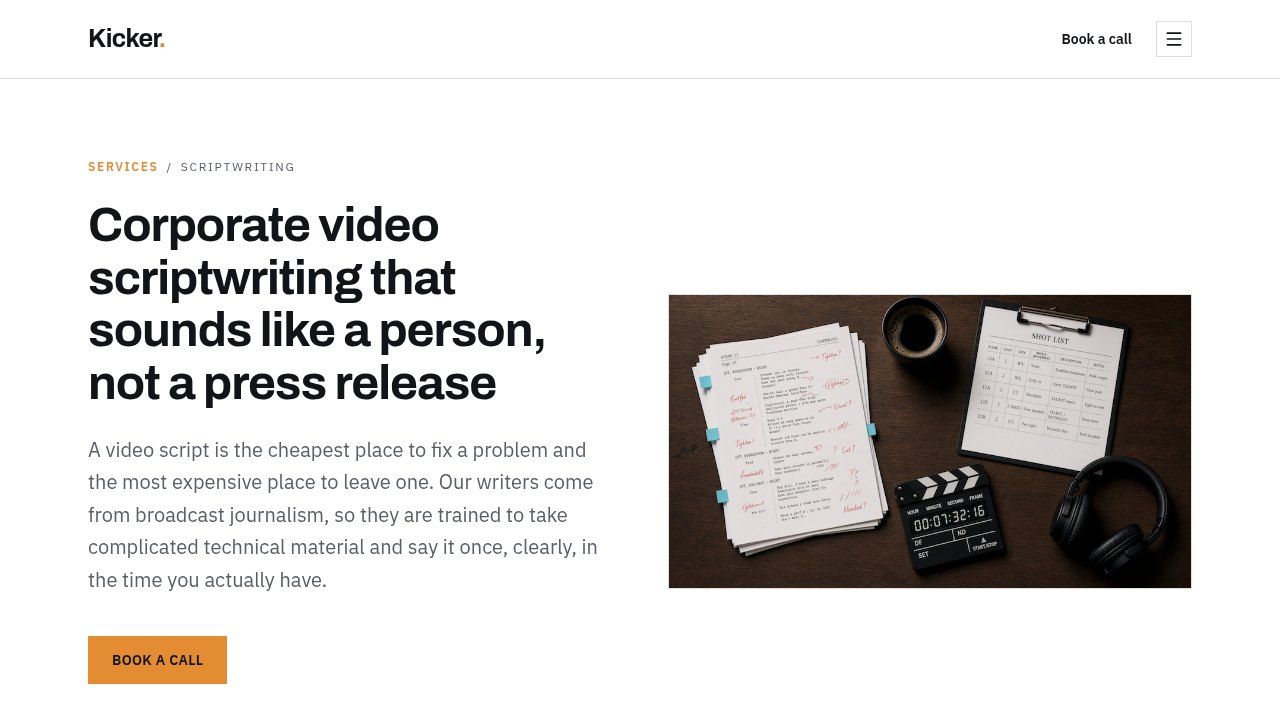
Kicker has made B2B films since 2005 and lists New York, Dallas, and Calgary in its footer, with clients in 32 states and 8 provinces. You get a two-column shooting script, timed narration, interview and testimonial question guides with backup questions, on-screen text, and support with legal and compliance review. Its page calls script revision rounds unlimited, as long as each round is consolidated feedback from the stakeholder group.
The interview guides are the bit I’d point a client to. In documentary-style corporate video the questions decide what ends up on camera, and buyers almost never think of them as something that needs writing. For the narration side, see our corporate video script guide.
9. Cerebral Lounge
Washington roots
Cerebral Lounge has studios in Baltimore and Washington, DC, and says its writers work locally and remotely with agencies, nonprofits, networks, and in-house teams across the country. The page lists ADDY awards and SharkFest work among its case studies, and the footer calls it a Three Seas company. The copy reads like a Washington shop, with communicating policy and pitching a cause listed right next to introducing a product.
Nonprofits and advocacy groups should talk to them. Those clients usually struggle more with agreeing on a message internally than with getting it written, and the page describes a process that settles the message first.
10. OpenLight Films
San Francisco, concept first
OpenLight is a San Francisco production company, and its scriptwriting page sits inside a service list that runs from brand films and product videos to event coverage and photography. It names Chase and Under Armour as clients. Concept development comes before any drafting, the right order for a commercial. A Bay Area team making a product or crowdfunding video has an obvious local option here.
11. FUGO Studios
Atlanta, and scripts written for casting
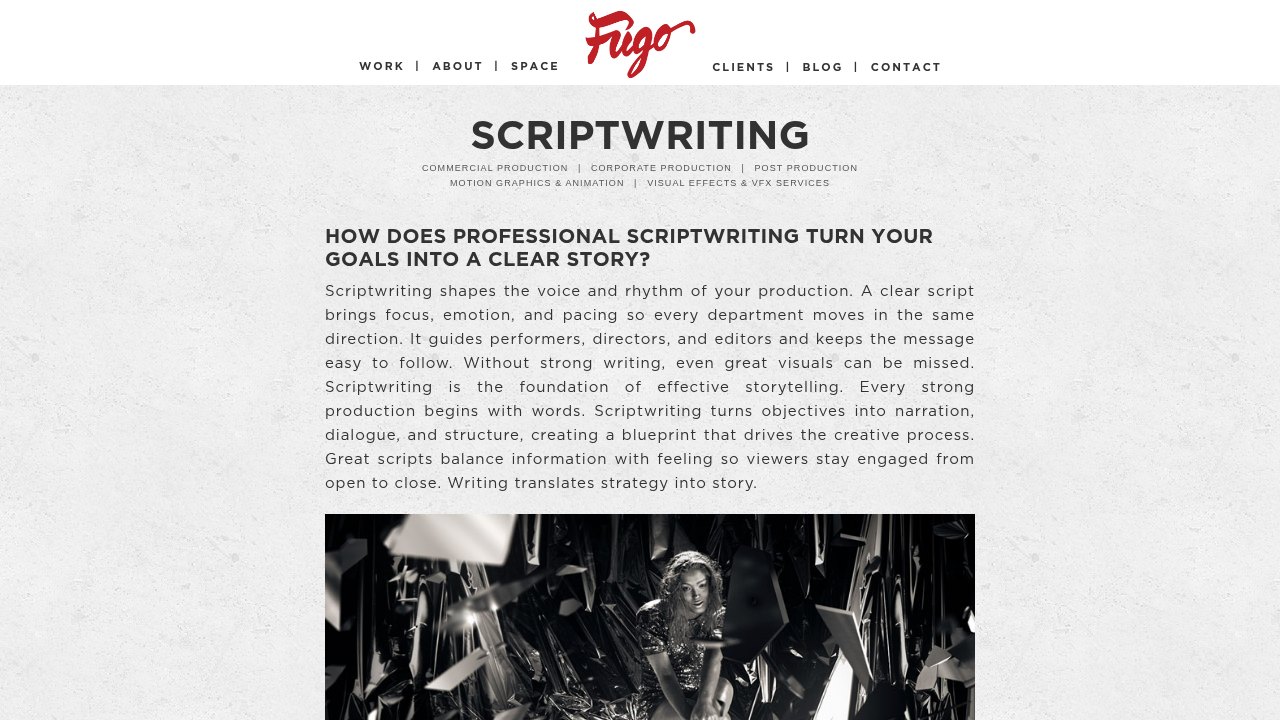
FUGO is based in Atlanta and says it works with agencies and marketing teams nationwide. Its services run from commercial and corporate production to motion graphics, animation, and VFX, and it rents out studio space. The scriptwriting page frames the script as the blueprint that guides performers, directors, and editors. That suits a project where casting is still open, because dialogue written with a specific actor in mind reads differently.
Software for teams who write their own
If someone on your team already writes well, what’s usually missing is a script format the people making the video can work from. All four tools handle formatting and revisions; Celtx and StudioBinder also do the two-column AV format most commercial and corporate work uses.
12. Final Draft
Licenses, and the format question
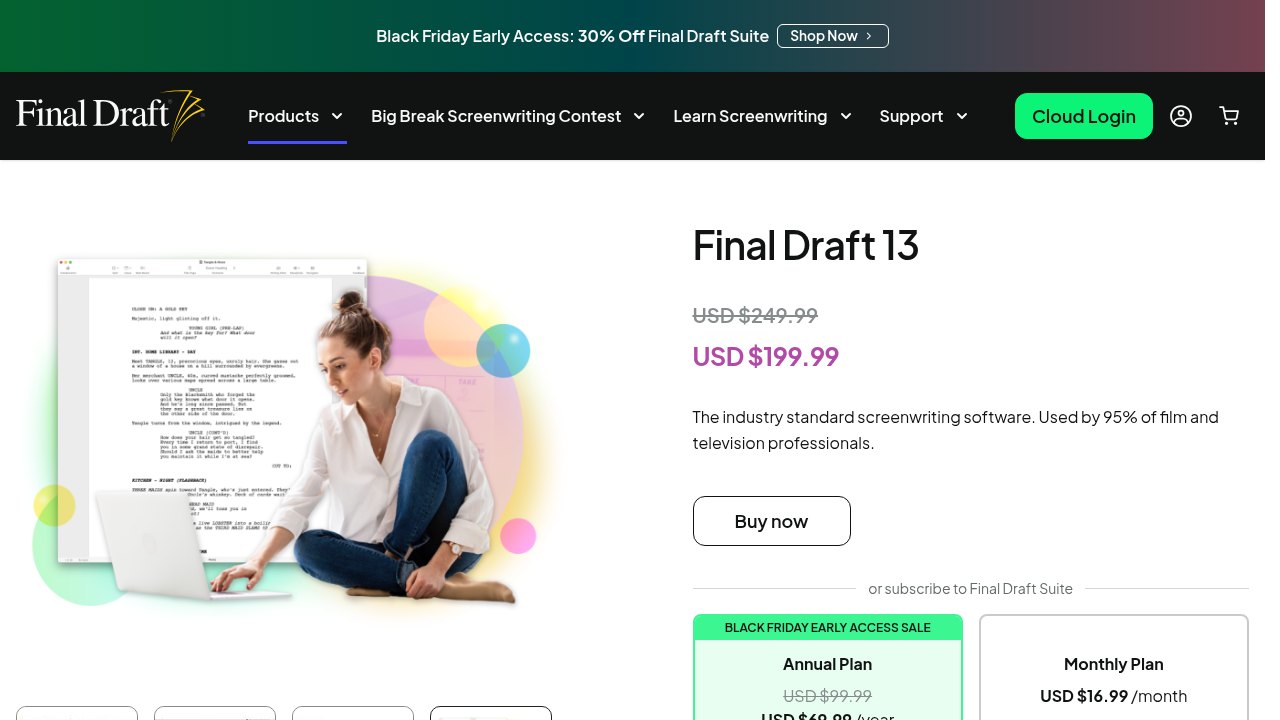
Final Draft calls itself the industry standard and says 95% of film and television professionals use it, which is its own figure. One license can be signed in on two computers at once, and the product page offers a 30-day money-back guarantee. It was made for screenplays and dialogue-heavy spots, so how well it suits a marketing team depends on what you write. Feed it explainer video scripts and check first that a template fits your columns.
I’d only buy it if your scripts go out to film and TV people, since they’ll ask for the .fdx file anyway.
13. Celtx
Why a corporate team would pick it
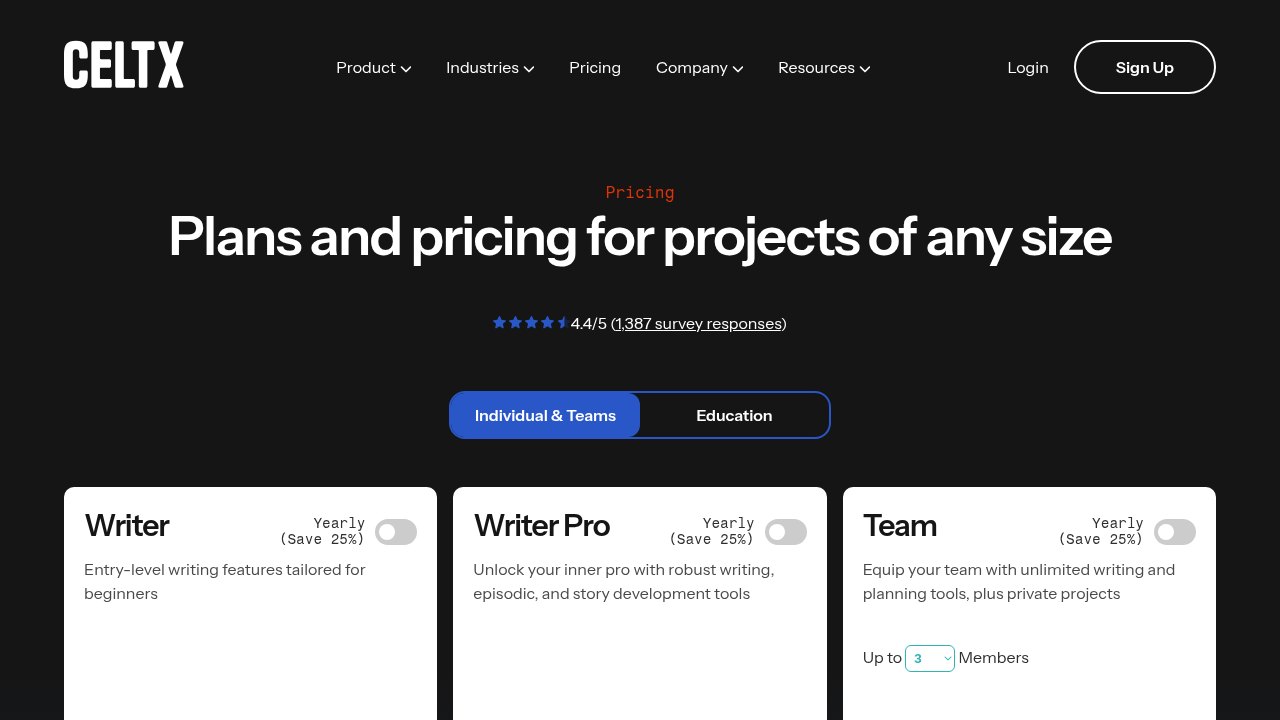
Celtx shows a 4.4 out of 5 rating from 1,387 survey responses on its pricing page. Team plans scale from three to fifteen members, monthly billing exists at a higher rate, and new accounts get a 7-day trial of the paid features before dropping to free. A corporate video team would come here for the AV editor: narration on one side, visuals on the other, laid out so a client reviewer with no film training can follow it.
Celtx is what I’d install for a team that writes its scripts and also plans its own shoots.
14. Arc Studio
Writers' rooms and credits
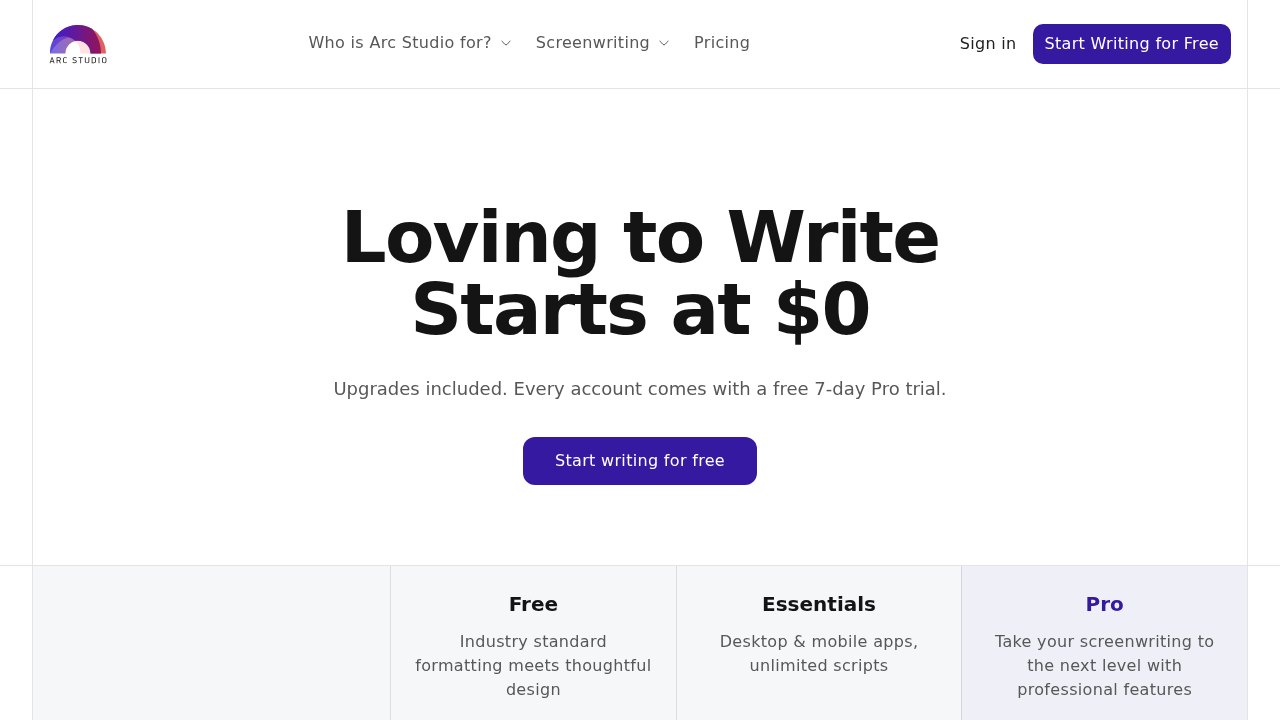
Arc Studio's pricing page quotes Christian Linke, showrunner on Arcane, on running a writers' room in it, so it leans toward episodic and film work. It works offline and syncs later, and upgrades are included. Some features, such as a table read with assigned voices and generated character images, are paid add-ons bought with credits, outside the plan price.
The nicest one to actually write in. Check the custom formats on Pro before you move a two-column workflow onto it.
15. StudioBinder
Locking and renumbering
StudioBinder applies WGA-approved screenplay formatting automatically and keeps every script version. Once a script is locked, it can be renumbered and pushed into the production tools. Most marketing teams will care about the AV script editor, and the company runs a separate StudioBinder Academy channel with tutorials on it.
If your team writes demo videos, our software demo script examples show what goes in each column. StudioBinder’s own tutorial sets up an AV script with audio, visual, image, and duration columns per row.
Freelancer, studio, production company, or a writer on staff
For a one-off with a sharp spec, a marketplace freelancer is fine, provided someone on your side has the hours to direct the writer and judge the draft. If the message itself is still unsettled, pay for a script studio or a writer-led shop; a good one will push back on the brief. Interviews and product demos filmed live are different again, because the script depends on what a crew can capture on the day, and that’s when I’d want the production company writing it.
Hiring a writer on staff only pays off at volume. At the O*NET median of $76,910 a year, you’d need a steady pipeline of scripts and other copy to keep one busy.
Where the video runs matters too. If it will mostly be watched in social feeds, the script has to work with the sound off; Olive Tree Marketing’s article on getting more attention with video on social media makes the case for subtitles, because plenty of feeds autoplay muted, and for short videos people can take in mid-scroll. In a regulated field, the review chain sets the schedule. Advisor Momentum’s page on video production for advisors and banks describes compliance review as a parallel lane running alongside the script, storyboard, and edit, so claims and disclosures get checked while they’re still easy to fix.
All 15 compared
| # | Service | Type | What they write | Cost signal (own page) | Published turnaround | Main drawback |
|---|---|---|---|---|---|---|
| 1 | Moonb | Creative team | Scripts for the videos, motion, and animation it produces | One set monthly rate, or a per-project quote | Averages 48 hours (our own count) | No feature film or TV writing |
| 2 | Freelancer.com | Marketplace | Ad, video, and screenplay scripts by bidding freelancers | Free to post; profiles from $7 an hour | Short scripts in a few days (its hiring guide) | “Script writing” also means code there |
| 3 | PeoplePerHour | Marketplace | YouTube, promo, short film, and screenplay scripts | Packages from $10 to $975 | Set per freelancer | Translators and generalists mixed in |
| 4 | Contra | Marketplace | Social, explainer, and educational scripts | Set by each independent; one video package at $2,500 | Not published | Many non-script portfolios on the page |
| 5 | VID | B2B video studio | B2B explainers, VSLs, brand stories, social hooks, course modules | Quote on request | First copy 3 to 5 business days; approved in 5 to 10 | Three revision rounds maximum |
| 6 | JaZzyMaE Media | Writer-led studio | Commercials, promos, explainers, documentaries, features | Not published; free first session | Not published | One writer’s calendar |
| 7 | Prose | Writer staffing | Brand, demo, and testimonial scripts | Not published | Writer placed 10 to 40 hours a week | You manage the writer |
| 8 | Kicker Video | Production company | Explainers, brand films, interviews, training | Scoped per project | Not published | Corporate and B2B focus |
| 9 | Cerebral Lounge | Production company | Branded content, campaigns, policy and cause messaging | Not published | Not published | Script-only scope to confirm |
| 10 | OpenLight Films | Production company | Scripts for commercials, product, and crowdfunding videos | Call for a price | Not published | Script-only work not mentioned |
| 11 | FUGO Studios | Production company | Commercials, corporate videos, national campaigns | Not published | Not published | Heavy for a quick polish |
| 12 | Final Draft | Software | Screenplays with tracked revisions | $249.99 once, or $16.99 a month | Not applicable | Mac and Windows only |
| 13 | Celtx | Software | Screenplays and multi-column AV scripts | Free; paid from $11.24 a month, billed yearly | Not applicable | Pre-production tools cost extra |
| 14 | Arc Studio | Software | Screenplays and episodic scripts | Free; $69 or $99 a year | Not applicable | Collaborator invites need Pro |
| 15 | StudioBinder | Software | Screenplays and two-column AV scripts | Free; paid tiers add features | Not applicable | More production suite than a writer needs |
The brief a writer needs
The best first drafts I see come from a one-page brief that covers six things: who is watching and what they already believe, the one message the video carries, where it runs and how long it can be, what viewers should do when it ends, what the picture can show (product, people, locations, existing footage) so the voiceover doesn’t have to say it, and who approves the final draft, by name.
Add the words your brand never uses, the claims legal has already cleared, and two videos you like with a sentence on why. I’d spend the most care on the videos, because they tell a writer more about your taste than anything else in the brief. Our creative brief guide has a template, and the corporate video script walkthrough shows a brief turning into two columns of narration and picture.
How many drafts are normal
There’s no industry standard, and the published terms on this list don’t agree. VID’s FAQ gives two free revision rounds and caps the job at three. Kicker doesn’t cap rounds but wants consolidated feedback each time. Freelancer.com advises tying payments to the outline, the first draft, and the final delivery. A script that’s going to work usually settles in a first draft, one structural revision, and a final polish for wording and timing. By draft five, something in the brief has usually moved, and I’d stop and rewrite the brief before asking the writer for another pass.
Most script tools track those rounds for you. Final Draft’s own walkthrough shows revision sets, each with its own page color, so everyone can see what changed in which pass.
Collect every stakeholder’s notes into one document before anything reaches the writer. When four people’s notes contradict each other, the writer has to guess which one wins, and that’s where most of the stalled scripts I’ve seen got stuck.
Frequently asked questions
From about $10 to whatever a studio quotes for the project. When I checked in November 2026, PeoplePerHour packages ran from $10 for a YouTube script to $975 for a 20 to 22 page comic script, Freelancer.com profiles started at $7 an hour, and most script studios and production companies quoted per project. Ask what the second and third drafts cost before you agree to the first one.
For a short commercial or explainer, usually a few days to two weeks from brief to approved draft. VID, for example, publishes 3 to 5 business days for first copy and 5 to 10 for an approved script. Stakeholder review is what slows most scripts down, so get your reviewers' time in the calendar before the writer starts.
Software is enough when someone on your team can already write and mostly needs correct formatting and a two-column layout reviewers understand. Hire a writer when the message is still unclear or nobody internally has time to draft. Plenty of teams do both: a hired writer drafts, and the team keeps the script in Celtx or StudioBinder for later edits.