pseudo illustration

Will AI Replace Graphic Designers The Future of Creative Careers

calendar icon
October 27, 2025
read time
8 minutes
Will AI Replace Graphic Designers The Future of Creative Careers

Let's cut right to it: No, AI is not going to replace graphic designers. What it is doing is changing the job description, pushing the profession to be more strategic than ever before.

Think of AI as the ultimate assistant. It’s a powerhouse tool that can churn through repetitive tasks, spit out endless variations for brainstorming, and speed up the entire creative process. This frees up the human designer to focus on what really matters: creative direction, big-picture strategy, and building strong client relationships.

The New Creative Partnership: Human Strategy, AI Execution

The whole "human vs. machine" debate is dramatic, but it misses the point entirely. The reality is much more of a partnership. AI isn't an independent creator with its own vision; it's an incredibly efficient executor. It can produce jaw-dropping visuals, but it completely lacks the critical thinking, cultural awareness, and emotional intelligence that are the hallmarks of truly great design.

This new dynamic elevates the graphic designer from a production artist to a strategic creative lead. Instead of getting bogged down for hours creating minor logo tweaks or manually resizing assets for a dozen different platforms, designers can now direct AI to handle the grunt work. That means more time and brainpower for the high-value stuff—like digging into a client’s business goals, figuring out how to connect with a target audience, and weaving a compelling brand story.

Shifting Roles And Responsibilities

As AI tools become more common, the day-to-day responsibilities of a designer are definitely changing. Tasks that used to take painstaking manual effort can now be knocked out in a fraction of the time. But this isn’t a threat. It’s an opportunity for designers to lean into the skills that machines can't touch.

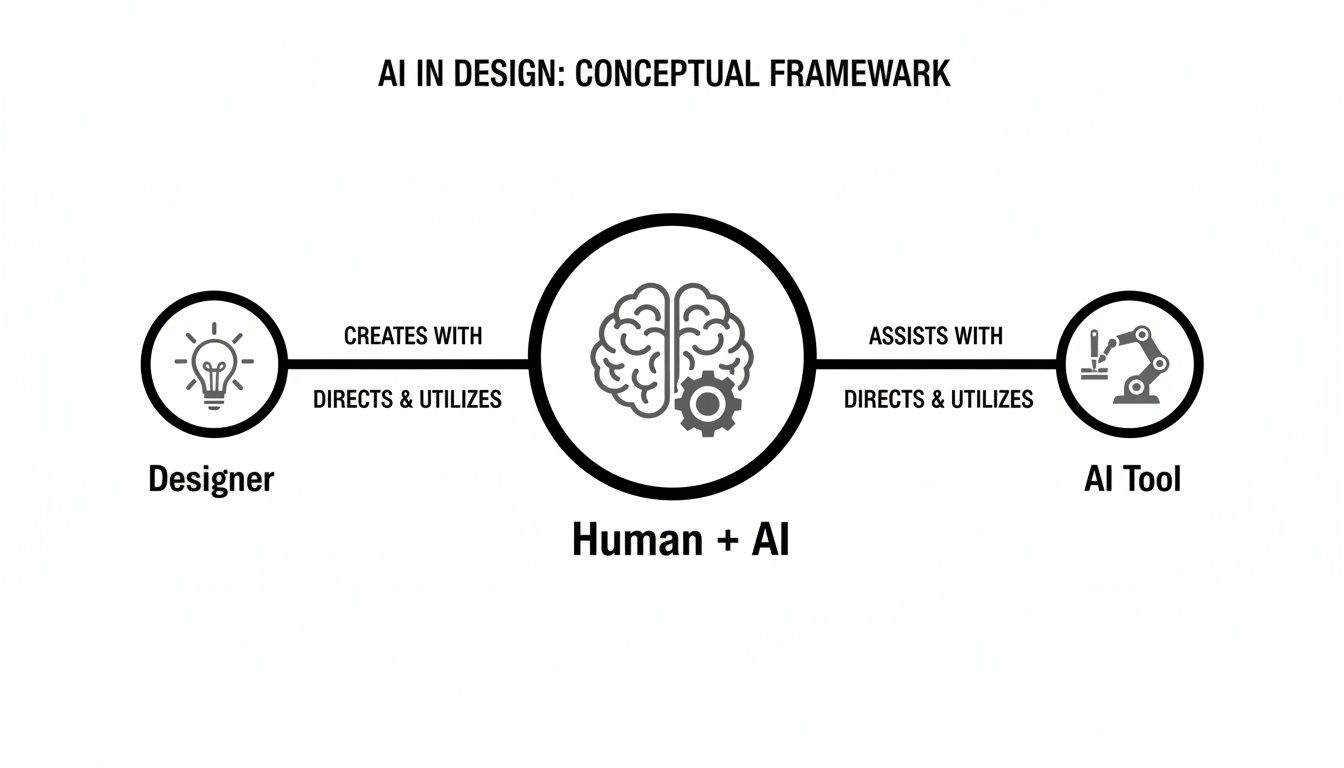
The framework below shows how this new collaborative model works, with the designer firmly in the driver's seat.

Conceptual framework diagram illustrating the interaction between a designer, human-AI, and AI tools.

As you can see, the most powerful creative work happens right where human strategy and AI execution overlap. The human provides the "why," and the AI delivers the "how"—fast.

To get a clearer picture of this new division of labor, let's break down a few common design tasks.

Human Designer vs. AI Assistant: A Task Comparison

This table shows exactly how the roles of strategist and executor play out in the real world, highlighting where human insight is irreplaceable and where AI muscle provides the biggest boost.

Human Designers vs AI Tools in the Creative Process

Design Task Human Designer's Strength (The Strategist) AI Tool's Strength (The Executor)
Initial Concepting and Brainstorming Understands brand history, audience psychology, and business goals to set the creative direction. Generates hundreds of visual ideas, mood boards, and style explorations based on prompts.
Logo and Brand Identity Develops a unique strategic concept that tells a story and resonates emotionally. Ensures originality. Creates multiple logo variations, color palettes, and typography pairings instantly.
Social Media Graphics Creates a cohesive campaign narrative. Tailors messaging for different platforms and audience segments. Resizes a master design into dozens of required formats and dimensions in seconds.
Web Design Mockups Focuses on user experience (UX), information architecture, and conversion goals. Populates layouts with placeholder content, generates design system components, and suggests UI patterns.
Client Feedback and Revisions Interprets subjective feedback, navigates client politics, and makes strategic adjustments. Applies specific, objective changes across all assets simultaneously (for example change this blue to #00529B).

Ultimately, the designer remains the conductor of the orchestra. They use their expertise to guide the AI, filter its outputs, and refine the results until they perfectly align with the strategic goals of the project. AI is a powerful instrument, but it still needs a skilled musician to play it.

AI Is Already Here (And Growing Fast)

This isn't some far-off future scenario; the industry is already leaning into this new way of working. By 2025, an estimated 61% of design professionals are expected to have AI tools integrated into their daily workflows.

This rapid adoption is driving huge market growth, with AI-powered design tools projected to jump from $5.54 billion in 2024 to $6.77 billion in 2025. While some headlines claim generative AI could automate 30% of work hours by 2030, for designers, it’s proving to be more of a force multiplier, not a replacement. It just helps them get more done.

The real value of a modern graphic designer isn't in their ability to use software, it’s in their ability to solve problems. AI is just another tool, like Photoshop or Illustrator, that helps them solve those problems faster and more effectively.

This trend isn't happening in a vacuum. The rise of AI models for photo shoots shows how technology is changing the way all kinds of creative assets are made. It also brings up the same kinds of questions we see in other fields, like whether will ai replace animators. The answer is almost always the same: human creativity is, and will continue to be, the essential ingredient.

How AI Is Actually Used in Design Today

The conversation around AI often swings from wild utopian dreams to dystopian nightmares, but what's happening on the ground is much more practical. For designers right now, AI isn't some autonomous creator calling the shots. It's more like a supercharged assistant—a creative partner that crushes the specific, high-volume tasks that used to eat up hours, or even days.

Instead of a single "AI designer," what we're really seeing is a bunch of specialized tools plugging right into existing workflows. Think of platforms like Midjourney or Adobe Firefly not as replacements, but as powerful engines for brainstorming and getting things done. A designer can now whip up a hundred different concepts for a mood board in the time it used to take to make just one.

That’s the core of AI in design today: acceleration and iteration.

From Tedious Tasks to Rapid Prototyping

One of the first things designers noticed was how AI automates the soul-crushing, repetitive work. Tasks that were once manual bottlenecks are now practically instant.

  • Complex Selections: Pulling a person out of a busy background or isolating tiny, intricate objects now takes a single click.
  • Asset Variation: Need that banner ad in ten different sizes? AI can resize and reformat a master design in seconds, letting the designer focus on the actual creative.
  • Content-Aware Fills: Extending a photo's background or zapping an unwanted object is no longer a painstaking chore.

This efficiency completely changes the game in the early stages of a project. A designer can explore dozens of visual directions without a massive time commitment. They can generate realistic product mockups in different settings or play with various typographic treatments for a headline, leading to faster, smarter creative decisions. Digging into the top AI-driven ad creative generation platforms shows just how far this has come for large-scale production.

Ideation at an Unprecedented Scale

But it’s not just about speeding up the grunt work. AI has become a fantastic brainstorming partner. A human designer provides the strategic prompt—the spark of an idea—and the AI returns a whole forest of possibilities. This is where tools like Adobe Firefly really shine, allowing for quick visual exploration based on simple text prompts.

For instance, a prompt like "logo for a sustainable coffee brand, minimalist, earth tones, line art style" can spit out dozens of starting points in seconds.

Digital illustration showing two men intensely focused on their respective tablet devices.

This image shows just how a simple text prompt can generate a wide array of visual concepts. While the results look impressive, they’re just that—a starting point, not a finished product. The designer’s real job is to sift through these raw ideas, refine them, and inject brand strategy and meaning.

AI generates options; the designer makes decisions. The machine can produce endless visuals, but it has no critical judgment. It doesn't know which one will connect with a specific audience or align with a company's core values.

This distinction is everything. The AI doesn’t understand why one concept works better than another. It can't grasp the subtle nuances of a brand's voice, its history, or its long-term goals. It might create a beautiful image, but it doesn't know how to build a cohesive visual identity that tells a story across every touchpoint.

It might even struggle to generate clean, legible text. That's where a designer's typographic expertise and knowledge of specific tool become non-negotiable for creating a polished final asset.

So, when we look at AI's current role, the question of replacement becomes clearer. It's a powerful executor, not a strategic thinker. AI provides the raw materials—the visual assets, layout ideas, and color palettes—while the human designer acts as the architect, strategist, and quality controller, making sure every single element serves a greater purpose.

Where Human Creativity Remains Irreplaceable

AI can generate pixels, patterns, and palettes with astonishing speed, but it can’t tell a story, understand nuanced human emotions, or forge a genuine connection with an audience. This is where we draw the line. While AI is a powerhouse for execution, human designers are still the indispensable soul of the work.

Illustration of a person using a computer at a desk with floating digital content elements.

The whole "will AI replace designers" conversation often misses a fundamental point: great design is about communication, not just creation. It demands empathy, strategic vision, and a deep understanding of cultural context—qualities that are, at their core, human.

The Power of Strategic Thinking

An AI tool can spit out a thousand logos in a minute, but it can't sit in a client meeting, absorb their business challenges, and translate those abstract goals into a concrete visual strategy. This high-level strategic thinking is where a human designer's true value shines. It's the difference between making something that looks good and making something that works.

This really boils down to a few key things:

  • Problem-Solving: Designers aren’t just decorators; they’re complex business problem-solvers. They’re trained to ask "why" long before they ever touch "what," making sure the final design actually achieves its core objectives.
  • Brand Stewardship: A designer gets the history, values, and audience of a brand on a gut level. They make sure every single visual element, from a quick social media post to a full-blown rebrand, feels consistent and authentic.
  • User-Centricity: Truly effective design is built on a foundation of empathy for the end user. Designers are constantly thinking about the user experience, anticipating human needs and behaviors in a way that AI simply can't replicate.

This strategic foundation is the bedrock of the entire creative workflow. If you look at the principles of a structured design process in graphic design, you’ll see just how much of the critical work happens before a single pixel is ever placed on the screen.

Emotional Intelligence and Connection

At its heart, design is about emotion. It’s about making people feel something—trust, excitement, nostalgia, confidence. AI runs on data and algorithms; it has no lived experience, no empathy, and zero ability to create an emotional bond.

Think about an iconic campaign like Nike's "Just Do It." An AI could certainly generate images of athletes and slap a slogan on them. But it could never capture the raw, inspiring spirit of overcoming personal struggle that has made that campaign resonate for decades. That kind of connection comes from a uniquely human understanding of aspiration and grit.

An AI can recognize a smile in a photo, but it can't understand the complex blend of relief, joy, and pride behind it. A human designer can capture that feeling and translate it into a visual language that moves people.

This emotional intelligence is what allows designers to navigate cultural sensitivities, tell stories that stick, and create work that becomes a part of our shared experience.

Genuine Originality and Unpredictability

AI models are trained on massive datasets of existing, human-created work. Their "creativity" is, by its very nature, derivative—a highly sophisticated remix of what's come before. But true originality, the kind that breaks all the rules and kicks off new trends, comes from the unpredictable sparks of human imagination.

An AI can’t have a "happy accident" in the studio, get inspired by a random conversation, or pull from a niche personal experience to create something genuinely new. It's programmed to find patterns, while human creativity often thrives on smashing them. It's the difference between iteration and true innovation.

The question isn't whether AI is a powerful tool—it absolutely is. Its role is simply shifting toward that of a partner. In fact, over 80% of content creators are already using AI in their workflows. The real demand is for human insight to guide these tools, creating a new breed of designers who are experts at being "AI whisperers."

Ultimately, the question of replacement comes down to this: AI is a phenomenal tool for the what, but the human designer will always own the why and the how. Strategy, emotion, and originality aren't features to be coded—they're the very essence of human creativity.

The New Skillset For AI-Powered Designers

The smartest designers aren't panicking about AI; they're adapting. As AI tools start handling more of the tedious, manual parts of design, a designer's real value is shifting. It's moving away from pure execution and toward creative strategy and direction. This isn't about trying to out-design a machine—it's about learning how to conduct it.

Think of it like being an orchestra conductor versus a musician. The AI can play the notes perfectly, cranking out visuals on command. But it needs a human conductor to provide the vision, interpret the strategy behind the music, and guide the whole performance into something that feels cohesive and creates a real emotional impact.

A person cuts a ribbon from a red heart as a robot observes, illustrating human-AI collaboration.

This new role requires a deliberate pivot, moving from a hands-on maker to a high-level creative partner. Leaning into this change is the key to not just surviving, but actually thriving.

Mastering The Art Of Prompt Engineering

The most immediate new skill to pick up is learning how to talk to AI. Prompt engineering—sometimes called "AI whispering"—is the art of writing precise instructions to get generative tools to produce a specific result. A vague prompt gets you generic, unusable mush. A masterfully crafted one can unlock some truly incredible creative pathways.

This is way more than just typing a few words. It’s about understanding how different AI models think and how they interpret language, style, and composition.

  • Specificity is Everything: Instead of asking for "a logo for a coffee shop," a prompter would write something like, "Minimalist line art logo for 'Morning Ritual,' an artisanal coffee brand. Use a single, continuous line to form a steaming mug and a rising sun. Earthy color palette, #A67B5B brown."
  • Iterate and Refine: The best designers treat prompting like a conversation. They start with a broad idea, see what the AI spits out, and then tweak their prompts with negative keywords, style modifiers, and compositional details to steer the AI closer and closer to their vision.

Getting good at this turns the AI from a slot machine of random images into a highly responsive creative assistant that can execute complex ideas in seconds.

Doubling Down On Strategic Thinking

With AI speeding up the production side of things, the ability to think strategically becomes a designer’s most valuable asset. The focus is shifting from "how do I make this look good?" to "what business problem are we actually solving here?" This means acting more like a consultant and less like a technician.

The most in-demand designers will be those who can connect a visual solution directly to business objectives like increasing conversions, improving brand perception, or driving user engagement.

This requires a much deeper dive into the business context. Designers need a seat at the table during the earliest project stages, asking the tough questions about the target audience, market positioning, and what the competition is doing. A huge piece of this puzzle is knowing how to pull the real needs and goals out of a client, which all starts with a rock-solid plan. We break down exactly how to do this in our guide on how to write a creative brief.

As AI gets better and more accessible, a lot of non-designers will be able to create basic visuals. But that only makes true strategic direction more valuable, not less.

Elevating Communication And Client Management

Finally, as the technical work gets partially automated, soft skills become hard currency. A designer’s ability to communicate complex ideas, interpret vague feedback, and build strong client relationships is more critical than ever before. AI can't negotiate a deadline, manage expectations, or present a creative concept with genuine passion and conviction.

This means you have to be an even better storyteller and collaborator. You need to walk a client through your strategic process, explaining the "why" behind your design choices in a way that builds trust and gets them excited. That human-to-human connection is the glue that holds a creative project together, ensuring the final result isn't just pretty, but strategically sound and client-approved.

To stay ahead, designers need to cultivate a blend of timeless creative skills and new AI-centric competencies. The table below outlines the essential skills for the future-proof designer.

Essential Skills for the Future-Proof Designer

Skills Creatives Must Master in the Age of AI

Skill Category Key Skills to Master Why It Matters with AI
Traditional Creative Foundations Typography, Color Theory, Composition, Visual Hierarchy, Branding AI can generate options, but it lacks the deep understanding of why certain visual principles work. This knowledge is crucial for guiding and curating AI output.
Evolving Technical Skills Prompt Engineering, AI Tool Proficiency (Midjourney, DALL·E 3, etc.), Curation, Post-Production Editing Your ability to speak to AI determines the quality of its output. You become the director, not just the creator, refining AI-generated assets into finished products.
New Strategic Competencies Business Acumen, Marketing Strategy, User Experience (UX) Principles, Data Analysis With AI handling routine tasks, your value shifts to solving business problems. You must connect design choices directly to strategic goals and ROI.
Essential Soft Skills Communication, Client Management, Storytelling, Empathy, Collaboration AI cannot build relationships, manage subjective feedback, or present a vision. These human-centric skills become your primary differentiator and value add.

Embracing these skills ensures that designers don't just survive in the age of AI—they become indispensable strategic partners.

How Creative Teams Should Integrate AI

For creative directors and business leaders, the question isn't if you should adopt AI, but how. Folding generative AI into your creative process isn’t about finding a cheaper replacement for your design team. Think of it as a strategic investment in efficiency and creativity that gives your entire team a serious upgrade.

Trying to swap human talent for an AI tool is a fast track to producing generic, soulless creative. The real magic happens when you pair your designers' strategic minds with the machine's incredible speed. But to do that, you need a clear framework for how and when to use these powerful new tools.

Building Your AI Integration Playbook

First things first: you need to demystify AI for your team and set some ground rules. Instead of letting it be a free-for-all, create a structured approach that empowers your people while protecting your brand's quality and consistency. This playbook should spell out which tasks are perfect for an AI assist and which absolutely demand a human-only touch.

Think of it like assigning roles on a project. AI is a beast when it comes to churning out volume and variation, which makes it the perfect assistant for certain parts of the creative workflow.

  • Rapid Ideation: Need a hundred mood board concepts, color palettes, or initial layout ideas? An AI can generate a massive pool of visual starting points in minutes, not hours.
  • Asset Generation: Need a specific background texture, a simple icon set, or a photorealistic product mockup? AI can spin these up on demand, saving your team from tedious manual work.
  • Production Tasks: Let AI handle the grind. Resizing a campaign graphic for ten different social media platforms or cutting out complex backgrounds from a batch of photos is a perfect job for a machine.

This kind of deliberate task delegation is a core part of effective creative operations management. It ensures your most precious resource—your team’s creative energy—is spent on work that actually moves the needle.

When To Rely On Human Expertise

While AI is a powerful executor, it’s a terrible strategist. Your human design team is still irreplaceable for any task that requires deep thinking, emotional intelligence, and a genuine feel for your brand.

Save your human talent for the work that defines your brand and truly connects with your customers. These are the areas where context, nuance, and strategic insight are everything.

AI can generate a logo, but it can't build a brand. Your team understands your company’s history, your audience’s psychology, and the competitive landscape. That strategic oversight is what turns pixels into a cohesive, meaningful brand identity that connects with people and lasts.

Here’s where your human team must always take the lead:

  1. Brand Strategy and Development: Only humans can translate messy business goals and abstract brand values into a compelling visual system.
  2. Client-Facing Communication: Reading a room, interpreting subjective feedback, and building trusted client relationships are skills that are uniquely human.
  3. Final Creative Execution: That last 10%—the final polish, the typographic tweaks, and the quality control that makes a design feel perfect—requires a discerning human eye.
  4. Original Concepting: Truly new ideas that break the mold come from human experience and imagination, not an algorithm remixing its training data.

By creating this clear division of labor, you empower your team to work on a higher level. Designers evolve from being pure producers into creative directors who guide powerful AI tools to bring their strategic vision to life. This collaborative model doesn't just make your team faster; it makes them smarter, more strategic, and ultimately, more valuable.

The Future of Design Is a Partnership, Not a Replacement

All this talk about "will AI replace graphic designers" brings up images of some creative apocalypse, but the reality is way less dramatic and a lot more interesting. AI isn't the end of design. It’s the next major step in how we create, just like Photoshop completely changed the game for designers decades ago.

This whole discussion boils down to one simple, powerful idea: AI is the ultimate executor, and the human designer is the indispensable strategist.

AI brings incredible speed and scale to the table. Seriously, it can spit out a hundred concepts in the time it takes you to make a coffee. But all that power is missing the one thing that gives design its soul.

Humans Provide The "Why"

AI works without context, emotion, or intent. It can't feel a client's anxiety about a rebrand, understand the deep-seated motivations of a target audience, or weave a brand story that actually connects with people on a cultural level. This is where human creativity is simply untouchable.

The future of design belongs not to AI alone, but to the creative professionals who master the art of working alongside their intelligent assistants to deliver unprecedented value and innovation.

Ultimately, the best work will come from this partnership. AI will handle the "what"—the lightning-fast production of assets and ideas—while the designer provides the crucial "why" that steers the entire ship.

This isn’t a threat; it’s an invitation to level up. A recent analysis of over 180 million jobs found that while roles focused on pure execution are fading, strategic creative roles like creative directors and graphic designers are holding strong. The data backs it up: the industry isn't getting rid of designers, it's elevating them.

So, embrace these tools. Treat them like incredibly powerful collaborators. The future isn’t about trying to out-create AI; it’s about learning how to direct it. When you pair human vision with machine intelligence, you can solve bigger problems and do more impactful work than ever before.

Frequently Asked Questions

When big changes sweep through an industry, it’s natural to have a lot of questions. We’ll tackle some of the most common ones we hear from designers and business leaders trying to make sense of AI in the creative world.

Which Graphic Design Jobs Are Most At Risk From AI?

The roles most likely to feel the immediate impact are those heavy on repetitive, high-volume production tasks. Think bulk image resizing, simple background removals, and churning out minor variations of social media ads. It’s the grunt work, really.

But it’s far more likely that specific tasks will be automated within a role, not that whole job titles will vanish overnight. The positions that are safest—and frankly, becoming more valuable—are the ones that demand strategic thinking, deep client collaboration, brand stewardship, and truly creative problem-solving. These are the human skills that AI can’t replicate.

What Are The Best AI Tools for Graphic Designers to Learn Now?

To keep your edge, you’ll want to get comfortable with the tools that are quickly becoming the new industry standard. A few key players to master are:

  • Adobe Firefly: It's built right into the Adobe Creative Cloud, making it a no-brainer for anyone already living in that ecosystem.
  • Midjourney: This one is a powerhouse for generating stunningly high-quality, artistic images. It’s perfect for brainstorming and finding inspiration.
  • DALL-E 3: Known for being incredibly user-friendly and great at understanding complex, detailed prompts.

Don't just stop at image generators, though. It’s just as important to explore the AI features popping up in platforms you already use, like Figma and Canva. Even specialized tools like Khroma, which creates smart color palettes, can seriously speed up your workflow.

Can I Legally Use AI-Generated Images in Commercial Projects?

This is where things get tricky, as the legal side of AI art is still being figured out. The short answer is: it depends entirely on the tool you're using.

You have to be careful here. Tools like Adobe Firefly are trained on Adobe Stock’s own library of licensed content, so they’re built from the ground up to be commercially safe. On the other hand, images from models trained on data scraped from all over the internet exist in a legal gray area and carry a lot more risk.

The bottom line is you absolutely must review the terms of service for any AI tool before you even think about using its images in a commercial project. If it’s for a major campaign, your safest bet is to talk to a lawyer to avoid any copyright headaches down the line.

Will AI Lower The Demand and Pay for Graphic Designers?

AI is definitely shifting the goalposts. We'll likely see a drop in demand for low-skill, purely executional design work, which could push down prices for those commoditized services. A recent analysis of 180 million jobs backs this up, showing that while rote production roles are declining, strategic creative jobs are holding their ground.

But here’s the flip side: demand for highly skilled designers who can direct AI tools, develop bulletproof brand strategies, and provide sharp creative oversight is actually going up. These are the people who can charge more because they’re not just making things—they’re delivering strategic value, made even more powerful by AI's speed. The path forward isn't about competing with AI; it's about evolving into a creative strategist who uses it as a tool.

Table of Content

Frequently Asked Questions

Who exactly is Moonb for?

We’re built for marketing directors, creative directors, founders, or entrepreneurs who know great marketing requires exceptional content but don't have the time, resources, or expertise to build or scale an internal creative department. Whether you have a small internal team or just one overwhelmed designer, Moonb immediately levels up your creative capabilities.

Why should we choose Moonb instead of hiring internally?

Building an internal creative department takes months of hiring, onboarding, and management, and comes with substantial fixed costs and risks. With Moonb, you get immediate, scalable, high-quality creative output, expert strategic input, and total flexibility for less than the cost of a single senior creative hire.

Will Moonb replace my existing creative team?

Not necessarily. Moonb is designed to either fully replace your need for an internal creative team or powerfully complement your existing team, allowing them to focus on what they do best, while we amplify your creative capacity and strategic depth.

What does the onboarding process look like?

Once you sign up with us you will receive an email within a few minutes containing two essential links. The first link directs you to our production platform where you can access all your videos and request reviews. The second link takes you to your customer portal to manage your account with us. Your dedicated Creative Director will contact you immediately to schedule a first call, during which we'll gather all the necessary information to get started. We'll then create a content strategy plan and begin working on your productions. We will develop a content calendar with precise deliverables and a review process. You can be as involved as you wish or leave it entirely in our hands.

What types of creative projects can Moonb handle?

Almost everything creative: animations (explainer, product launches, campaigns), graphic design (social media, digital, print, packaging), branding (visual identities, logos, guidelines), and strategic creative consultation and concept development.

Will I have the working files? What about ownership of the work?

Absolutely, you'll receive the working files, and you'll own all the intellectual property created.

Who will be my point of contact?

As soon as you sign up, you'll be assigned a dedicated creative team, supervised by a Creative Director who will be your main point of contact. You will be onboarded to our production platform, where you can oversee the entire process and manage each production.

Do you sign non-disclosure agreements?

Absolutely, your privacy matters to us. We can offer you our standard Non-Disclosure Agreement (NDA), or you are welcome to provide your own.