
Explore difference between reels and story: Marketer's Guide Reels and Stories


The biggest difference between a Reel and a Story boils down to purpose. Reels are permanent, discoverable videos built to reach new audiences, while Stories are temporary, 24-hour snapshots made for engaging your existing followers.
Think of it this way: Reels are your brand's highlight reel for the world. Stories are the daily conversation you have with your community.
Reels vs Stories At a Glance
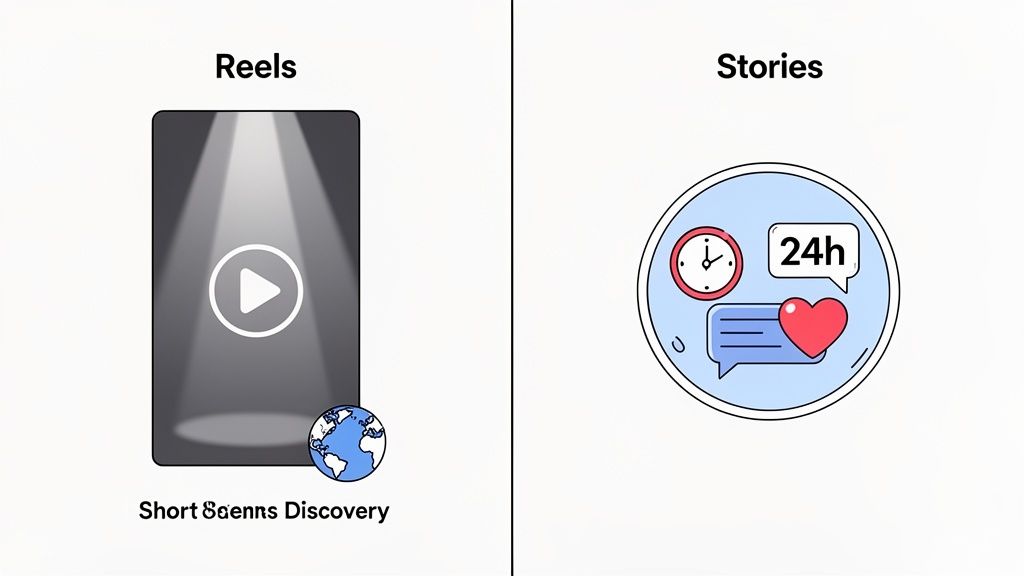
Knowing when to use each format is crucial for any marketing leader looking to build both reach and loyalty. Reels are your growth engine. The Instagram algorithm actively pushes them to non-followers on the Explore page and the dedicated Reels tab. Because they’re evergreen, a single great video can keep attracting new leads for weeks, or even months.
Stories, on the other hand, are all about intimacy and immediacy. They sit at the top of a follower's feed for just 24 hours, creating a sense of urgency that’s perfect for behind-the-scenes content, interactive polls, and exclusive offers. While the audience is smaller, the engagement you get is often deeper and more personal.
This guide will unpack the strategic differences, helping you decide when a polished, permanent Reel is the right move versus when a raw, fleeting Story will deliver better results. For a related breakdown, check out our article on how Reels compare to standard Instagram posts.
To make it even clearer, here’s a quick-reference table that lays out the most important distinctions between the two.
Key Differences Between Reels and Stories
Ultimately, a smart Instagram strategy doesn't choose one over the other—it uses both in harmony. Reels bring new people in the door, and Stories turn them into a loyal community.
The Strategic Purpose of Each Format
To really get the difference between Reels and Stories, you have to look past the technical specs and focus on why you’d use one over the other. Each format is built to do a very different job for your marketing. Think of Reels as your engine for brand expansion and discovery—they’re designed to pull in new audiences at the top of your funnel.
Stories, on the other hand, are all about community nurturing and driving action. They’re the perfect tool for going deeper with the audience you already have.
Reels: The Engine for Audience Growth
The whole point of a Reel is to get your brand in front of people who don’t follow you. Simple as that. Because they live permanently on your profile, they act like evergreen content, working around the clock to bring in new viewers long after you’ve hit publish. The algorithm is literally designed to push entertaining Reels to a massive audience through the Explore page and the dedicated Reels tab.
This makes Reels the perfect vehicle for:
- Brand Awareness Campaigns: It’s your chance to introduce your brand’s personality and values to a cold audience.
- Educational Content: Share industry tips, tutorials, or how-to guides that instantly position you as an expert.
- Showcasing Products in Action: Create videos that solve a problem or build aspiration around what you offer.
A Reel is an investment in future growth. Its only job is to stop the scroll for a potential new customer and make a first impression powerful enough to earn a profile visit and a follow.
Stories: The Catalyst for Community and Conversion
While Reels cast a wide net, Stories are for cultivating the fish you’ve already caught. Their 24-hour disappearing act creates an authentic, in-the-moment vibe that you just can’t replicate. This urgency fosters a much more intimate connection with your followers and encourages them to interact right away.
This makes Stories a perfect fit for your mid and bottom-of-funnel goals. For a deeper dive on this, our guide on building effective marketing campaign frameworks can help you see where these formats fit into the bigger picture.
Stories really shine when you use them for:
- Behind-the-Scenes Access: Give people a raw, unpolished look at your company culture or creative process. It builds a ton of trust.
- Interactive Engagement: Use polls, quizzes, and Q&A stickers to get direct feedback and make your audience feel like they're part of the conversation.
- Driving Immediate Action: Announce flash sales, limited-time offers, or new content drops and use a direct link sticker to get those instant clicks.
To really get the most out of short-form video, you need to play to each format's strengths. For Reels, that means leaning into established Instagram Reels best practices to get discovered. At the end of the day, the difference is crystal clear: use Reels to say "hello" to new people, and use Stories to strengthen the bond with your friends.
Comparing Critical Features and Functions
To really get the difference between Reels and Stories, you have to look past the high-level strategy and dig into their core mechanics. The technical and functional distinctions are what truly dictate how, when, and why you should use each format. These aren't just minor details—differences in lifespan, length, visibility, and interactive tools are the strategic levers your marketing team needs to pull to hit specific goals.
This chart gives you a quick visual summary of how each format is built for a different job: Reels drive growth, and Stories build community.
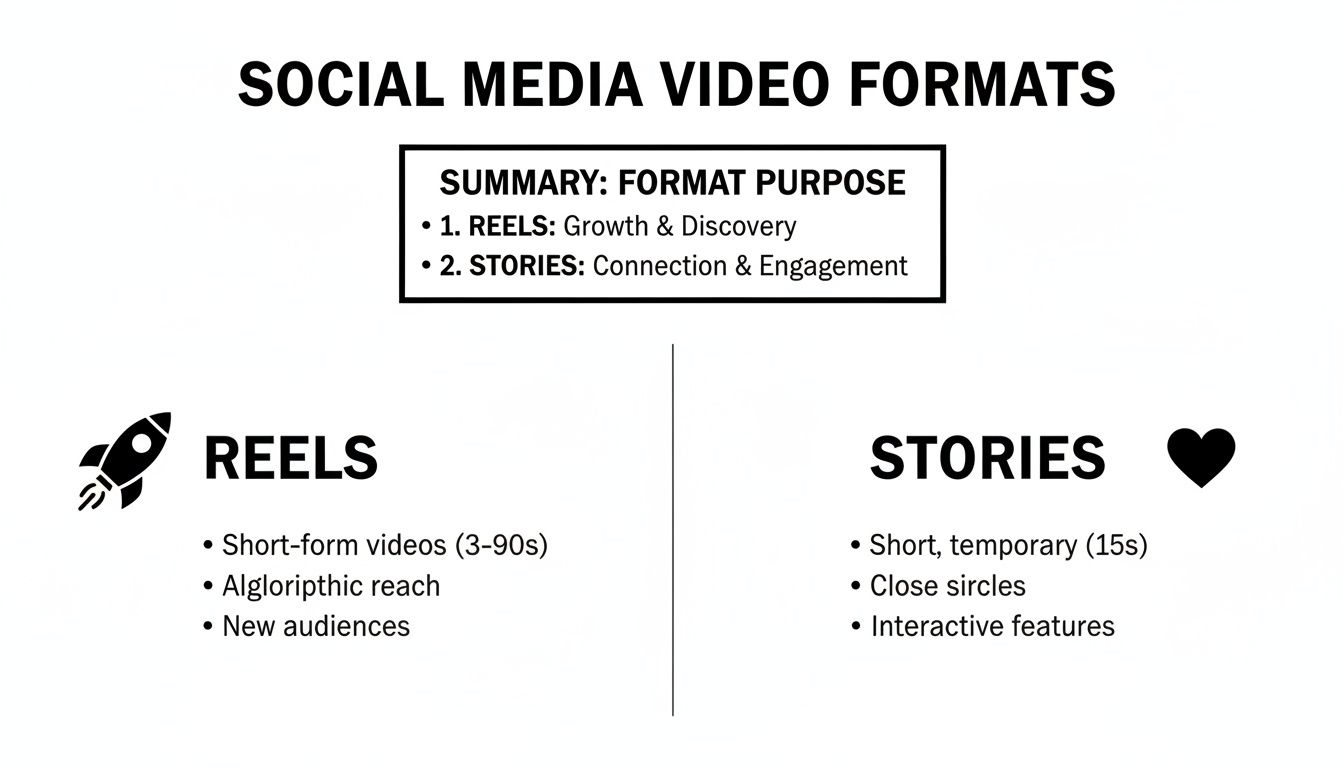
The rocket icon for Reels and the heart for Stories perfectly capture their separate but complementary roles. One is for launching your brand to new heights, the other is for nurturing the audience you already have.
Lifespan and Permanence
The most fundamental difference is how long the content sticks around. Reels are permanent assets. They live on your profile’s dedicated Reels tab and can be featured on your main grid, which means they can act as evergreen content, pulling in new viewers for weeks or even months after you post them.
On the flip side, Stories are ephemeral, disappearing after just 24 hours unless you manually save them to your Profile Highlights. This fleeting nature creates a sense of FOMO (fear of missing out) and encourages people to watch immediately, making them perfect for in-the-moment updates, not long-term brand building.
A Reel is an evergreen asset for your brand; a Story is a fleeting conversation with your community.
Content Length and Format
How long your video can be directly impacts the kind of story you can tell. Reels give you more room to work with, allowing for more developed narratives with a maximum length of up to 90 seconds. That extra time is ideal for tutorials, behind-the-scenes looks, or short-form educational content.
Stories are built for quick, bite-sized updates. Each individual Story, whether it's a video or an image, is much shorter—video clips are capped at 60 seconds per frame. You can string multiple frames together, but the experience is designed for rapid taps, not a long, sustained watch. To make sure everything looks right, it's always a good idea to check an Instagram Story size guide.
Visibility and Audience Reach
This is where the algorithm creates a massive divide. Reels are designed for discovery. The algorithm actively pushes them to users who don't already follow you, featuring them heavily on the Explore page and the main Reels feed. This makes them your number one tool for reaching new audiences and driving broad brand awareness.
Stories, however, are primarily shown to your existing followers. They appear in the dedicated bar at the top of the home feed, targeting the people who have already decided they want to hear from you. Their visibility is all about nurturing relationships with your current community, not finding new members.
Creative and Technical Specifications
Both formats offer a suite of creative tools, but they’re geared toward different outcomes. Reels focus on features that boost shareability and help you jump on trends, while Stories prioritize direct, one-on-one interaction.
Here's a detailed breakdown of the technical specs and creative tools available for each format.
As you can see, the toolset for each is intentionally different. Reels give you features like Remix and Trending Audio to help your content spread, while Stories offer interactive stickers like Polls, Quizzes, and the crucial Link Sticker to drive immediate action from your loyal followers.
For a deeper dive into getting your visuals just right, check out our guide on the https://www.moonb.io/blog/best-video-formats-and-aspect-ratios-for-maximum-engagement to really maximize engagement.
How the Algorithm Treats Reels vs Stories
For any marketing leader, the biggest difference between Reels and Stories is how Instagram’s algorithm treats them. This isn't just a minor technical detail; it's the core of how you should think about allocating creative resources. Each format was built for a completely different purpose, and that dictates who sees your content and why.
Reels are Instagram’s engine for discovery and growth. The algorithm is engineered to push your content far beyond the people who already follow you. It actively serves your video to fresh eyes on the Reels tab, the Explore page, and even right in their main feeds based on their interests and past behavior.
The whole system is built to reward entertainment and shareability. When a Reel racks up high watch times, shares, and saves, it sends a powerful signal to the algorithm: this is good stuff, show it to more people. That's how viral loops are born.
The Reach and Discovery Divide
The numbers really spell it out. When it comes to reach, Reels just blow Stories out of the water. On average, Reels hit a reach rate of 30.81%—that's more than double the rate for Stories, carousels, or single image posts. This makes them an absolute powerhouse for getting discovered, according to an in-depth analysis of Instagram Reels statistics.
Think about that. Nearly a third of your potential audience might see your Reel, while Stories are stuck with a much tighter, follower-focused distribution that usually sits below 15% for most accounts.
This is exactly why a killer Reel can pull in thousands of views from people who have never heard of you, while a really engaging Story gets tons of love from a smaller, dedicated group of your existing fans. If you want to dig deeper, we have a whole guide on the techniques that trigger virality.
Stories and Follower-First Curation
Now, let's flip the coin. The algorithm treats Stories as a tool for retention and community building. It has zero interest in pushing your Stories to a broad, unknown audience. Instead, it carefully curates them for the people who already follow you, sticking them right at the top of their home feed.
The order of those Stories isn't random, either. It’s based on which accounts a user interacts with the most. So, your most loyal, engaged followers are the ones most likely to see your Stories first.
Think of the Reels algorithm as a talent scout, always searching for the next big hit to show the world. The Stories algorithm is more like a close friend, sharing updates only with those who have already shown they care.
This follower-first approach is what makes Stories perfect for nurturing relationships, getting direct feedback, and pushing for immediate action from a warm audience. The entire system is designed for depth of connection, not breadth of reach.
Measuring Success with the Right KPIs
It’s easy to get lost in vanity metrics, and they can tank even the most creative social media strategy. To really get a handle on the difference between Reels and Story performance, marketing directors have to track the right Key Performance Indicators (KPIs) for each format. If you’re not measuring what matters, you can’t accurately report on impact or ROI.
The simple truth is that Reels and Stories are built for different jobs, so their success metrics are fundamentally different. Think of Reels as your growth engine—their KPIs should reflect how well you’re expanding your audience and how your content resonates with people who don't follow you yet. Stories, on the other hand, are your community-building tool, so their KPIs need to measure loyalty and direct engagement from your existing followers.
Growth Metrics for Reels
With Reels, it’s all about discovery. Sure, high view counts are a nice start, but the deeper metrics tell you if you’re actually reaching new, relevant audiences. Keep your eyes on these growth-oriented KPIs:
- Reach and Plays: This is your top-of-funnel bread and butter. How many unique accounts saw your Reel? A high reach number, especially from non-followers, is solid proof your content is cutting through the algorithm's noise. If you want to dive deeper, check out our guide on understanding reach and impressions.
- Shares and Saves: These are pure gold because they signal real content value. A Share means someone found your Reel so useful they passed it along to a friend, doing your marketing for you. A Save tells you the content is evergreen and worth coming back to—a huge win for educational or inspirational videos.
A Reel with massive reach but barely any saves might be entertaining for a moment, but it's ultimately forgettable. A Reel with high saves, even with a smaller initial reach, becomes an asset that builds brand authority and delivers lasting value.
Engagement Metrics for Stories
Success for a Story isn’t about going viral; it's about strengthening the relationships you already have. The focus here shifts from broad reach to deep, meaningful interactions. Your primary KPIs should be:
- Interaction Rate: This covers all those taps on stickers like Polls, Quizzes, and Sliders. These metrics are a direct line into how actively your community is participating in the conversations you start.
- Reply Rate and DMs: A direct message is one of the highest-value interactions you can get on Instagram. A high reply rate shows your content feels personal, hits home, and is successfully building a one-on-one connection.
- Link Clicks: When it comes to bottom-of-funnel goals, this is your most important Story metric. It tells you exactly how effective you are at driving your nurtured audience to take a specific action, whether that's visiting a landing page or making a purchase.
At the end of the day, the data tells the most compelling story about the difference between Instagram Reels and Stories. On average, Reels pull in an engagement rate of 3.21%, while Stories lag behind at just 1.08%. That's a nearly threefold difference, which is precisely why brands focused on boosting visibility and grabbing wide-scale attention are all-in on Reels. You can find more data about Reels and Stories engagement rates on seizemarketingagency.com. By measuring what truly matters for each format, you can build a balanced strategy that uses Reels to grow your audience and Stories to convert them.
Matching Each Format to Your Marketing Funnel
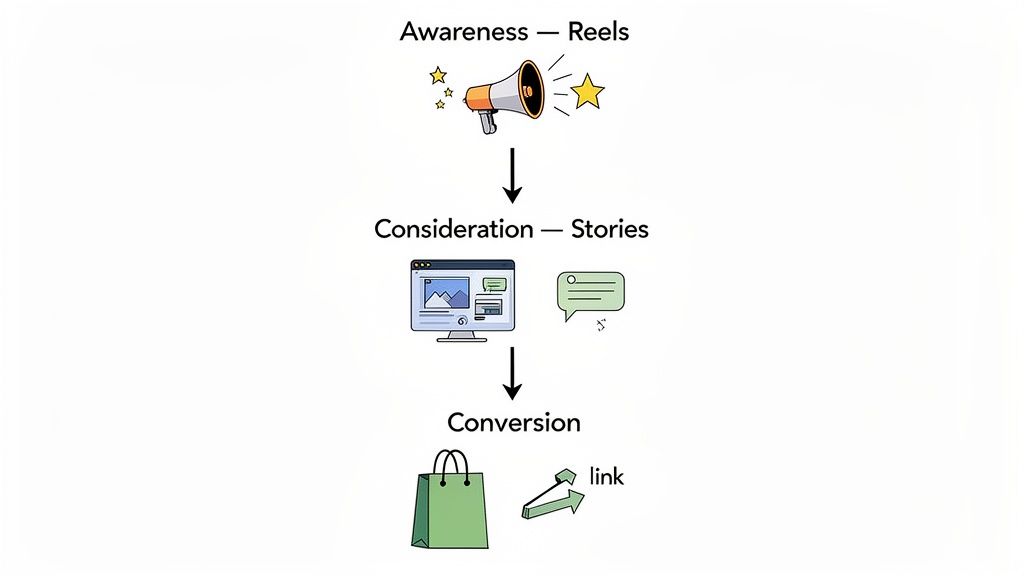
Knowing the technical specs is one thing, but knowing when to use each format is what really moves the needle. The simplest way to make the call is to map your content directly to your marketing funnel. Each format has a specific job to do, whether it’s getting new eyes on your brand or nudging a loyal follower to finally click “buy.”
Think of it this way: Reels are your top-of-funnel powerhouse. They’re built to cast a wide net and get you in front of people who’ve never even heard of you. Stories, on the other hand, are your mid-to-bottom-funnel workhorse, perfect for nurturing the community you already have and pushing them toward a specific action.
Top of Funnel (Awareness): Go with Reels
When you're at the awareness stage, it's all about discovery. You need content that can break out of your follower bubble and make a killer first impression. This is exactly what Reels were designed for.
- Educational Content: Drop some knowledge with short, value-packed tutorials or quick tips that solve a real problem for your ideal customer.
- Trend Participation: Jump on trending audio and video concepts to slide your brand into broader conversations, putting you in front of thousands of potential new fans.
- Brand Storytelling: Use the 90-second format to tell your origin story or share your mission in a way that’s actually entertaining. It’s a shortcut to building an instant connection.
Mid-Funnel (Consideration): Nurture with Stories
Once someone hits that follow button, the game changes. You’re no longer trying to get discovered; you’re trying to build trust. Stories are the perfect tool for this, creating a much more intimate, one-on-one vibe.
- Product Demos: Walk people through how your product works. A few quick Story frames can answer common questions and squash objections in a super casual, no-pressure way.
- Behind-the-Scenes Access: Show them the real stuff—your team, your workspace, your messy creative process. That kind of transparency makes your brand feel human and authentic.
- Q&As and Polls: Don't just talk at your audience; talk with them. Ask for their opinions, answer their DMs, and make them feel like they're part of the conversation.
A Reel attracts a stranger with a hook. A Story turns that stranger into a friend by showing them you're listening.
Bottom of Funnel (Conversion): Convert with Stories
Okay, it’s time to make the sale. For that final push, you need to drive a specific, immediate action. With their interactive features and sense of urgency, Stories are tailor-made for closing the deal. Use the link sticker to drive:
- Flash Sales and Limited-Time Offers
- Exclusive Discount Codes for Followers
- New Product Launch Announcements
While Stories are your go-to for immediate sales, don't count Reels out completely. An evergreen Reel that acts as a powerful testimonial or case study can be a great asset for new leads to find and reference as they get closer to making a decision.
Your Top Questions, Answered
Even with a solid game plan, you'll still run into specific questions when you're in the trenches, deciding between these two formats. Let's clear up some of the most common ones to help you fine-tune your approach.
Should I Post the Same Content to Both Reels and Stories?
In a word, no. While you can always share a Reel to your Story to give it an extra push, the content itself needs to be built for its native environment. Reels are your polished, entertaining, and often educational videos designed to be discovered by people who don't follow you yet. They live on your profile forever, so they should be high-quality assets.
Stories, on the other hand, are for your current followers. They thrive on the raw, interactive, and "you-had-to-be-there" content. Think about it: posting a Story-style poll as a Reel just wouldn't land. The interactive stickers don't work, and that in-the-moment feel is completely out of place in a feed built for discovery.
How Often Should a Business Post Reels vs. Stories?
This really comes down to your team's bandwidth and what you're trying to achieve.
For Stories, the name of the game is consistency. You want to stay top-of-mind, so aiming for daily activity—maybe 3-5 Story frames per day—is a great way to keep your audience tuned in for timely updates.
With Reels, it's all about quality over quantity. The algorithm rewards content that genuinely hooks people, not just a high volume of posts. A good starting point is to aim for 2-3 high-quality Reels per week. A steady, predictable cadence is far more effective than just dumping a bunch of videos whenever you have time.
Here's the core difference: Reels are your evergreen marketing assets built for growth. Stories are your daily conversations built for nurturing your community. Their production schedules should reflect that.
Can Reels Just Replace Stories Altogether?
Not a chance. They serve fundamentally different strategic roles, and thinking one can replace the other is a classic mistake that can seriously stall your growth.
If you only focus on Reels, you're constantly chasing new followers while completely ignoring the people who already chose to follow you. That's like spending all your time trying to get new customers in the door but never speaking to the ones already in your store.
Stories are your tool for building real relationships. They let you gather direct feedback with polls and Q&As and drive immediate traffic in a way Reels simply can't. A smart, balanced strategy uses Reels to attract new faces and Stories to turn those new faces into loyal fans and customers.
Ready to scale up your creative for both Reels and Stories without the overhead? Moonb gives you a dedicated creative team on a simple monthly subscription. Get consistent, high-quality video and design assets on demand.