

What Does a Creative Director Do?


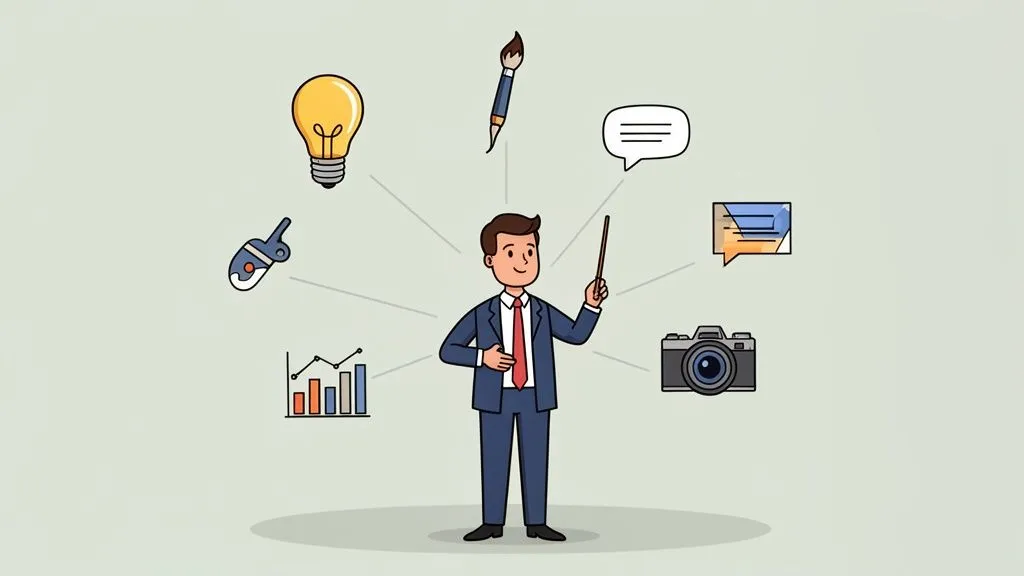
Think of a creative director as the visionary leader of a brand's creative orchestra. While your designers, writers, and videographers are the skilled musicians playing their parts, the creative director is the one making sure every note combines into a powerful, cohesive symphony—one that actually moves an audience and hits business goals.
The Conductor of Brand Creativity
.jpg)
So, what does a creative director really do, besides making things look good? They are the translators, turning abstract business objectives into a tangible, unified creative vision. Their job is to be the bridge between high-level strategy and day-to-day execution.
This ensures every single piece of content—from a quick social media post to a massive ad campaign—feels like it comes from the same brand and serves a clear purpose. It's all about setting the "why" before the team even starts thinking about the "how." They establish the emotional tone, the visual style, and the core story that guides the entire creative process.
To give you a clearer picture, here’s a quick breakdown of how a Creative Director splits their time between big-picture thinking and hands-on guidance.
Creative Director Role At a Glance
This table shows how the role is a constant balancing act. A great Creative Director lives in both worlds, connecting the dots between the boardroom and the design software.
Strategic Vision and Leadership
At its core, a creative director's value comes from their ability to maintain a 30,000-foot view. They aren’t just managing projects; they are curating the entire brand experience.
This involves a few key things:
- Defining the Creative North Star: They set and fiercely protect the brand's look, feel, and voice across every single channel.
- Mentoring Creative Talent: They guide and push designers, copywriters, and other creatives to produce the best work of their careers.
- Championing Great Ideas: They have to fight for bold, sometimes scary, creative concepts and get buy-in from key stakeholders who might be risk-averse.
It’s a highly valued position because it directly ties creative output to business performance. The average salary for a Creative Director in the US is $102,782 in base pay, but total compensation can climb as high as $183,000. This number reflects just how crucial their strategic input is for shaping brand perception and driving real results.
A creative director's ultimate goal is to ensure that the creative work is not only beautiful and innovative but also effective. They are the guardians of the brand's soul, making sure its story is told consistently and compellingly.
Clarifying Creative Roles
It’s easy to get the creative director confused with other senior creative roles. To really nail down the differences, it helps to compare a Creative Director vs Art Director.
While an Art Director is typically deep in the weeds, focusing on the visual execution of a specific project, the Creative Director’s scope is much broader. They're thinking about the overarching strategic vision for the entire brand, not just one campaign. We break it down even further in our detailed comparison of the Creative Director and Art Director roles.
A Day in the Life of a Creative Director
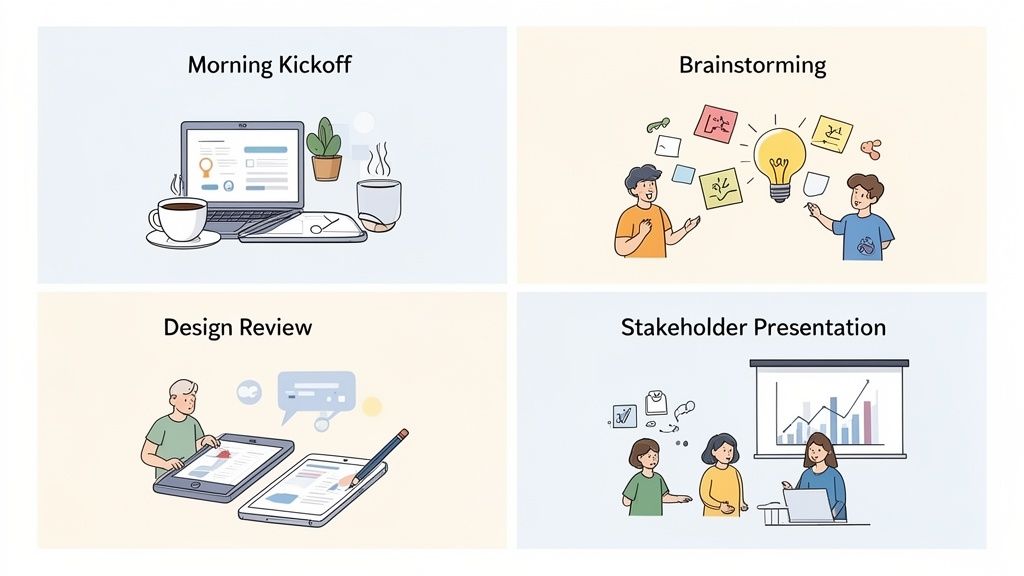
The title "Creative Director" might sound a bit lofty, but the day-to-day reality is a fast-paced mix of big-picture strategy and in-the-weeds creative guidance. No two days are ever the same. One minute you're in a budget meeting, the next you're deep in a conversation about a brand's core story.
So, to pull back the curtain, let's walk through what a typical day might look like. Think of it as a journey from a raw idea to a polished final piece, with the creative director clearing the path for their team every step of the way.
Morning: The Strategic Kickoff
A creative director’s day often kicks off not in Photoshop, but in a conference room. They might join the head of marketing and a product manager to get the ball rolling on a new campaign. This first meeting isn't about colors and fonts; it's about digging into the why.
Their job here is to ask the tough, clarifying questions:
- Who are we really talking to with this campaign?
- What is the one thing we absolutely need them to walk away knowing?
- How do we want them to feel?
- What does success actually look like for this project?
By zeroing in on these answers, the creative director builds the strategic foundation for everything that follows. This is non-negotiable. Without it, you get creative work that might look nice but doesn't move the needle. A solid strategy ensures the work is not just beautiful, but strategically sound and goal-oriented. They are the translator, making sure the business goals are crystal clear before a single pixel is pushed. A well-defined strategy at this stage is essential, and you can learn more about how to structure this with a comprehensive creative brief template.
Midday: The Brainstorm and Mentorship
With the strategy locked in, the focus pivots inward to the creative team. This part of the day is all about sparking ideas and providing a clear sense of direction. They'll often lead a brainstorm, creating a space where writers, designers, and video producers feel safe to throw wild ideas at the wall.
A great creative director knows their job isn't to have all the best ideas themselves. It's to guide the team toward the best solution. They provide the guardrails for the creative process, maybe by starting with a few keywords or themes that capture the project's soul.
The creative director's true art is nurturing the creative spark in others. They are part talent scout, part therapist, and part strategic guide, knowing exactly when to push an idea forward and when to gently steer the team in a new direction.
After the brainstorm, it’s time for one-on-one reviews. They might sit with a graphic designer looking at initial mockups for an ad. The feedback is always specific, constructive, and tied directly back to the strategic goals: "The layout is super clean, but let's try a warmer color palette to really hit that 'approachable' brand tone we talked about."
Afternoon: The Stakeholder Presentation
Later in the day, the lens zooms back out. The creative director becomes the chief advocate for the team’s work, tasked with presenting and defending the creative concepts to executives and other key stakeholders. This is where their powers of persuasion and communication really shine.
They don't just show a design; they tell the story behind it. They carefully connect every creative choice—every color, font, and photo—back to the business objectives from the morning kickoff. They explain why a certain visual will connect with the target audience and deliver the results everyone agreed on.
This critical role requires them to:
- Articulate the creative vision in clear, compelling business terms.
- Anticipate and address potential concerns before they even come up.
- Secure the buy-in and budget needed to bring the vision to life.
By day's end, the creative director has worn many hats: strategist, mentor, critic, and champion. They’ve made sure the creative engine isn’t just running, but is heading in the right direction, turning abstract goals into tangible, brand-defining work.
The Essential Skills of a Creative Director
What’s the real difference between a sharp senior designer and a great creative director? It's not just about logging more hours in Figma. It's about a fundamental shift in their skillset. While a designer perfects the craft of making things, a creative director masters the strategy behind why things are made and has the leadership chops to make it all happen.
Their toolkit is a unique mix of hard and soft skills. They need to speak the language of business just as fluently as they speak the language of design, and they have to know how to inspire a team of creatives to do their best work. This dual focus is precisely what makes the role so valuable—and so different from others on the creative team.
The Hard Skills of Creative Leadership
A creative director’s hard skills are the bedrock of their strategic and technical know-how. This isn't about being the fastest in Adobe Creative Suite anymore; it's about having the vision to shape the entire brand narrative from 30,000 feet.
Here’s what that looks like in practice:
- Brand Strategy: They need to be able to zoom out and see the whole picture—the company’s market position, who the audience is, and what the business is trying to achieve. Then, they translate all that into a clear, unified creative vision.
- Campaign Development: This is the ability to dream up and map out multi-channel campaigns, ensuring every single touchpoint—from a social media ad to a billboard—feels like it’s part of the same cohesive story.
- Art and Design Principles: A great CD has a deep, almost intuitive grasp of what makes a design work. They know typography, color theory, and composition inside and out, which lets them give sharp, decisive feedback that elevates the team's work.
- Copywriting and Storytelling: While they might not be writing every line of copy, they have to be incredible story editors. They spot powerful narratives and guide the writing to connect with people on an emotional level. Our guide to visual storytelling examples dives into just how powerful this can be.
These skills aren’t abstract; they lead to tangible outputs that guide the entire creative department. The creative director is the one producing the foundational documents—brand style guides, campaign concept decks, and rock-solid creative briefs that act as the North Star for everyone else.
The Soft Skills of Creative Influence
If hard skills are the map, soft skills are what get everyone excited about the journey. A creative director's success often hinges on their ability to lead, persuade, and collaborate effectively.
These are the skills that make or break a creative leader:
- Team Leadership and Mentorship: They have to build a culture where designers, writers, and other creatives feel safe enough to take risks and are genuinely motivated to push their own boundaries. It's about fostering talent, not just managing tasks.
- Persuasive Communication: A huge part of the job is selling the creative vision. This means articulating the strategic "why" behind design decisions to stakeholders and getting buy-in from executives who might not have a creative background.
- Stakeholder Management: They are the ultimate creative buffer, acting as the main point of contact for feedback from executives, marketing leads, and clients. This protects the team from confusing, contradictory requests and keeps projects on track.
Ultimately, a CD’s day is spent managing multidisciplinary teams, from motion designers to scriptwriters. This strategic oversight is why they command a salary premium. Creative directors can earn an average of $144,518, a significant jump from senior graphic and product designers. The premium isn't just for experience; it's for the leadership that connects creative work directly to business goals. You can see more salary data in this creative industry salary guide.
A creative director's job isn't just to have the best ideas, but to create an environment where the best ideas can be born, nurtured, and defended.
To really see how these skills make the role unique, it helps to compare it to others in the creative pipeline. The table below breaks down the key differences in focus and responsibility.
Creative Director vs Art Director vs Senior Designer
This table clarifies the key differences in responsibilities, focus, and strategic impact between a Creative Director, an Art Director, and a Senior Designer.
This breakdown makes the leadership premium crystal clear. While a senior designer produces fantastic work and an art director makes sure a project looks incredible, the creative director is the one held accountable for making sure all that creative effort actually moves the business forward.
How to Integrate Creative Leadership into Your Team
Bringing a creative director into your marketing organization can be a total game-changer, but only if you set them up for success. You can't just drop them onto the org chart and hope for the best. You need a clear workflow that makes them the central hub connecting high-level marketing strategy with the day-to-day creative grind.
When you get it right, a creative director doesn't just manage creatives; they make the entire marketing function stronger. Think of them as a translator. They take the marketing director's business goals, KPIs, and audience insights and turn them into a compelling vision the production team can actually get excited about and build from.
This simple act of translation prevents so many common headaches. No more marketing goals getting lost in translation or creative work that looks pretty but completely misses the mark. Instead, the creative director ensures every single asset is both on-brand and on-brief from the get-go.
Establishing a Proven Workflow
The best way to structure this relationship is with a clear, linear handoff process. This creates accountability and lets each leader play to their strengths. The creative director becomes the bridge between strategy and production, not another barrier.
Here’s a practical, step-by-step look at how this flow works in the real world:
- Marketing Defines the "Why": The whole process kicks off with the marketing director or department head. Their job is to define the campaign's core business objectives, nail down the target audience, craft the key messaging points, and decide how success will be measured (the KPIs).
- Creative Director Builds the "How": Now, the creative director steps in. They take all that strategic input and distill it into a powerful creative brief. This document is the roadmap, outlining the visual direction, emotional tone, and narrative concept that will guide the entire production team.
- Production Team Executes the Vision: With a crystal-clear brief in hand, the designers, writers, and videographers can do what they do best—create. The creative director oversees this process, providing feedback and making sure the final output lines up perfectly with the initial strategy.
This visualization shows how a creative director’s core functions guide a project from strategy all the way to execution and management.
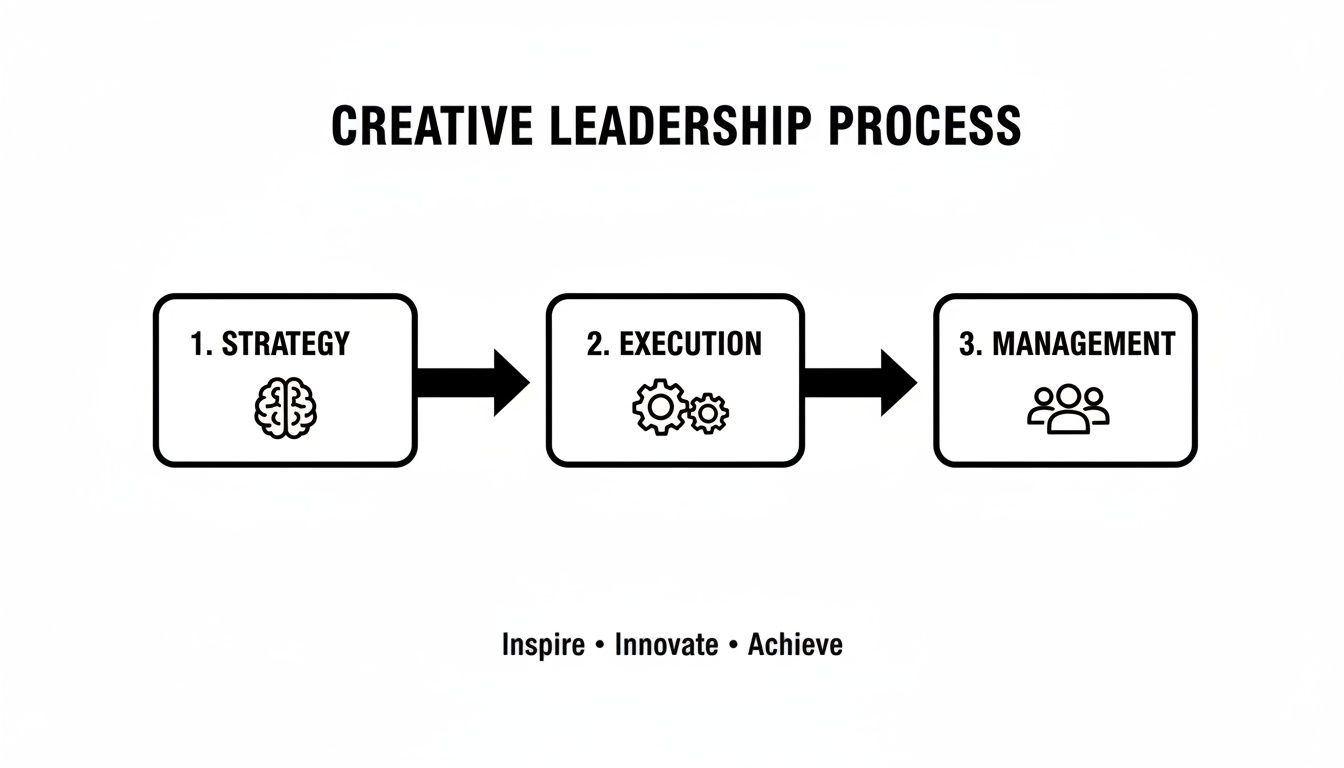
This flow highlights the director’s role: to inspire with a clear strategy, innovate during the execution phase, and ultimately, hit those business goals.
Communication and Feedback Loops
Of course, a structured workflow is only as good as the communication that holds it together. Vague feedback and siloed conversations are the enemies of great creative work. You have to establish clear communication protocols to keep projects moving and everyone on the same page.
Try putting these best practices into place:
- Centralized Feedback: Ditch the random Slack messages and email threads. Use a shared platform or document for all creative feedback. This gives the creative team a single source of truth and prevents conflicting notes from derailing the project.
- Regular Check-ins: Schedule brief, consistent stand-ups or weekly reviews. These aren't for micromanaging; they’re for unblocking the team and making sure everyone is aligned on priorities and progress.
- Shared Dashboards: A project management tool with a shared dashboard creates transparency for the entire marketing org. Anyone can see project statuses, timelines, and final deliverables in one spot.
By defining clear roles and communication channels, you empower the creative director to be the strategic guardian of the brand's creative output. This ensures every piece of content is not just aesthetically pleasing but is a hard-working asset driving toward your marketing objectives.
This blueprint transforms the creative director from a simple manager into a true strategic partner. They become the force that guarantees your marketing goals are met with on-brand, high-impact work, every single time. For teams looking to implement this structure, learning how to build an in-house creative team with the right roles and processes is a crucial first step.
Measuring the ROI of Creative Direction
Strong creative leadership is so much more than just making things look good; it's a direct investment in your business's growth. While the "beauty" of a campaign might feel subjective, the impact of a great creative director is anything but. Their work translates directly into measurable outcomes that show up on the bottom line.
Forget seeing this role as a cost center. It's time to understand it as a revenue-driving asset. A creative director’s strategic oversight is the thread that connects every design choice, line of copy, and video edit back to real business goals. This is how you stop just making content and start making content that works.
Connecting Creative Vision to Business KPIs
A creative director’s success isn't measured in awards or compliments. It's measured in key performance indicators (KPIs) that directly reflect their influence on the brand's health and profitability. Their strategic guidance is specifically designed to move the needle on trackable metrics.
Here are a few core KPIs a creative director owns:
- Improved Brand Consistency: By creating and enforcing a unified vision, they make sure every customer touchpoint feels cohesive. This builds trust and strengthens brand recall over time.
- Higher Audience Engagement: Their knack for crafting compelling stories and visuals leads to content that truly resonates, driving up likes, shares, comments, and click-through rates.
- Increased Conversion Rates: A creative director is all over A/B testing ad creative, using data to fine-tune visuals and messaging. This constant optimization leads to ads that convert better, lowering customer acquisition costs.
- Faster Campaign Turnaround Times: With a clear vision from day one, the creative team wastes less time on confusing revisions. They can focus on producing high-quality work and getting campaigns to market faster.
The true ROI of a creative director is seen when brand perception shifts, engagement climbs, and conversion funnels become more efficient. They are the strategic link between a beautiful idea and a profitable outcome.
From Creative Oversight to Revenue Growth
A creative director is in a unique spot, bridging the gap between creative execution and business strategy. They are constantly reviewing creative, forecasting trends, and measuring campaign performance to squeeze out every last drop of growth. This involves everything from approving budgets and negotiating with vendors to making sure every single output is aligned with KPIs like ROI and conversion rates.
Their total pay, which can range from $56k-$183k, often includes profit sharing—a clear sign of the measurable impact they're expected to deliver. You can find more insights on how creative director compensation is tied to performance.
This level of leadership leads to more decisive A/B tests and a much bigger impact on the bottom line. For instance, by making sure creative assets are not only on-brand but also optimized for performance, they can significantly lift campaign results. Strong creative leadership also streamlines the entire content pipeline, making effective marketing asset management a core benefit of their role. Their guidance ensures that every asset produced is a strategic tool built for maximum impact.
So, when it comes down to it, how does a creative director drive ROI? They align every single creative decision with a specific business objective. They transform the creative department from a team that makes things look good into a powerhouse that actively drives revenue and strengthens the brand’s position in the market.
The Modern Way to Access Creative Direction

Here’s a common growing pain: your company needs top-shelf creative strategy long before it has the budget for a six-figure executive. The old-school path of launching a long, expensive search for a full-time creative director just isn’t practical. This leaves you in a tough spot, scaling up marketing efforts without the unified brand vision that makes them actually work.
This is where a totally different, more agile approach is making waves. On-demand creative subscription services are changing the game completely. They treat creative leadership less like a permanent headcount and more like a scalable utility you can plug right into your marketing team. It’s a new way of answering "what does a creative director do?" by zeroing in on the function, not just the job title.
The Subscription Model Explained
Imagine having all the horsepower of a seasoned creative director—the strategic mind, the brand guardianship, the team mentorship—but without the headaches of a traditional hire. That’s the magic of a creative subscription. For one predictable monthly fee, you get instant access to a dedicated creative director and their entire production crew.
This model is a fundamental shift in how businesses get their hands on elite creative talent. Instead of burning months and thousands on recruiting, you can have an entire creative department ready to roll in just a few days. For fast-moving companies that can't afford to hit pause on their brand, that kind of agility is a massive advantage.
An on-demand creative director gives you the strategic engine of an in-house leader with the plug-and-play flexibility of a subscription. It tears down the barriers to world-class brand guidance, making it a real possibility for businesses at any stage.
Key Benefits of Creative as a Service
This isn't just a temporary fix; it's a smart, strategic move that offers some serious perks over the old way of doing things. It’s all about getting the right expert on board at the exact moment you need them.
- Eliminate Hiring Delays and Costs: You get to skip the entire recruitment circus. That means saving months of time and the hefty fees that come with headhunters and endless interviews, giving you immediate access to vetted, top-tier talent.
- Gain Immediate Strategic Oversight: Your dedicated creative director jumps in from day one, ready to translate your business goals into a clear, actionable creative vision that your marketing team can run with.
- Scale Without Overhead: Gearing up for a big launch and need to crank out content? You can scale up your creative output in an instant without adding permanent salaries or juggling freelance contracts.
- Predictable, Transparent Pricing: A flat monthly fee means no surprise invoices or scope creep. You get unlimited requests and revisions, which lets you plan your budget with confidence and gives your team the freedom to explore creative ideas.
This model is built for the reality of modern marketing, where the demand for high-quality, on-brand creative never stops. It ensures every dollar you put into marketing is backed by a cohesive, compelling creative strategy that turns your brand's vision into an engine for growth.
Frequently Asked Questions About the Creative Director Role
Navigating creative team structures can feel a little murky. As your company scales, figuring out what a creative director actually does—and when you need one—is key to keeping your brand sharp and your marketing effective. Let’s clear up some of the most common questions leaders have about this role.
What Is the Main Difference Between a Creative Director and a Marketing Director?
Think of it this way: a Marketing Director is focused on the "what" and "why" of a campaign—the strategy, the audience, the budget, and the business goals. They set the destination.
A Creative Director, on the other hand, is all about the "how." They’re the ones translating that strategy into a creative vision that connects with people on an emotional level. They design the vehicle that gets you to the destination in style.
They are two sides of the same strategic coin. One defines the market objective; the other crafts the creative message to hit it.
Do I Need a Creative Director if I Already Have Senior Designers?
In most cases, yes, especially when you start to scale. Your senior designers are masters of their craft—they can execute projects beautifully. But a Creative Director provides the high-level, long-term vision that ties everything together.
They act as the guardian of the brand's creative soul, ensuring every campaign, social post, and landing page feels like it came from the same place. This frees up your senior designers to do what they do best—create amazing work—without getting pulled into endless high-level strategy meetings.
A Creative Director’s job is to protect the brand's creative integrity from a bird's-eye view, making sure every single project contributes to a cohesive brand story. That’s a fundamentally different job than the project-level focus of a senior designer.
At What Stage Should My Business Hire a Creative Director?
The alarm bells usually start ringing when brand consistency and creative quality become non-negotiable for growth. This tipping point often shows up when you find your team:
- Scaling marketing across a bunch of new channels at once.
- Launching major campaigns that absolutely need a single, unified vision.
- Noticing the brand message is getting diluted or inconsistent across different touchpoints.
But bringing on a full-time executive is a huge commitment. Before you jump into a lengthy and expensive hiring process, consider a more flexible approach. An on-demand model gives you access to that crucial strategic oversight right when you need it, making it a viable option even for earlier-stage companies. You get the expert guidance to elevate your brand without the long-term overhead.
Ready to integrate expert creative direction without the overhead? With Moonb, you get a dedicated Creative Director and a full production team on a simple monthly subscription. Get world-class creative leadership on demand.