
The Average Cost of Video Production Demystified


Here's the bottom line right up front: the average cost of video production usually lands somewhere between $1,500 and $50,000. But let's be honest, a single "average" number is almost always misleading.
It’s like asking for the "average cost of a car." A reliable sedan gets you from A to B, but it serves a totally different purpose—and has a wildly different price tag—than a high-performance sports car. Video production works the exact same way.
Why a Single Average Cost Is a Myth
Trying to nail down one average price for a video is a fool's errand. Why? Because every single project is a unique mix of creative vision and practical resources. The final number on the invoice isn't pulled from a simple price list; it's shaped by the interplay of three core factors: quality, complexity, and scope.
A simple talking-head video for social media has completely different requirements than a polished, animated explainer video with custom graphics and a professional voiceover. This is precisely why one project might cost $2,000 and another $20,000. Once you get a handle on these drivers, you can stop guessing and start budgeting strategically.
"The true cost of a video isn't just the price on the invoice. It's the sum of all the creative and technical decisions made from script to final cut. Every choice, from the camera used to the complexity of the graphics, has a direct impact on the budget."
Key Factors That Shape Your Budget
To get a realistic estimate, you need to look at the building blocks that make up your final quote. These variables are at the heart of any production, whether it's big or small.
- Production Quality: This covers everything from the camera resolution (think HD vs. 4K) and lighting setups to the experience level of the crew. Higher quality demands better gear and more skilled professionals, which naturally drives up the cost.
- Complexity: A straightforward interview in one location is far less complex than a narrative story with multiple locations, actors, and slick visual effects. Animation, in particular, introduces layers of complexity that require very specialized talent.
- Scope & Length: The overall scale of the project is a huge factor. This includes the final video's runtime, the number of shooting days required, and just how much footage needs to be sorted through and edited in post-production. You can get a better sense of how scope changes by exploring the different types of video content.
This reality is playing out in a booming market. The global video production industry shot up from USD 70.40 billion in 2022 to an estimated USD 98.99 billion in 2023, and projections are only climbing. For marketing leaders, this explosive growth is actually creating new opportunities for efficiency. As Grand View Research's analysis shows, innovative models like fixed-fee subscriptions can offer serious savings over the traditional per-project pricing grind.
Understanding Your Video Production Budget Line by Line
To really get a handle on video production costs, you have to look past the final price tag and see where every single dollar goes. Think of it like an itemized receipt for building a house. You don't just pay a lump sum for "a house"; you see the costs for the foundation, the framing, the electrical, and all the finishing touches.
Each part is crucial, and understanding the breakdown helps you see the true value you're getting. Every video project is split into three distinct phases, each with its own list of costs.
This chart breaks down the three core elements that really drive your video's final cost: quality, complexity, and scope.
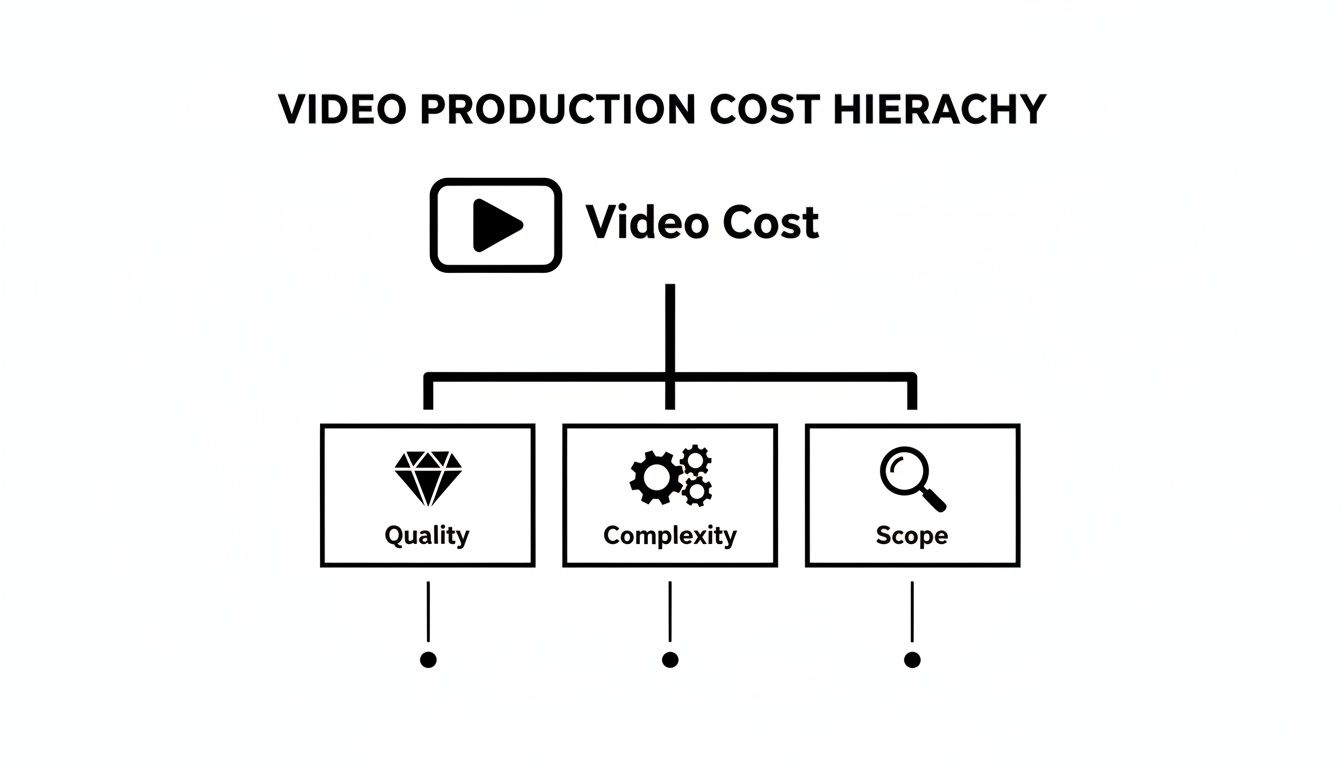
As you can see, every decision you make flows down from these three big-picture factors, touching every line item from the initial planning to the final delivery.
Phase 1: Pre-Production – The Strategic Blueprint
This is the planning stage, and it’s arguably the most important one. Getting pre-production right prevents expensive mistakes and reshoots later. It’s the architectural plan you finalize before a single brick is laid.
Here are the key costs you'll see in this phase:
- Scriptwriting & Storyboarding: A professional script can run anywhere from $500 to $5,000, based on its length and the research needed. A storyboard, which visually maps out every shot, will add another $500 to $2,500.
- Creative Direction & Strategy: This is where the core concept, messaging, and visual style get hammered out. A Creative Director's time is a major investment, but it's what ensures the final video actually hits your business goals.
- Logistics & Coordination: This bucket covers all the behind-the-scenes work—scouting locations, securing permits, casting talent, and scheduling the entire crew. It's time-consuming but absolutely essential for a smooth shoot.
Phase 2: Production – The Filming Day
This is what most people picture when they think of video production: the actual shoot. Costs here are usually calculated on a day-rate basis, and they can stack up fast.
Here’s where the money goes on set:
- Crew: The size and experience level of your crew are huge cost drivers. A small shoot might just need a camera operator and a sound tech. A bigger production could have a Director, Director of Photography (DP), gaffers for lighting, grips, and a handful of production assistants. Day rates can start at $500 for a junior crew member and go well over $2,000 for a seasoned DP.
- Talent: Hiring professional actors can cost between $500 to $2,500+ per day, depending on their experience and if they're union. Using your own employees can save cash, but be prepared for extra coaching and more takes.
- Equipment: The camera is just the start. The budget also needs to cover professional lighting, audio gear like microphones and mixers, tripods, dollies, and maybe even specialized equipment like drones or gimbals. A basic camera rental package might be $300/day, while a high-end cinema camera setup can easily top $1,500/day.
Phase 3: Post-Production – Assembling the Story
Once the cameras stop rolling, all that raw footage heads into post-production to be brought to life. This is where the story truly takes shape, and the amount of detail required can dramatically swing the budget. It’s like a chef turning raw ingredients into a gourmet meal.
Post-production is where the magic happens, but it’s also where budgets can unexpectedly inflate. Every graphic, sound effect, and color correction pass adds time and requires skilled expertise.
The key expenses here usually include:
- Video Editing: This is the heart of post-production. An editor sifts through all the takes, pieces together the best shots, and crafts a narrative with the right pacing. Editing rates typically fall between $75 and $200 per hour.
- Motion Graphics & Animation: Need to add animated text, your logo, or some slick visual effects? That requires a specialist. Simple motion graphics might add $1,000 to a project, while a fully animated explainer video can cost $5,000 or more per minute.
- Sound Design & Music: Professional sound mixing, sound effects, and licensed music are what give a video that polished, high-end feel. A stock music license can be had for $80-$300 a track, but a custom-composed score is a much bigger investment.
- Color Correction & Grading: This is the final polish that makes your video look consistent and professional. It’s what separates amateur-looking footage from high-quality content.
Finally, getting granular with every expense is key, which can even include a line item for the transcription service cost to create subtitles or other accessibility features. If you want to dive even deeper into the A-to-Z process, check out our comprehensive guide to video production.
How Video Type Shapes Your Production Costs
Let's get one thing straight: not all videos are created equal. The average cost of video production can swing wildly depending on what you’re actually making. A quick, punchy social media clip and a polished corporate brand story are two completely different animals, and their budgets reflect that.
Think of it like building a house. A simple garden shed (your social media video) needs a basic plan and a weekend to assemble. But a custom-built home (your big promotional film) requires architects, a huge crew, specialized materials, and months of work. Both provide shelter, but their complexity, purpose, and price tags are worlds apart.

Let's break down the most common video types to see how their unique DNA impacts the final cost.
Social Media Clips And Short-Form Content
These are the fast-food of the video world—designed for quick consumption on platforms like TikTok, Instagram Reels, and YouTube Shorts. The goal here isn't cinematic perfection; it’s about grabbing attention and getting a reaction, fast.
Production is lean and mean. You’re typically looking at a small crew (or even just one person), minimal gear, and a super-quick editing process. Authenticity and a strong hook in the first three seconds are what matter most.
- Typical Cost Range: $500 – $2,500 per batch of videos
- Key Cost Drivers: Sheer volume of clips, simple graphics, and rapid-fire editing cycles.
- Best For: Daily engagement, building brand awareness, and showing off your company culture.
Animated Explainer Videos
Explainer videos are absolute workhorses, especially for tech, SaaS, and fintech companies. Their superpower is taking a complicated product or service and breaking it down into a simple, easy-to-follow animated story.
While you don't need a film crew or a location, you do need skilled animators, illustrators, and scriptwriters. The price is driven by the animation style (2D is more affordable than 3D), character design, and the intricacy of the motion graphics.
An explainer video is an investment in clarity. The budget reflects the specialized talent required to turn a complex idea into a simple, compelling narrative that anyone can understand in 90 seconds.
- Typical Cost Range: $2,000 – $8,000 for a 60-90 second video
- Key Cost Drivers: Animation style (2D/3D), script complexity, professional voiceover talent, and custom illustrations.
- Best For: Product demos, explaining a service, and generating leads at the top of your funnel.
Corporate Brand Stories And Promotional Videos
This is your brand's blockbuster movie. These flagship videos are all about forging an emotional connection, building trust, and showing the world who you are and what you stand for. Production quality is everything here.
Expect a bigger crew, professional actors or well-prepped interview subjects, high-end cameras, and a ton of time in post-production. Location scouting, cinematic lighting, and sophisticated color grading all add to the budget.
- Typical Cost Range: $10,000 – $50,000+
- Key Cost Drivers: Crew size, on-screen talent, multiple locations, advanced camera work, and detailed post-production.
- Best For: High-impact website headers, investor meetings, and major marketing campaigns.
Interestingly, the cost for these high-end productions is coming down. Industry reports by Ken Research show that enterprise marketing videos now average $3,000-$15,000, a drop of 20-30% from a few years ago. This is largely thanks to new efficiencies from AI tools and better remote collaboration, showing how modern production models can offer big savings.
Internal Training And Educational Videos
The main job of a training video is to communicate information clearly and make it stick. You’re not trying to win a Cannes Lion here. While you still need good quality to keep people engaged, the whole approach can be much more straightforward.
These projects often use a mix of screen recordings, simple talking-head interviews with in-house experts, or basic animations to illustrate key concepts. Budgets are usually kept in check by creating a whole series of videos in one go to be as efficient as possible. Our other guide gets into more detail on corporate video production prices and strategies.
- Typical Cost Range: $1,500 – $7,000 for a series of modules
- Key Cost Drivers: The amount of content needed, how complex the topic is, and the mix of live-action vs. screen recording.
- Best For: Employee onboarding, software tutorials, and company-wide announcements.
The Hidden Factors That Influence Your Final Cost
Beyond the script and camera, a handful of critical variables can cause your video production budget to balloon. Understanding these hidden cost drivers is the key to managing your spending without sacrificing your creative vision. Think of it like a road trip—unexpected detours can add serious time and expense. These factors are your potential detours.
The most significant variables usually boil down to people, places, and pixels. From the size of your crew to the complexity of your visual effects, each choice has a direct, and sometimes surprising, impact on the final invoice.
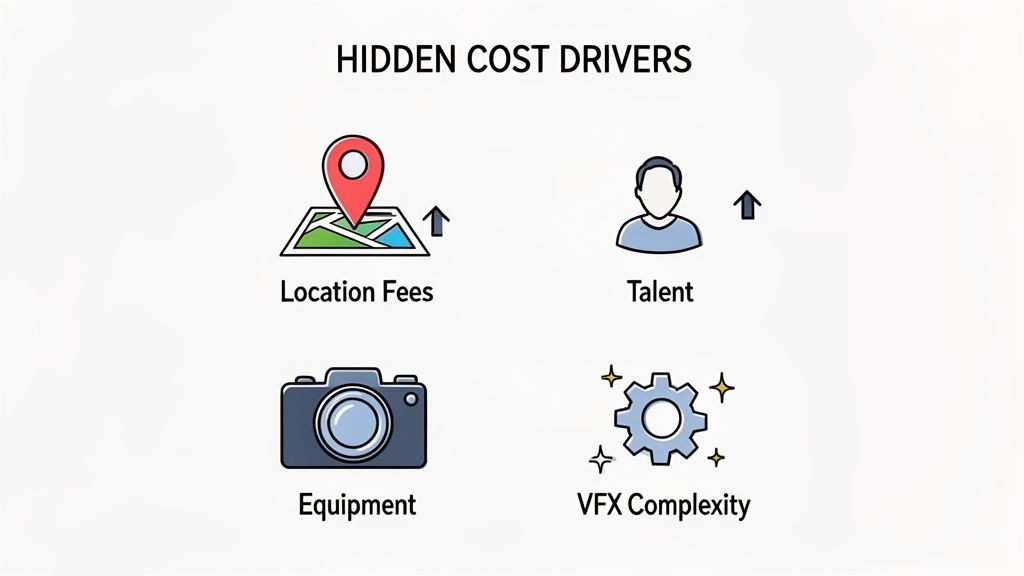
Let's pull back the curtain on these key factors so you can find that sweet spot between your creative goals and your financial reality.
Crew Size and Experience Level
The team you assemble for your shoot is one of the biggest line items on any budget. It's a classic case of "you get what you pay for."
A skeleton crew for a simple interview might just be a camera operator and a sound tech. But a polished promotional video? That could require a Director, a Director of Photography (DP), lighting experts (gaffers), and production assistants.
More experience commands a higher price but often delivers better results, faster. A seasoned DP might cost $2,000 for a day, but their expertise in lighting and composition can elevate the entire project. The trick is to match the crew's skill level to the project's needs—don't overspend on a simple shoot or under-resource a complex one.
Equipment Choices and Technical Specs
The gear you choose has a ripple effect on the entire production. Opting for a high-end cinema camera over a standard DSLR doesn't just increase the rental cost; it changes the entire post-production game.
Those advanced cameras produce much larger files, which demand more data storage and more powerful computers for editing. This can add significant time and expense down the line. A simple decision to shoot in 4K resolution, for example, impacts everything from data wrangling on set to the final rendering time.
If you're digging into the post-production specifics, our guide on how much video editing costs is a great next stop.
Location Logistics and Talent Fees
Where you shoot and who you put in front of the camera are major budget influencers. Filming in a controlled environment like your own office is almost always the cheapest route.
But once you start renting a professional studio or securing permits for public locations, new costs pop up. Location fees can run anywhere from a few hundred to several thousand dollars per day.
Your choice of on-screen talent creates one of the biggest swings in a production budget. Using company employees is economical, but hiring professional actors ensures a polished performance that connects with your audience.
Professional actors typically charge between $500 and $2,500+ per day. It feels like a big investment, but it's often worth every penny for projects where performance is make-or-break.
Geographic Location and Market Rates
The city where you produce your video plays a massive role in the final bill. Production costs in major media hubs like New York or Los Angeles are significantly higher than in smaller markets. Why? Higher crew rates, location fees, and general overhead. A shoot in a major city can easily cost double what it would in a smaller town.
This isn't just a local thing; it's a global phenomenon. The USD 98.99 billion global market in 2023 was led by North America, which accounted for 30.9% of the revenue. In the U.S., a standard 1-2 minute marketing video typically costs $5,000 to $25,000.
Contrast that with China's booming market, where similar videos can be produced for as low as $2,000-$10,000. It’s a stark reminder of just how much location matters. You can discover more insights about these market dynamics from Grand View Research.
Choosing the Right Production Partner for Your Business
Figuring out the average cost of video production is only half the battle. The other, arguably more important half, is deciding who is going to create your content. This choice is one of the most critical you'll make, and it has a massive impact on your budget, workflow, and the final quality of what you get.
There are four main paths you can take, and each one comes with its own financial and operational pros and cons. Let's break them down so you can find the perfect fit for your business goals.
The Freelancer Model
Hiring freelancers—think a videographer from Upwork or a freelance editor—is often the quickest and most budget-friendly route for one-off projects. You get direct access to specialized talent for a specific task, whether it's motion graphics or sound design, without any long-term strings attached.
The catch? You become the producer. The responsibility for finding, vetting, and coordinating a bunch of different people falls squarely on your shoulders. This can be a huge time sink, and if you don't already have a trusted network of creatives, the quality can be all over the place.
The Production Agency Model
Going with a traditional production agency is the full-service, hands-off experience. They manage everything from the initial brainstorming to the final file delivery, giving you a dedicated team of experts. This is a fantastic option for those big, high-stakes projects, like a major brand film where you need absolute top-tier quality and seamless project management.
The trade-off, of course, is the cost and rigidity. Agencies have significant overhead, making them the most expensive choice by a long shot. A single project can easily run $20,000 to $50,000+. The other major risk is scope creep—any little change or addition outside of the original plan can trigger huge extra charges, making your final bill feel totally unpredictable.
The traditional agency model is great for delivering high-impact, one-off projects. But its project-based pricing and the constant threat of scope creep make it a tough fit for businesses needing a steady stream of content without the budget rollercoaster.
The In-House Team Model
Building your own in-house creative team gives you the ultimate control, brand consistency, and speed. Your team lives and breathes your company culture every day, which means they can turn around internal projects quickly and have a deep, instinctual grasp of your brand voice.
The challenge here is the immense overhead. You're not just paying salaries. You're also on the hook for expensive gear (which can be $20,000-$30,000 just to get started), software subscriptions, benefits, and continuous training. A small team with just a videographer and an editor can easily cost over $130,000 a year, and that's before you even buy a single camera. For most startups and scale-ups, this high fixed cost is simply out of reach.
The Subscription Service Model
A more modern approach that's really catching on is the creative subscription service. This model essentially blends the quality you'd expect from an agency with the predictability of a fixed monthly payment. For one flat rate, you get access to a whole creative crew—from directors and animators to scriptwriters and editors.
This is built for businesses that need a consistent flow of high-quality content but can't deal with the volatility of per-project pricing or the massive cost of an in-house team. The benefits are pretty clear:
- Predictable Costs: You pay the same amount every month. No more budget surprises.
- Scalable Output: Need to ramp up content? You can do it without having to hire more people.
- No Overhead: You get all the perks of a full team without paying for salaries, benefits, or expensive equipment.
Services like Moonb are designed for this exact reality, offering unlimited requests and revisions. It’s the ideal setup for marketing teams that need a steady supply of video assets for social media, product explainers, and promotional campaigns. For a deeper look at picking the right partner, you can learn more about how to choose a video production company in our detailed guide.
Making Your Video Production ROI Work for You
At the end of the day, every dollar you put into video production isn't just another line item on a spreadsheet—it's an investment. The real win isn't finding the absolute cheapest quote; it's getting the highest possible return. That shift in mindset, from cost to value, is the final piece of the puzzle in mastering the average cost of video production.
When you understand the why behind the numbers in a budget, you're empowered to make smarter calls. Knowing why a specific lighting setup costs what it does, or why one animation style is pricier than another, lets you tie your spending directly to your goals. Are you trying to generate leads? Boost conversions? Build a loyal following? The video stops being just a task to check off and becomes a genuine tool for growth.
Once you’ve nailed down the costs, it’s just as important to have solid video marketing for social media strategies in place. This is how you make sure your investment actually turns into engagement and real-world results.
Final Questions Before You Sign on the Dotted Line
Before you commit to any contract, you need to arm yourself with a few key questions. These will ensure your budget is locked in with your strategic goals.
- How do you handle revisions, and how many are included? This one is huge for avoiding the dreaded (and expensive) trap of scope creep.
- What specific metrics will this video help us hit? Tying the project to clear KPIs from the start keeps everyone focused on what actually matters: results.
- Can you give me a detailed breakdown of the post-production process? This helps uncover potential hidden costs in editing, color grading, or sound design that might pop up later.
- What’s the plan for delivering the final files and who owns them? Make sure you get all the final files and even the raw footage. You never know when you'll want to repurpose clips for future marketing.
By asking the right questions and landing on a production model that gives you predictable costs and creative wiggle room, you're doing more than just managing an expense. You’re setting yourself up to focus on what truly drives your business forward: your strategy, your message, and your growth.
Frequently Asked Questions
When you're trying to pin down video production costs, a lot of specific questions tend to pop up. We hear them all the time. Here are some clear, straight-up answers to the most common ones we get, helping you get your bearings and make decisions with confidence.
How Long Does a 2-Minute Corporate Video Take?
For a standard 2-minute corporate video, you’re usually looking at a timeline of 3 to 8 weeks from the first conversation to the final file. It’s not a single sprint; the whole process unfolds in stages.
First, you have pre-production—all the planning, scripting, and storyboarding. That typically takes about one to two weeks. The actual shoot might only be a day or two of focused work. Where the clock really starts ticking is in post-production. Editing, adding graphics, sound mixing, and handling revisions can easily stretch from two to five weeks, depending on how complex the project is and how many rounds of feedback are needed.
What Is the Single Biggest Hidden Cost?
Hands down, the most common and damaging hidden cost is scope creep. This is what happens when the project's goals or deliverables start expanding after the budget and timeline have already been locked in.
Maybe it’s adding a new scene, requesting more complex animations than originally planned, or getting trapped in a never-ending cycle of "just one more tweak." Traditional agencies often bill heavily for these kinds of changes, and those extra charges can make your final invoice balloon unexpectedly. That's a huge reason why production models with clear revision policies—or even unlimited revisions—give you so much more peace of mind and budget control.
The biggest budget killer isn't the camera or the crew—it's the unplanned 'one more thing.' Defining the scope clearly from the very beginning is the best defense against unexpected costs.
Can I Save Money by Writing the Script Myself?
It seems like a smart way to cut costs, but trying to write the script yourself is a move that often backfires. There's a huge difference between writing an email or a blog post and writing for the screen. Professional scriptwriters are masters of pacing, dialogue, and visual storytelling—it's a completely different craft.
A weak script can sink the entire production before it even starts, making the money you spent on a great crew and gear a total waste. A much better strategy is to put together a super-detailed creative brief. Collaborate closely with a professional writer to make sure the very foundation of your video is rock-solid.
Is 4K Resolution Necessary for My Videos?
Honestly, not always. While 4K delivers an absolutely gorgeous picture, it also inflates costs across the board. You're not just paying for a 4K camera; you're also paying for massive data storage solutions and more powerful (and expensive) editing computers to handle the huge files.
For the vast majority of marketing videos destined for social media feeds and websites—where people are watching on smaller screens—standard high-definition (1080p) is more than enough to look sharp and professional. And it's way more budget-friendly. Save the 4K investment for the big stuff, like videos you plan to feature on massive screens at a trade show or in a keynote presentation where every pixel counts.
Ready to get consistent, high-quality video content without the unpredictable costs? With Moonb, you get an entire creative team for a flat monthly fee. Stop worrying about scope creep and start focusing on growth. Explore how Moonb can transform your content strategy today.