
Why Your Past Video Campaigns Did Not Perform


We’ve all been there. You pour your team's time, budget, and creative soul into a new video campaign. You hit "launch" with high expectations, only to be met with... crickets. Maybe some views trickle in, but the business results you actually need—leads, sales, sign-ups—are nowhere to be found.
This painful cycle can make you question if video is even worth the effort. But the real problem usually isn't video itself. The core reason why your past video campaigns did not perform and how to fix them boils down to five common gaps: mismatched goals, fuzzy audience targeting, bland creative, sloppy distribution, or broken measurement.
Diagnosing Your Underperforming Video Campaigns
Instead of guessing what went wrong or, even worse, blindly launching another campaign hoping for a different outcome, the first step is a clear-eyed audit. An effective diagnosis is what moves you from feeling overwhelmed to feeling empowered. It turns vague problems into specific, solvable challenges.

Pinpointing the Root Cause
Every failed campaign leaves a trail of breadcrumbs. Was the video beautifully shot but shown to a completely wrong audience? Did it rack up thousands of views but forget to actually ask the viewer to do anything?
To help you follow those breadcrumbs, we've put together a diagnostic checklist. Think of it as a framework for systematically reviewing your past efforts to find the primary breakdown points. This structured approach helps you get past surface-level vanity metrics and really dig into the "why" behind poor performance.
Key Takeaway: A successful video campaign is a system. Strategy, creative, targeting, distribution, and measurement all have to work together. When one part breaks, the whole system sputters. Your goal with this audit is to find that weakest link.
Below is a quick-start table to guide your analysis. By matching the symptoms you're seeing with their common causes, you can quickly figure out where to focus your energy.
Video Campaign Performance Diagnostic Checklist
Use this checklist to quickly connect the problems you're seeing in your campaign data to the most likely underlying issues and start formulating a plan to fix them.
This diagnostic framework is your starting point. For a more exhaustive look at revamping your entire video strategy, check out A Modern Playbook for Your Video Content Marketing Strategy.
And if you need to tool up for the job, our guide on the best tools for analyzing video performance can help you pick the right software to get the job done. In the sections ahead, we’ll break down each of these problem areas and give you actionable fixes to build a high-performing video engine for your business.
Connecting Video Performance to Business Outcomes
Let's be blunt: the single biggest reason video campaigns flop is the massive gap between views and actual business value. A video can go viral, racking up millions of shares and impressions, but if those eyeballs don't translate into leads, pipeline, or cold, hard revenue, the campaign failed. It's that simple.
To fix this, you have to build a direct, measurable line from every view to a concrete business result.

Too many teams fall into the expensive trap of chasing vanity metrics. It feels good to see high numbers, but impressions don't pay the bills. Sure, video drives incredible engagement—a whopping 78% of customers prefer learning about businesses through it—but marketers who only optimize for views see a much worse ROI. Why? Because there's no predictable path from an impression to revenue.
Setting Goals That Actually Drive Business Growth
If you want to move from chasing views to driving real growth, you need to get laser-focused on your objectives. Forget vague goals like "increase brand awareness." The campaigns that win are built on SMART goals (Specific, Measurable, Achievable, Relevant, Time-bound) that are tied directly to the bottom line.
This means you stop talking about soft metrics and start focusing on hard numbers your CFO actually cares about. Your entire video strategy should be designed to answer questions like, "How many demo requests did this specific video generate?" or "What was our customer acquisition cost from this campaign?"
For instance, a B2B SaaS company might set a goal to hit a 2% view-to-lead conversion rate from their LinkedIn video ads within Q3. This goal is specific (view-to-lead), measurable (2%), achievable (based on past performance or benchmarks), relevant (it fills the sales pipeline), and time-bound (Q3).
Or, an e-commerce brand could aim for a $45 Cost Per Acquisition (CPA) on a new product launch video targeting Instagram Reels. This metric ties ad spend directly to a sale, giving them a crystal-clear benchmark for success.
When you define success in terms of pipeline and revenue, it forces every single creative and strategic decision to serve a tangible business outcome. This shift in mindset is the most powerful fix you can possibly make.
Instrumenting Your Videos for Accurate Tracking
Once your goals are locked in, you need the right plumbing in place to measure everything. Without proper tracking, you're flying blind, throwing money at ads and hoping for the best. To prove your video efforts are moving the needle, it's essential to clearly define how you'll measure marketing ROI from the start.
This comes down to instrumenting every video asset with the right tools to follow a user's journey, from the first second they watch to the final conversion.
- UTM Parameters: These are just simple tags you add to your URLs. They tell your analytics platform exactly where traffic is coming from—the campaign, the source (like Facebook), and the medium (like a video ad). This is how you attribute conversions with surgical precision.
- Conversion Pixels: This is a tiny snippet of code you place on your "thank you" or order confirmation pages. When a user completes an action, the pixel "fires," telling ad platforms like Meta and Google which ads are actually driving results.
- Compelling Calls to Action (CTAs): Your video has to tell the viewer exactly what to do next. Don't be subtle. Whether it's "Book a Demo," "Download the Guide," or "Shop Now," your CTA needs to be clear, direct, and perfectly aligned with your campaign goal.
When you combine these three elements, you create a closed-loop system. You can see exactly which videos are crushing it and which are duds. This data is the foundation for real optimization, allowing you to double down on what works and cut what doesn't.
You can dive deeper into this topic by reading our detailed guide on calculating your video marketing ROI. Getting this foundational work right ensures every dollar you spend on creative and distribution is an investment with a measurable return.
Refining Your Audience Targeting and Data
You can have the most brilliant, compelling video in the world, but if you show it to the wrong people, it’s going to fall flat. Every time. Poor audience targeting is the silent killer of video performance, wasting your budget and cratering your metrics. Honestly, this is one of the first places I look when a campaign isn't working.

This isn’t just a small hiccup; it's a massive drain on the entire industry. Relying on bad data is a primary reason video campaigns fail, and the costs are staggering. One estimate puts the economic fallout from poor data quality at around US$3.1 trillion annually. Many companies lose as much as 20–30% of their revenue just from these kinds of inefficiencies. You can read more about how this plays out in this analysis of AI-driven marketing failures.
Building High-Intent Audiences from First-Party Data
The fix is to stop leaning so heavily on broad, third-party audiences and start building segments from your most valuable asset: your own first-party data. This is the information you've gathered directly from your customers and prospects, and it's pure gold.
Why? Because it reflects real user behavior and intent. It comes from sources you own and trust, like:
- CRM Data: Think lists of your best customers, highest lifetime value (LTV) clients, or recent sales-qualified leads.
- Product Usage Data: People who have actually completed specific, high-value actions inside your app or software.
- Website Behavior: Visitors who checked out your pricing page, watched a product demo, or downloaded a case study.
By slicing and dicing this data, you can build incredibly precise custom audiences. A fintech company, for example, could run a video campaign targeting only users who started a loan application but didn't finish. That’s infinitely more powerful than targeting a generic "interest in finance" bucket.
Pro Tip: Your best customers are the perfect seed for lookalike audiences. Uploading a clean list of your highest LTV customers to platforms like Meta or LinkedIn allows their algorithms to find new people with similar traits, dramatically improving your targeting accuracy.
Mastering Data Hygiene and Segmentation
There's an old saying in data: garbage in, garbage out. If your source data is a mess, your custom audiences and lookalike models will be, too. For anyone serious about performance, regular data hygiene isn't just a suggestion—it's non-negotiable.
Start by cleaning your lists. Get rid of duplicates, fix formatting errors, and filter out low-quality leads or customers who haven't engaged in years. This simple step makes a huge difference in the quality of data you upload to ad platforms.
Next, get strategic with segmentation. Don't just lump everyone into one giant "customer" list. For a SaaS business, you could create meaningful cohorts like:
- High-Engagement Trial Users: People who signed up for a trial and used key features more than five times.
- Enterprise Customers: Clients from companies with over 500 employees.
- Churned Users (Last 90 Days): A perfect segment for a highly specific win-back video campaign.
This level of detail ensures your video's message is perfectly tuned to where the audience is in their journey, which naturally leads to higher relevance and better conversion rates. You can find more specific tactics in our guide on boosting Facebook video conversion rates.
Applying Human Oversight to AI-Driven Platforms
Today's ad platforms are incredibly smart, using AI to automate bidding and find new audiences. But treating them like a "set it and forget it" machine is a recipe for burning through cash. Without a human in the driver's seat, these systems can easily start chasing low-value users.
Think of yourself as the one setting the guardrails. You need to give the AI a clear framework to work within. That means:
- Setting Strict Bidding Caps: Know your maximum allowable CPA and don't let the algorithm run wild beyond it.
- Using Exclusion Lists: Be proactive about telling the platform who not to target. Exclude existing customers from acquisition campaigns or low-value leads from your CRM.
- Monitoring Audience Expansion: Keep a close watch on features like Meta's "Advantage+ Audience." They can be powerful, but if they expand too broadly and performance dips, you need to be ready to tighten the targeting back to your core, high-intent segments.
When you combine high-quality, segmented first-party data with smart human oversight, you finally put yourself in control. This is how you make sure your carefully crafted videos actually reach the right people and start driving predictable, scalable results.
Implementing an Always-On Creative Testing Framework
Treating video like a one-off, "big bang" campaign is a surefire way to get mediocre results. If your past video campaigns fell flat, it might be because you launched a single creative and just hoped for the best. Real, sustainable success comes from a consistent, iterative approach to both production and testing.
Operationalizing this means shifting away from sporadic, project-based video creation and embracing a predictable rhythm. It's all about building a system for continuous learning and improvement.
Moving From Projects to a Predictable Cadence
The goal here is to stop thinking in terms of singular "campaigns" and start thinking in terms of a constant stream of creative assets. For most brands, this means establishing a rhythm of producing 4-8 short-form video assets every single month. This consistent output is the fuel for your testing engine.
This approach works because video marketing is cumulative; brands that produce steady, iterative creative will always outperform those that don't. Industry analyses consistently show that treating video as a one-off effort is a primary reason for failure. In fact, benchmarks reveal that moving from sporadic publishing to a weekly or biweekly cadence can boost engagement and conversion rates by 20–50% over just a three-month optimization window as the creative learnings compound. You can explore more about these trends in recent 2025 video marketing reports.
Key Insight: Consistency creates data. The more high-quality creative you put into the market, the more feedback you get from your audience. This feedback loop is what allows you to rapidly discover what works and systematically eliminate what doesn't.
A Practical Framework for Creative A/B Testing
With a steady flow of new videos, you can finally begin systematic A/B testing. This isn't about throwing random experiments at the wall; it's a structured process to isolate variables and identify winning elements that you can then scale across all future creative.
Your testing should be focused and methodical. Instead of pitting completely different videos against each other, focus on changing just one key element at a time. This is the only way to confidently attribute performance changes to a specific variable.
Here are the most impactful elements to start testing:
- The Hook (First 3 Seconds): This is, without a doubt, the most critical part of your video. Test different opening scenes, questions, or on-screen text overlays to see what actually stops the scroll.
- The Core Message or Angle: Frame the same product benefit in different ways. For example, test a "pain-focused" angle ("Tired of wasting time on manual data entry?") against a "gain-focused" angle ("Automate your data entry in 60 seconds").
- The Call-to-Action (CTA): Experiment with different verbal and visual CTAs. Does "Book a Demo" perform better than "Start Your Free Trial"? Does an animated button on-screen outperform a simple text overlay?
- Visual Format: Test user-generated content (UGC) style against a more polished studio production. Or, compare a fast-paced, text-heavy video with one that's slower and more cinematic.
To dive deeper into the first and most crucial element, check out our guide on how to create video hooks that stop scrolling in seconds. Mastering this single component can dramatically lift the performance of all your videos.
Budgeting for Learning and Iteration
One of the most common mistakes I see is teams allocating 100% of a campaign budget to a single, completely untested creative. A much smarter approach is to reserve a portion of your budget specifically for these experiments.
A good rule of thumb is to dedicate 10-20% of your total video ad spend to creative testing. This isn't "wasted" money—it's an investment in intelligence. This dedicated budget lets you run multiple variations at once and gather data quickly without blowing your main budget.
Once you identify a clear "winner"—a creative that significantly outperforms the others on your key metric (like CPA or CPL)—you can then confidently allocate the remaining 80-90% of your budget to scale that top performer.
This disciplined process of constant testing and iteration is how you find the answer to "why your past video campaigns did not perform and how to fix them." It transforms your video marketing from a gamble into a predictable system for driving growth, reducing acquisition costs, and accelerating your team's learning curve.
Building an Agile and Scalable Production System
Let's be honest: even with a killer strategy and dialed-in targeting, your video campaigns will fall flat if you can’t actually produce great creative at the speed your testing demands. This is where the wheels fall off for so many teams. They get stuck in slow, clunky production models that snuff out any momentum before a campaign even has a chance to prove itself.
Traditional approaches just can't hack it anymore. Relying only on your in-house team is a recipe for burnout and a limited creative viewpoint. Juggling freelancers for every project creates a mountain of admin work and wildly inconsistent quality. And full-service agencies? They can be painfully expensive and slow, making the kind of rapid A/B testing we need basically impossible.
These old ways of working are bogged down by the same old problems: hiring delays, scope creep from endless revision cycles, and costs that seem to come out of nowhere. All of this kills the creative agility you need for an "always-on" testing mindset.
The On-Demand Infrastructure Advantage
The fix is to move away from these fractured, project-by-project workflows and embrace a modern, on-demand creative infrastructure. Think of it less like hiring a vendor and more like plugging a complete creative department directly into your marketing team.
This model, often built around a subscription, grants you instant access to a full suite of talent—creative directors, scriptwriters, animators, editors, you name it. The benefits hit the traditional bottlenecks right where it hurts:
- Unlimited Requests and Revisions: This is a game-changer. It completely removes the fear of scope creep and actively encourages you to experiment. You can fire off as many creative briefs as you need to keep your testing pipeline full.
- Transparent Turnaround Times: Knowing exactly when your assets will be delivered lets you plan your campaign calendar with confidence. No more guessing games.
- Fixed Monthly Costs: Budgeting becomes straightforward and predictable. You get all the creative output you need without the overhead of salaries or the sticker shock of agency invoices.
When you remove the operational friction, your team is free to focus on what really matters: high-level strategy and analyzing test results, not getting buried in project management. This system becomes the engine that powers a high-performing, scalable growth machine.
Integrating a Streamlined Creative Solution
For marketing directors and founders, plugging in an agile system like this transforms video marketing. It stops being a series of stressful, high-stakes launches and becomes a continuous, data-driven process. The goal shifts from trying to produce one "perfect" video to generating a steady stream of high-quality assets built for learning.
This simple, powerful loop of continuous improvement is what it's all about.
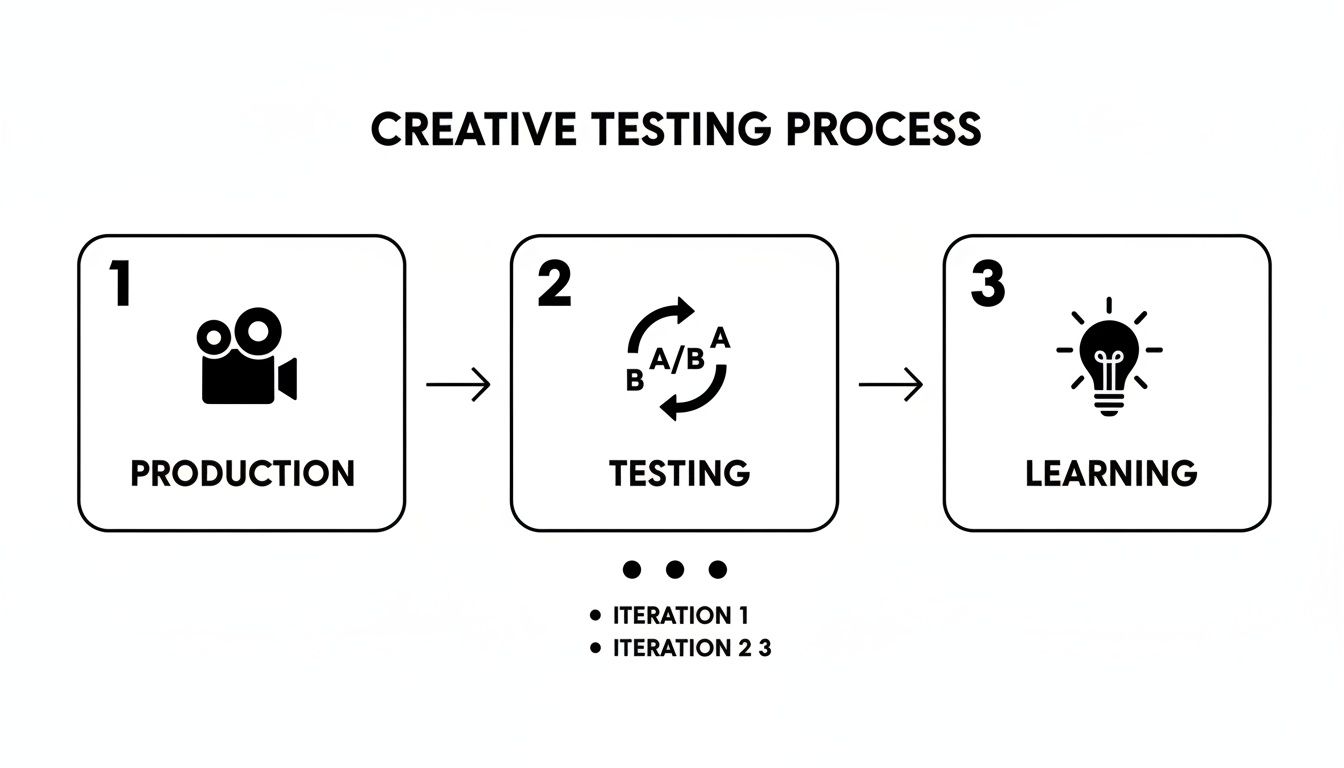
This cycle is the core of what you enable: produce a variety of creative, test it systematically against your key metrics, and pour those learnings right back into the next production sprint.
Bringing on an on-demand partner like Moonb lets you put this testing framework into action immediately. Instead of wasting months trying to hire a video editor, you can have an entire team ready to execute in days. For a deeper look at optimizing these workflows, check out our guide on creative operations management. This is how you build a production system that doesn't just keep up with your strategy but actually pushes it forward, making sure your future campaigns consistently hit their mark.
Common Questions About Fixing Video Campaigns
Even with a solid game plan, you're bound to have questions as you start digging in and fixing your video campaigns. Let's tackle some of the most common ones we hear from marketers who are shifting to a more rigorous, data-driven approach. Getting these answers straight will help you set the right expectations and keep your focus where it needs to be.
How Long Does It Take to See Results?
This is always the first question, and the honest answer is: it takes some patience. You might see positive signs—like a lower CPM from better targeting—within a few days. But a real, significant lift in the metrics that matter, like your CPA or the quality of your leads, usually takes a 60 to 90-day period to materialize.
Consistency is everything here. Think of the first few weeks as setting a new baseline, triple-checking your tracking, and getting your initial creative tests out the door. The months that follow are all about iterating on what you learn—pouring gas on the creative that’s winning and scaling up what works. We've seen teams who truly commit to this 'always-on' testing mindset drop their CPA by 15-35% in the first quarter alone.
What Is the Most Important Metric for B2B SaaS?
For any B2B SaaS company, the north star metric is almost always a qualified action that screams high intent. We're talking about demo requests or free trial sign-ups. Metrics like Click-Through Rate (CTR) or Video Completion Rate (VCR) are useful for diagnosing problems, but they aren't the final destination.
The only true measure of success is whether your video spend is putting qualified opportunities into the sales pipeline. When you focus on Cost Per Demo Request or Cost Per Qualified Lead, you tie every creative decision back to revenue. That's infinitely more valuable than chasing vanity metrics like raw views.
How Much of My Budget Should I Allocate to Creative Testing?
If you want to build an iterative creative engine, you have to fund it. A good rule of thumb is to set aside 10-20% of your total campaign budget just for creative experiments. This isn't "wasted" money. It's an investment in learning. It’s how you de-risk the other 80-90% of your spend.
Having a dedicated testing budget gives you the freedom to systematically test at least 3-5 creative variations for every single campaign. You can play with different hooks, messaging angles, visual styles, or calls-to-action to discover what your audience actually responds to. Without it, you're just gambling 100% of your budget on one creative that could be a massive underperformer, leaving a ton of performance and valuable insights on the table. This methodical approach is the secret to figuring out why your past video campaigns flopped and how to make sure the next one doesn't.
Ready to stop the cycle of underperforming campaigns and build a predictable creative engine? Moonb provides the on-demand creative infrastructure you need to produce, test, and scale high-quality video content without the bottlenecks. Get started today and see how our agile system can transform your video marketing performance.