
A Guide to Corporate Video Production


Corporate video production is all about creating video content that communicates a specific message for a business. But this isn't just about flashy TV commercials; it’s a powerful tool used for everything from marketing and training to internal communications and building brand trust.
What Is Corporate Video Production

Think of corporate video production as your company’s most persuasive storyteller. It’s the art and science of turning your business goals into compelling visual stories that actually connect with people. While a block of text explains something, a well-crafted video demonstrates it and gets people excited.
There's a reason this has become so fundamental for businesses. Viewers reportedly retain 95% of a message when they see it in a video, compared to just 10% when they read it in text. That makes video an incredibly efficient way to cut through all the noise out there.
More Than Just a Marketing Tool
While most people immediately think of advertising, the real scope of corporate video is much broader. It acts like a skilled diplomat for your company, able to wear many different hats.
- For External Audiences: You can build trust with potential customers through authentic testimonials, simplify complex product features with clear demos, or create a powerful brand story that really resonates with your ideal customer.
- For Internal Teams: It’s also perfect for aligning employees with company values, delivering consistent training across every department, and even fostering a stronger sense of community with engaging internal updates.
At its core, it’s about using a dynamic medium to get your message across with clarity and impact, no matter who you're talking to.
A well-executed video serves as a powerful asset for communicating value. It’s not just about what you say, but how you show it. This visual proof builds credibility and makes your message more memorable.
The Shift From Luxury to Necessity
Years ago, professional video production was a luxury item, something reserved for massive corporations with bottomless marketing budgets. That’s just not the case anymore. Today, it’s an accessible—and essential—part of a modern communication strategy for businesses of all sizes.
The reason for the shift is simple: video gets results. From boosting brand awareness and generating qualified leads to improving employee engagement, the return on investment is clear.
As we go on, we’ll dig into the specific types of videos you can create, the step-by-step production process, and how to choose the right partner to bring your vision to life. This guide will give you the foundation you need to make smart decisions and start using the power of video for your own business goals.
Exploring Different Types of Corporate Videos
The phrase "corporate video" can feel a bit stuffy, but it's really just a catch-all for a huge range of video content. Each type is a different tool in your toolbox, designed to solve a specific business problem. Just like a mechanic wouldn't use a hammer for every single job, a smart marketer knows you can't use the same video for every goal.
The real key is matching the right format to what you're trying to achieve. Are you building brand loyalty? Educating new hires? Driving sales? Understanding this versatile toolkit is the first step toward creating video that actually works.
Videos for External Audiences
When you're talking to customers, potential clients, or the general public, your goal is usually to build trust, show your value, and get them to take action. These videos are, for all intents and purposes, the public face of your company.
- Brand Videos: Think of these as the heart and soul of your video strategy. A great brand video tells your company’s story—your mission, your values, and what makes you tick. The goal isn’t a hard sell; it’s about making an emotional connection that builds lasting loyalty. These are perfect for your website’s homepage or a pinned post on social media.
- Product Demos: Nothing turns a list of features into must-have benefits quite like a solid product demo. These videos show your product in action, solving a real-world problem for your ideal customer. By visually proving its value, you can head off questions, overcome objections, and make the buying decision a whole lot easier.
- Customer Testimonials: Word-of-mouth is still one of the most powerful marketing tools out there, and testimonial videos are its digital twin. Featuring a happy customer sharing their success story in their own words provides authentic social proof that no sales pitch can ever replicate. Stick these on landing pages and in social media ads, and watch them work their magic.
The data backs this up. Research shows the most common forms of corporate video are presentations (65%), advertisements (57%), and explainer videos (47%). Interestingly, explainers are on track to become the most popular single-use case for video marketing.
Key Takeaway: The best external-facing videos don't just talk at people; they tell a story. They make the customer the hero and position your company as the trusted guide who helps them win the day.
Videos for Internal Audiences
Corporate video isn't just for winning over outsiders. It's also an incredibly powerful tool for engaging and aligning your most important asset: your own team. Internal videos help create a connected culture, keep everyone on the same page, and make operations run smoother.
To see even more formats and ideas, check out our complete guide on the types of corporate videos your business should be making.
- Training and Onboarding Videos: Consistent, high-quality training is a game-changer for performance and safety. Training videos make sure every employee gets the same crucial information, whether it’s for new hire onboarding or a tutorial on complex software. Using screen recording for corporate training videos is a fantastic way to create instructional content that's both clear and easy to follow.
- Internal Communications: In a world of remote and hybrid work, video is the glue that keeps teams connected. A quick quarterly update from the CEO or a highlight reel from a company event can do wonders for transparency, celebrating wins, and reinforcing the company culture. It helps every employee feel like they’re a valued part of the mission.
- Company Culture Videos: These videos give potential hires an authentic peek behind the curtain. By showcasing your work environment, team dynamics, and core values, you can attract top talent that genuinely fits your culture, which is a huge win for both recruitment and long-term retention.
Corporate Video Types and Their Strategic Goals
To pull all this together, it helps to see how each video type maps to a specific business goal. This table breaks down some of the most common formats, what they're meant to achieve, and where they work best.
Ultimately, the goal is to be intentional. When you choose a video format because it's the right tool for the job—not just because it's popular—you're setting your content up for success from the very beginning.
The Three Stages of Video Production
Every great corporate video, whether it's a slick brand film or a simple training tutorial, follows a proven path from idea to final cut. Think of it like building a house: you wouldn't just start throwing up walls without a solid blueprint. The same rule applies here. A successful video depends on a methodical process, broken down into three key stages.
This structured approach makes sure the final video doesn't just look good, but actually hits the business goals you set for it. To really nail the process of turning a concept into a polished video, it's helpful to understand the complete video creation workflow. Each stage builds on the one before it, transforming a simple idea into a powerful communication tool.
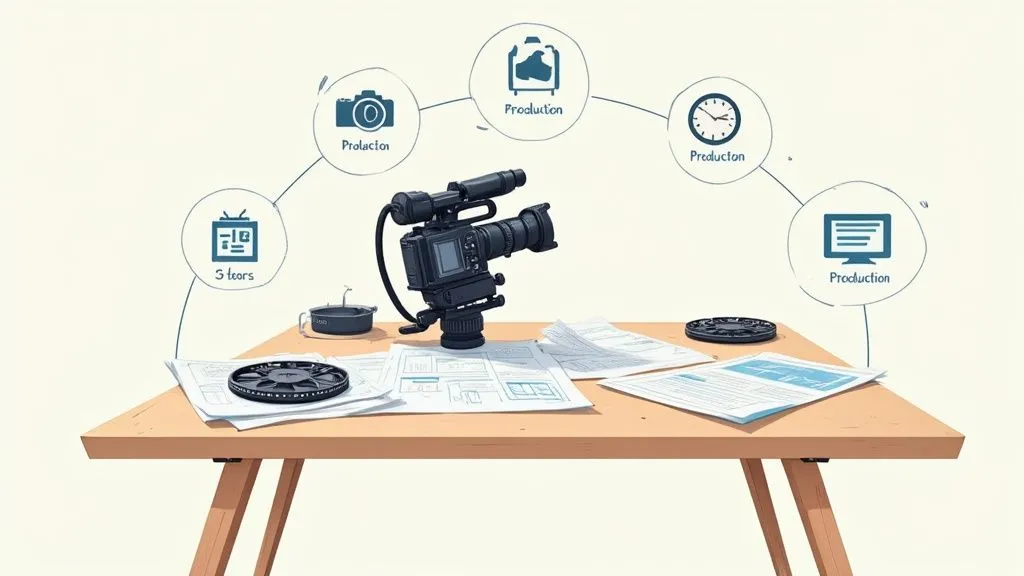
This visual shows how all kinds of different video projects move through the same core production phases.

As you can see, it doesn't matter if you're building brand awareness, showing off a product, or training your team—the fundamental process of planning, filming, and editing always stays the same.
Stage 1: Pre-Production
This is the blueprint phase, and honestly, it’s the most important part of the entire journey. Strong pre-production is the foundation of a successful video. This is where you map everything out, from your goals and message to the tiny details, long before a camera even comes out of its case. Rushing this step is a surefire way to blow your budget and end up with a video that just doesn't work.
Key activities during pre-production include:
- Goal Setting: Nailing down exactly what the video needs to accomplish. Is it for generating leads, onboarding new hires, or just getting your name out there?
- Scriptwriting: Crafting the story and dialogue that will drive the video. This is where you establish the tone, key talking points, and a clear call to action.
- Storyboarding: Basically, creating a comic book version of your script. This sequence of sketches maps out every shot, angle, and graphic, making sure the whole team is on the same page creatively.
- Logistics Planning: This is all the behind-the-scenes work, from scouting locations and casting talent to scheduling interviews with your team. It also includes creating a detailed shoot schedule to keep everything on track.
Pre-production is where you solve problems on paper, not on an expensive film set. About 70% of a project's success is determined before filming even begins, which just goes to show how critical good planning really is.
Stage 2: Production
If pre-production was the blueprint, production is the construction phase. This is where the plan springs to life and you capture all the raw ingredients for your video. The main focus here is bringing the script and storyboard to life with precision, one shot at a time.
A typical day on set has a lot of moving parts.
- Filming and Directing: The director works with the on-screen talent to get the best performance, while the camera crew captures all the necessary footage based on the storyboard.
- Lighting and Sound: Technicians set up professional lighting to create the right mood and look. At the same time, audio engineers capture clean, crisp sound—which is every bit as important as the visuals.
- Capturing B-Roll: On top of the main footage (the A-roll), the crew also shoots supplementary footage, or B-roll. These extra shots add context and visual flair, making the final video much more engaging and dynamic.
This stage is all about gathering high-quality assets. The better the raw footage and audio, the more creative freedom the editor has in the final phase. For a deeper look at the details of each stage, check out our full guide to video production.
Stage 3: Post-Production
This final stage is where the real magic happens. Think of post-production as the interior design and finishing touches, where all the raw footage is shaped into a polished, compelling story. An editor takes all the puzzle pieces captured during production and assembles them into a video that flows perfectly.
This is often the most time-consuming part of the whole process, involving a ton of creative and technical skill.
- Editing: The editor sorts through all the takes, picks the best ones, and sequences them according to the script. They fine-tune the pacing and timing to create a smooth, logical narrative.
- Color Grading: This is where the video gets its professional look. The editor adjusts colors, contrast, and saturation to create a consistent visual tone that matches the mood of the story.
- Sound Design and Mixing: The audio gets a final polish. Background music, sound effects, and voiceovers are mixed together to create an immersive audio experience for the viewer.
- Graphics and Animation: Any on-screen text, logos, or motion graphics are added here to highlight key points and reinforce your brand identity.
After all that, the video goes through a final review for any last-minute tweaks before it’s exported and ready to share with the world. Each stage is totally essential, flowing right into the next to create a final product that’s both strategically effective and creatively engaging.
Budgeting Your Corporate Video Project
Talking about the cost of a corporate video can feel a lot like asking, "How much does a house cost?" The answer is always the same: it depends. A simple, single-camera interview will have a wildly different price tag than a multi-location brand film packed with custom animation and professional actors.
The final price comes down to a mix of factors—crew size, equipment quality, script complexity, and post-production time. Each element adds to the total investment, but it also contributes to the quality and impact of the final video. Understanding these variables is the first step to setting a budget that makes sense for your goals.
Key Factors Influencing Your Video Budget
Before you can land on a number, you need to know what you're actually paying for. A professional video budget is built from several core components that scale up or down based on your project's ambition. Think of these as the building blocks of your video's final cost.
Here are the main cost drivers to keep in mind:
- Crew Size and Expertise: A lean shoot might just need one talented videographer. A bigger production, on the other hand, requires a director, camera operators, sound engineers, and lighting techs. More experienced pros command higher rates, but they often bring an efficiency that saves you time and headaches down the road.
- Equipment Quality: The gear really does make a difference. Costs can range from basic DSLR setups to high-end cinema cameras, drones, gimbals, and professional lighting rigs. The creative vision for the video will dictate what’s needed on set.
- Talent and Locations: Will you feature your own employees or hire professional actors? Filming in your office is free, but renting a studio or securing permits for a unique location adds to the bottom line.
- Post-Production Complexity: This is a huge one. Simple editing is straightforward, but adding custom motion graphics, detailed color grading, and professional sound design requires specialized skills and a lot more time in the edit bay.
Realistic Budget Tiers for Corporate Video
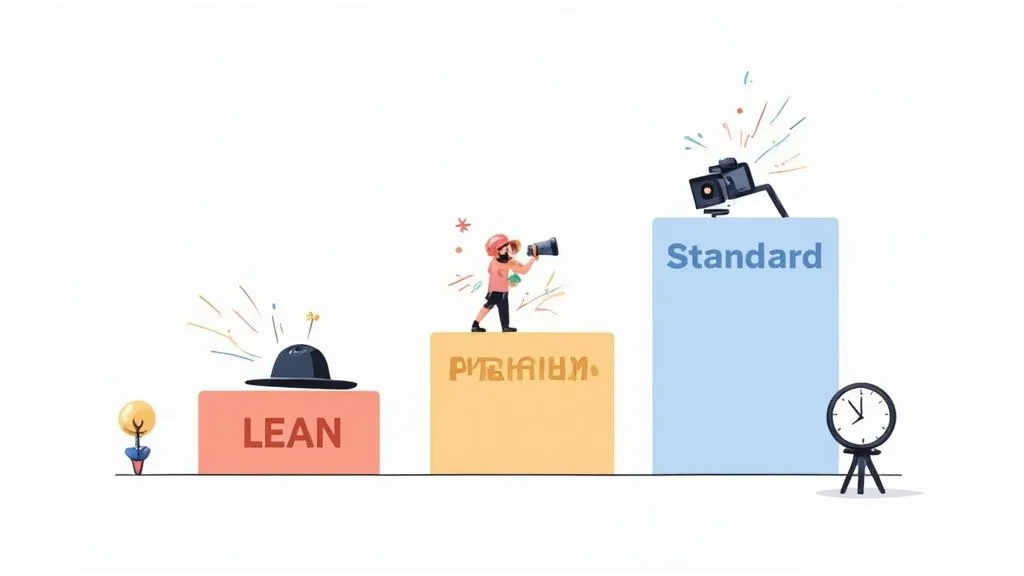
To make budgeting more concrete, it helps to think in tiers. Each level offers a different scope of production value, so you can align your investment with your specific goals. While every project is unique, these general ranges are a practical starting point for planning.
For a more detailed breakdown, explore our complete guide to corporate video production prices and what to expect at each level.
- Lean Production ($1,500 - $5,000): This tier is perfect for straightforward projects like internal training videos, simple customer testimonials, or basic event coverage. Expect a small crew, minimal gear, and clean, basic editing. The focus here is on clear communication over cinematic flair.
- Standard Production ($5,000 - $15,000): This is the sweet spot for many businesses. It covers high-quality brand stories, product demos, and recruitment videos. This budget allows for a more experienced crew, better equipment, and more sophisticated post-production, including some basic motion graphics.
- Premium Production ($15,000+): At this level, you’re investing in top-tier creative work. This is for broadcast-quality commercials, immersive brand films, or videos with advanced visual effects and custom animation. These projects involve senior creative talent, extensive planning, and a polished, high-end final product.
The industry is seeing massive investment, with global spending on video ads projected to hit over $190 billion in 2025. At the same time, accessible tools have opened the door for more businesses, with 23% of marketers in 2020 spending under $300, showing that impactful video is achievable at almost any scale.
Key Insight: Your budget should be a direct reflection of your goals. A video designed to be the centerpiece of a major marketing campaign requires a larger investment than a quick social media update. Aligning the budget with the video's strategic importance ensures you get the best possible return on investment.
Choosing the Right Production Partner
Picking who will actually create your videos is easily one of the biggest calls you'll make on this entire journey. It’s a decision that echoes through everything—your budget, your deadlines, and ultimately, how good the final product turns out. You’re not just hiring someone with a camera; you're building a relationship that needs to click with your company’s goals, workflow, and resources.
The right partner feels like a natural extension of your team, someone who can grab your vision and run with it. The wrong one? That’s a fast track to blown budgets, missed deadlines, and a video that just doesn’t land with your audience. To get it right, you need to get familiar with the three main ways to get video done: building your own in-house team, hiring a traditional agency, or working with a modern subscription service.
Evaluating In-House Video Production Teams
Going in-house means hiring your videographers, editors, and producers directly. They become part of your payroll, your team. This model gives you the ultimate control and brand immersion—your video team literally lives and breathes your company culture every single day.
That deep-seated knowledge is their superpower. They know your voice, your products, and your goals inside and out. Got a last-minute CEO message to film or an impromptu office event? They’re right there, ready to go. The trade-off, however, is the significant overhead. You're on the hook for salaries, benefits, pricey equipment, software licenses, and the constant training needed to keep their skills from getting stale.
- Pros: Total creative control, deep brand fluency, and immediate availability for quick-turn projects.
- Cons: High fixed costs, the risk of creative burnout or stagnation, and potential skill gaps for highly specialized work like 3D animation.
Analyzing Traditional Production Agencies
Hiring a traditional agency is the classic move. You have a project, they pitch you a concept with a quote, and if you give the green light, their team takes it from script to screen. The biggest plus here is tapping into a massive well of specialized talent and experience.
Agencies have seen it all, working with tons of different clients and industries. They bring a fresh perspective that an in-house team might miss and own all the top-tier gear you could ever need. The catch is usually the cost and the pace. Project-based pricing can get expensive fast, and every new video means a new round of proposals and negotiations. It can be a slow, clunky process, which isn't great if you need a steady drumbeat of content.
For a deeper dive, check out our guide on how to choose a video production company that’s the right fit for you.
Exploring Modern Subscription Services
A newer, more flexible model has popped up to fill the space between in-house and agency work. Subscription services, like Moonb, give you access to an entire creative team for a simple, flat monthly fee. Think of it as getting the predictable cost of an in-house hire with the wide-ranging expertise of an agency.
With a subscription, you get a dedicated creative director and a full roster of designers, animators, and writers ready when you are. This setup completely scraps the slow proposal process you get with agencies and avoids the heavy overhead of hiring internally. You can fire off unlimited requests and revisions, making it a perfect fit for businesses that need a constant stream of high-quality video without the volatile costs.
It’s a model that truly blends the best of both worlds—scalability, speed, and cost-efficiency. It's a modern answer for businesses that depend on a consistent flow of creative work to keep growing.
Plenty of businesses are weighing these options as we speak. Industry data shows that 55% of marketers are producing video in-house, 14% outsource everything, and 31% are using a hybrid approach. This just goes to show there’s no single “right” answer—only what’s right for your specific situation. Discover more insights about video marketing facts on storykit.io.
At the end of the day, the best partner is the one that aligns with your company’s unique needs. If you have a constant, massive demand for video and the budget to back it up, an in-house team could be your perfect match. If you have one big, high-stakes project a year, a traditional agency is a solid bet. But if you’re looking for a reliable, scalable, and budget-friendly creative partner for the long haul, a subscription model strikes an ideal balance.
How to Measure Your Video's Success
Making a great corporate video is a fantastic start, but it's really only half the job. If you can’t connect that video back to actual business goals, you're essentially flying blind. Measuring a video’s success isn't about chasing vanity metrics like view counts; it’s about understanding its real-world impact.
The best videos get the right people to take the right action. To prove that's happening, you need to track key performance indicators (KPIs) that line up perfectly with what you wanted the video to achieve in the first place—whether that was getting your name out there, engaging your community, or driving sales.
Aligning Metrics with Your Goals
First things first: you have to match your metrics to your objective. Not every video is built to make a sale, and judging them all by the same yardstick will give you a skewed picture of what’s actually working.
- For Brand Awareness: The mission here is simple: get in front of new eyeballs. The numbers that matter most are Reach (how many unique people saw your video) and Impressions (how many times it was displayed on a screen).
- For Audience Engagement: This tells you if your content is actually connecting with people. Keep an eye on Watch Time (the total minutes people spent watching) and Audience Retention to see exactly where you might be losing them. A high Click-Through Rate (CTR) on your call-to-action is another great sign of solid engagement.
- For Lead Generation and Conversions: This is where video starts putting money back in your pocket. You’ll want to measure the Conversion Rate by tracking how many viewers took the specific action you wanted, like filling out a form, downloading an ebook, or making a purchase.
A healthy benchmark to shoot for is a play rate of at least 30%. If you can also keep 70% of viewers watching past the 30-second mark, you've got a strong signal that your story is hitting the mark and holding their attention.
Demonstrating True Return on Investment
Using the analytics built into platforms like YouTube, LinkedIn, or your own website, you can start to build a clear case for your video’s value. For example, if adding a product demo video to a landing page bumps up form submissions by 20%, that's a direct, undeniable link between your video and new leads.
This kind of data is exactly what you need to justify budgets and make smarter decisions about your next video. By focusing on these goal-oriented metrics, you can shift the conversation from "how many people watched it?" to "how did this video move our business forward?"
To dive deeper into connecting these dots, check out our in-depth guide to calculating your video marketing ROI.
Got Questions? We've Got Answers.
When you're diving into corporate video, a few questions always seem to pop up. It's a big world, and it's easy to get turned around. Let's tackle some of the most common ones we hear from clients.
How Long Should My Corporate Video Be?
This is the million-dollar question, but the answer is simpler than you think: it depends entirely on where people will see it and what you want it to do.
If you're aiming for a social media ad or a splashy brand video for your homepage, keep it tight. You've got about 60-90 seconds to grab someone's attention and leave an impression. For something a little deeper, like a product explainer or a customer testimonial, around 2 minutes is the sweet spot. Anything longer, like a detailed training module, can stretch to 5-10 minutes, but you absolutely have to break it into digestible chapters.
What Are the Biggest Mistakes to Avoid?
I've seen two classic mistakes sink countless video projects. The first is bad audio. It's funny—people will forgive shaky camera work or less-than-perfect lighting, but crackling, muffled, or echoey sound is an instant turn-off.
The second is a muddy message. If your viewer finishes the video and thinks, "So what?" you've lost. You need a single, focused takeaway and a crystal-clear call-to-action. Without that focus, your video is just noise.
So many companies get caught up in selling, they forget to tell a story. The best videos hook you on an emotional level first. They build trust, and the business just naturally follows.
How Can I Get Started with a Small Budget?
You don't need a Hollywood budget to make a video that works. In fact, some of the most effective videos are scrappy and authentic.
Start by featuring your own team instead of hiring actors—it feels more genuine anyway. Use your office or workspace as the backdrop to save a bundle on location fees. But the most important thing? Nail the script. A powerful, simple story shot on a new smartphone will always, always beat a boring, overproduced mess that cost a fortune.