Digital Branding Services: Your 2026 Guide to Success
Discover top digital branding services for 2026. Learn strategy, deliverables, pricing, ROI, and how to choose the right partner for your brand's success.
Digital branding is the ongoing work of keeping a brand steady across every screen it shows up on: the website, the product UI, social feeds, motion graphics, short-form video. The logo is only the starting point. What I mean is everything that has to hold together after the logo exists, once the brand has to survive weekly shipping, new channels, campaign deadlines, and formats that move faster than any style guide.
I have sat in the meeting where a company unveils a beautiful new identity, and I have watched that same identity come apart within a month once real people started making real assets under real deadlines. The taste was never the problem. What was missing was the system underneath it.
That is what I want to walk a brand manager through here. Not what branding looks like in a case study, but how it actually gets produced week after week without slipping off-brand. The question that matters is not “do we have a brand.” It is “can my team make the next fifty assets without the whole thing coming apart.”
What Do Digital Branding Services Actually Include
What are you actually paying for when you hire out digital branding? It depends a lot on who you hire.
An agency tends to bring range and production depth. A freelancer often gives you a sharp point of view and speed, though the work can stop at core identity. An in-house team knows the product and the internal politics better than any outsider, but that same closeness makes it hard to step back and rebuild the system from scratch. An embedded team sits between those. It builds with your day-to-day reality in view, which is what you want if the goal is consistency that survives past launch week.

The six parts teams usually mean
-
Brand strategy This sets direction. Who you are talking to, how you are positioned, the proof you lean on, the tone. Good strategy also says what the brand should not do: what it will not claim, where it stays plain, which audience comes first.
-
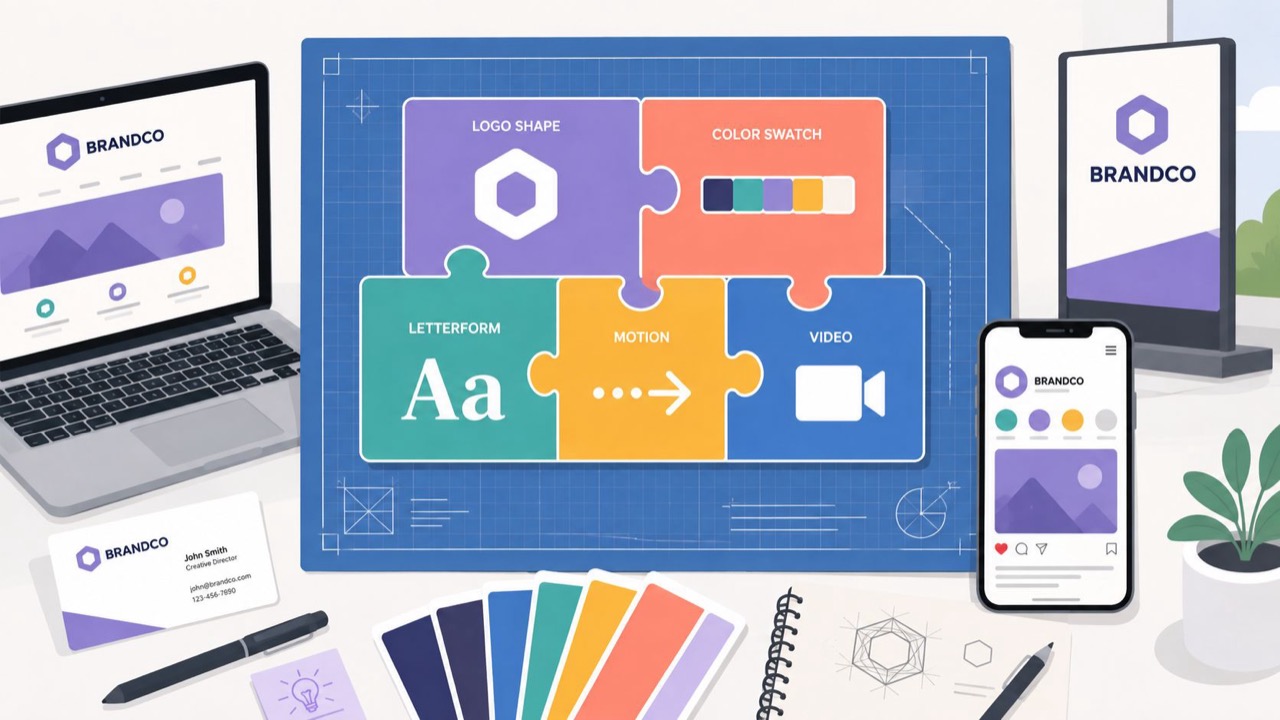
Visual identity Logo, typography, color, iconography, layout rules, image treatment. For digital use, it also means the practical setup most guides skip: color values tuned for screens, contrast that passes accessibility checks, a logo that behaves at every size, rules that hold from the website to a deck to a paid ad to the product UI.
-
Motion and video How the brand moves. Intros, transitions, lower-thirds, pacing, caption styling, thumbnail systems, editing patterns your team can repeat. A real motion system pays for itself because editors stop reinventing the look on every cut.
-
Design systems The layer that turns taste into repeatable output. Components, spacing, buttons, templates, and the logic for when to use which. If your team keeps rebuilding the same layouts from zero, this is usually the piece that is missing.
-
Social-native assets Content built for the platform, not key visuals resized to fit it. Carousels paced to be read on a phone. Stories with a clear reading order. Short-form templates that already account for captions, hooks, and the safe zones the UI eats.
-
Campaign creative The launch layer. Paid social variants, landing-page art direction, email headers, ad sets, explainer edits, promo graphics. The real test here is volume. Can the system make ten versions of an ad without version three wandering off-brand.
What good delivery looks like
The output has to be usable by the people who will make the next thing on Monday.
That means editable Figma files, template logic, motion presets, deck masters, social layouts, thumbnail rules, and answers to the small questions that come up every day. What type scale goes on a webinar slide. How to frame a product screenshot. What changes between a homepage hero and a paid ad.
This is where models separate fast. Some agencies hand over gorgeous assets and a static brand book with no operating rules. A freelancer can build a sharp identity and then be gone before the template library and the governance layer ever exist. In-house teams hold consistency well once a system is in place, though they often need outside help to define it cleanly the first time. Embedded partners tend to do best when a company needs both the system and the day-to-day support to make it stick across live channels.
If you are comparing providers, look at how they handle rollout, revisions, and ongoing production, not just the launch visuals. That is what the shape of their digital branding services should tell you.
How Does a Digital Branding Project Usually Work
Most solid branding projects move through the same arc: figure out what is broken, design the system, produce the assets, hand it over. The trouble is that clients usually only see the polished output, never the working rhythm that made it.

The normal project flow
Here is how the work actually runs, in my experience:
-
Discovery and audit I go through the site, the product, the decks, the emails, the ads, the social feed, and I find where it breaks. A quick brand audit almost always surfaces the same handful of problems: three typefaces doing the same job, five interpretations of one brand color, no clear hierarchy, and no motion rules anyone can repeat.
-
Strategy and messaging Get positioning, audience language, and tone straight, including the difference between what the brand says in a homepage headline, a paid ad, and a founder talking to camera.
-
System build Extend the visual identity for digital use, then build the templates and usage rules around it so the next person does not have to guess.
-
Production and handoff Ship real assets, not just rules, and test them on live surfaces before calling it done.
How long this takes depends on scope and how fast a client can turn feedback around, not on some fixed formula. A focused digital rollout can move in a few weeks. A full repositioning with a large asset library takes longer. Anyone quoting you an exact number of weeks before they have seen your material is guessing.
How teams keep weekly work on pace
Brand work stalls when feedback is scattered across email, Slack, and one person’s memory. The fix is not clever. It is a shared board, and it works.
Put every deliverable on one board (Notion, Trello, ClickUp, Asana, whatever your team already opens) with an owner, a status, and a due date. Keep review in one place: Figma for design, Frame.io for video, so comments land on the exact frame instead of somewhere in a thread.
Vague feedback kills momentum faster than hard feedback does.
That is why the teams who keep a brand consistent run a visible queue on a weekly cadence, with review links that are versioned so nobody is commenting on last week’s cut. The work keeps moving and the brand stays put.
A short walkthrough helps a team picture how brand work turns into repeatable production:
How Much Do Digital Branding Services Cost
Cost has less to do with the word “branding” than with the delivery model you choose. The same scope of work, priced through an agency, a freelancer, an in-house hire, or an embedded team, can land in very different places. The spend only makes sense when the model matches the work in front of you.
The real trade-offs between the four models
A traditional agency earns its keep on the big moments: a launch, a repositioning, a board-level rebrand. You get senior thinking. You may also get a lot of process and a slow handoff into the day-to-day content that comes after.
A freelancer is great when the need is narrow. One strong designer or motion lead can clean up a visual system quickly. The risk is coverage. The moment you need copy and web and motion and templates and ad variants and weekly content, one person becomes the bottleneck.
An in-house team gives you the most context and control. It also brings hiring time, management overhead, and skill gaps. Someone excellent at product design may not be your person for social video, and the reverse is just as common.
An embedded creative team sits in the middle. It fits when you need steady output across channels but do not want to hire every role yourself. If you want to see how a model like that is priced and scoped, read a provider’s pricing and scope closely before you compare it to anything else.
Comparing Digital Branding Service Models
| Model | How you pay | Best for | Where it hurts |
|---|---|---|---|
| Agency project | Project or retainer fees, usually the highest per engagement | Rebrands, launches, strategy-heavy work | Strong kickoff, weaker week-to-week continuation |
| Freelancer | Hourly or per project, lowest entry cost | A focused design or motion need | Limited capacity, single point of failure |
| In-house team | Salaries plus overhead, highest fixed cost over time | Long-term ownership and internal alignment | Hiring time, management load, uneven skill coverage |
| Embedded creative team | Monthly engagement, priced between a hire and an agency | Ongoing weekly output across web, social, and video | Needs clear scope and a real review rhythm |
The lowest-priced option often turns into the most expensive one once inconsistency forces rework across every channel.
To put the trade-offs in plainer terms: agencies usually lead on strategy depth and exploratory range, and they cover a lot of disciplines under one roof. In-house and embedded teams win on daily responsiveness and on holding the brand steady over time, because the same people keep touching the work. Freelancers can move fast on a clear scope, right up until the workload stacks and coordination eats the speed. In-house has the strongest institutional memory but the slowest path to scaling. And handoff quality is the thing that varies most from one vendor to the next, so ask to see real templates a client is using today, not a promise about what you will get.
How Do You Measure the ROI of Digital Branding
Branding ROI goes fuzzy the second a team measures only applause: likes, impressions, follower counts. The measurement that means something is what changes in recognition and buying behavior once the brand stops contradicting itself across surfaces.

What to track first
Start small. Four things are usually enough to tell you whether the work is landing:
- Branded traffic quality: Are the right people arriving, and do they stay once they do?
- Conversion behavior: Do the key pages convert more cleanly after the brand cleanup than before it?
- Sales friction: Are your reps spending fewer calls explaining who you are before they can talk about what you sell?
- Content performance by template: Which repeatable patterns actually perform, so you make more of those and fewer one-offs?
None of these need a fancy dashboard. A spreadsheet and a before-and-after window will show you the shape of it.
How branding creates business value
Consistency is the mechanism, not the color palette. When a brand shows up the same way everywhere, people recognize it faster and spend less effort deciding whether to trust it. That lower friction is where the business value comes from.
Lucidpress, now Marq, put a number on it in a survey that gets quoted everywhere: companies with consistent brand presentation reported revenue lifts of up to 33% (Marq). Treat that as correlation, not a promise. A new palette does not print money. What it points to holds up in practice, though: brands that stay consistent tend to convert and retain better, because buyers are not re-learning who they are on every touch.
The way I connect brand work to hard numbers is to pair it with media performance. If you are already spending on video and paid creative, a look at video marketing ROI is a practical way to tie visual consistency back to campaign outcomes you already track.
What Are the Most Common Mistakes to Avoid
The most common mistake I see is treating digital branding as a one-time file delivery. A team gets a logo, a palette, a few mockups, then wonders why everything looks off-brand a few weeks later.

The static brand book problem
The hardest surface to keep consistent is short-form video. Reels, TikTok, and Shorts reward fast, native cuts, and that fights everything a rigid brand book asks for: slow logo reveals, fixed compositions, static cues. Add platform cropping, caption overlays, and UI safe zones on top, and a PDF guide stops being any help at all.
What works instead is a living motion-and-usage guideline. In practice that means:
- A short logo sting that reads in under a second
- Locked lower-third and caption styles that survive compression
- Brand-color LUTs or edit presets so every clip keeps the same feel
- Title-safe templates for 9:16 so nothing important hides under captions or buttons
- Editable source files so your in-house team can cut the next batch without starting over
A brand system should be easier to use than to ignore.
This is the same reason static handoff documents fail. Teams need templates, walkthroughs, and examples from the channels they actually post on, not a beautiful book that sits in a shared drive.
The compliance bottleneck teams ignore
Regulated teams hit a different wall. In fintech and healthcare, legal review is part of every launch, and it is often the thing that decides whether a campaign ships on schedule. That is not a footnote to the branding work. It changes how the work has to be built.
If legal sign-off is in the loop, the creative process needs version logs, an approval history, and clear asset states from the first day, not bolted on at the end. Shared workspaces help. So do locked templates and a single source of truth for approved claims and language. If your team keeps missing launch windows, a look at common branding mistakes is worth the time, but the bigger fix is operational, not cosmetic.
How Do You Choose the Right Branding Partner
Choose a branding partner the way you would choose a lead operator, not the way you would pick a pretty portfolio. Taste matters. Reliable delivery matters more, because you will be living with this relationship long after the launch.

Questions that reveal how they really work
Ask these, and watch how fast the answers get specific:
-
How do you handle weekly production after the rollout? If the answer stays vague, you are buying a launch, not a system.
-
What exactly do you hand off? Ask to see editable templates, motion guidelines, deck masters, social files, and the review workflow. Real files, on screen.
-
Where does feedback live? The answer you want is one shared board and one review layer, not a scatter of threads.
-
How do you keep web, social, and video looking like the same brand? Listen for systems and process, not inspiration.
-
How do you work alongside our internal team? The strongest partners do not make you dependent on them for small tasks.
Which model fits which team
A startup with no creatives in-house may need a partner that can stand up the whole operating system from scratch. A mature marketing team might only need overflow capacity and a tighter weekly cadence. A regulated business will probably care most about approvals and audit trails.
Choose the working model first, then choose the people.
Moonb fits best here as a dedicated creative team that works on a steady weekly rhythm, stays on brand, and is there when you need it, as an extension of your team or an alternative to hiring the whole roster yourself, not as a one-off vendor.
Frequently asked questions
Strong branding helps a good product get understood and trusted faster than it would on its own. It does not fix product-market fit, a rough onboarding, or a feature set that misses what the buyer actually needs. I have watched this go both ways. A solid SaaS product with scattered messaging and dated visuals can read as less credible than it is; clean that up and demo requests get easier, because buyers understand what they are looking at sooner. It runs the other direction too. A polished brand can win the first click or the first call, but if the product lets people down, all the brand did was get them there faster. Branding earns its keep when the product already works and the team needs clearer positioning and steadier delivery across web, sales, social, and product.
Some of it shows up fast. If a company has obvious inconsistency across its site, deck, landing pages, and ads, a clean system sharpens things almost immediately. The first wins are usually internal: faster approvals, fewer revision rounds, less time rebuilding assets from nothing. Customer-facing results tend to appear first wherever confusion was blocking action, like a muddled homepage headline or a clunky signup flow. The bigger brand effects take longer, because they come from repetition. Recognition builds through steady exposure, not one launch week. A new identity or message framework starts paying off after your team has run it across campaigns, product updates, hiring, and customer comms for a while. That clock runs faster when one team owns execution, and slower when the work is split across five vendors who each read the rules differently.
It comes down to how much you produce, not just what you can spend. In-house makes sense when brand output is constant, you already have creative leadership in the building, and the work touches product, marketing, sales, and internal comms every week. A later-stage company with a brand lead, a product marketer, a designer, and a content team benefits from owning it, because decisions stay close to the business. The cost is coverage. One designer rarely covers strategy, motion, web, decks, social, and campaign work at the same level. A freelancer is the efficient choice for a narrow, well-defined job: an identity refresh, a website copy pass, a motion package for one launch. It works when the scope is clear and your internal team can carry feedback, rollout, and governance afterward. The weak spot is continuity. If that same freelancer is not around three months later, the system starts to slip. An agency fits a bigger reset: senior strategy, cross-disciplinary work under one roof, a rebrand or a high-stakes launch with a lot of assets in motion at once. The trade-off is that plenty of agencies are built for milestones, not weekly execution. They hand over a strong package, and keeping it alive falls back to you. An embedded team sits in the middle, for companies that need ongoing output but are not ready to hire every role. Picture a growth-stage B2B company with a head of marketing and a product marketer but no motion designer, brand designer, or creative director on staff. An embedded partner fills those gaps, keeps the work consistent week to week, and builds systems the internal team can actually use. The right answer is usually the model you can sustain after the rollout, not the one that looks best in the pitch.